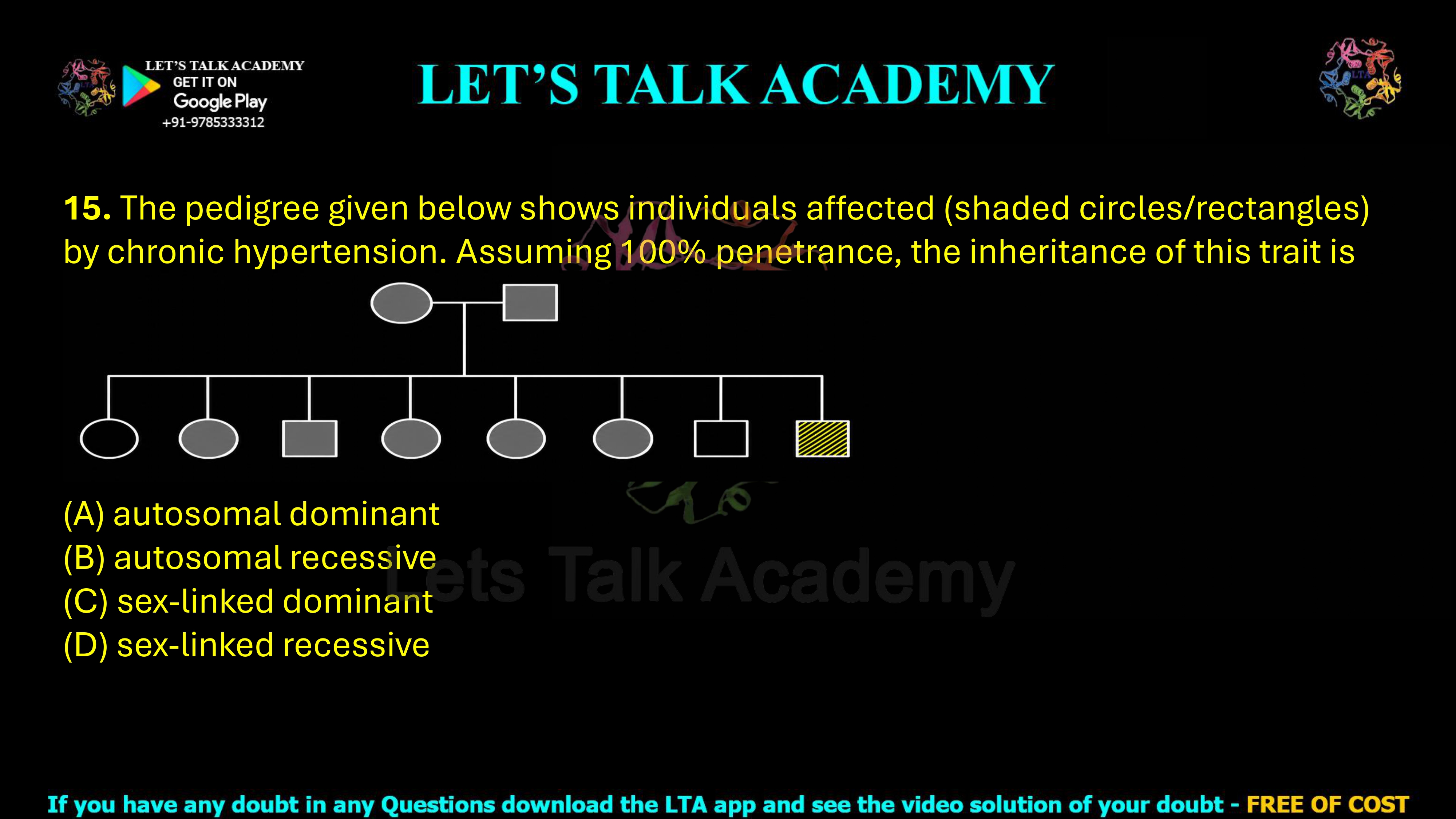
15. The pedigree given below shows individuals affected (shaded circles/rectangles) by chronic hypertension. Assuming 100% penetrance, the inheritance of this trait is
(A) autosomal dominant
(B) autosomal recessive
(C) sex-linked dominant
(D) sex-linked recessive
Pedigree Analysis of Chronic Hypertension: Identifying Autosomal Dominant Inheritance
Introduction
Pedigree analysis is one of the most important tools used in human genetics to trace the inheritance of traits and genetic disorders across generations. Since controlled breeding experiments cannot be performed in humans, pedigree charts provide an effective method for identifying inheritance patterns such as autosomal dominant, autosomal recessive, X-linked dominant, and X-linked recessive traits. Questions based on pedigree interpretation are among the most frequently repeated topics in competitive examinations because they evaluate conceptual understanding rather than simple memorization.
Correct Answer
Correct Option: (A) Autosomal Dominant
Detailed Explanation
The pedigree shows that both parents are affected, yet they produce both affected and unaffected sons and daughters. The trait appears in a single generation without skipping, indicating vertical transmission, which is a hallmark of autosomal dominant inheritance.
If both affected parents are heterozygous (Aa × Aa), the expected offspring are:
- 25% AA (affected)
- 50% Aa (affected)
- 25% aa (unaffected)
This prediction perfectly explains why most offspring are affected while a few are unaffected.
Another important observation is that both males and females are affected, and both sexes transmit the trait. This strongly supports an autosomal mode of inheritance rather than a sex-linked pattern.
Pedigree Features Supporting Autosomal Dominant Inheritance
| Pedigree Observation | Interpretation |
|---|---|
| Both males and females affected | Autosomal inheritance is likely |
| Trait appears in successive generations | Dominant inheritance |
| Affected parents produce unaffected children | Consistent with Aa × Aa cross |
| No sex bias | Supports autosomal inheritance |
Explanation of Each Option
Option (A): Autosomal Dominant
This option is correct. The pedigree demonstrates vertical inheritance, affects both sexes equally, and affected heterozygous parents can produce unaffected offspring. These are the defining characteristics of autosomal dominant inheritance.
Option (B): Autosomal Recessive
This option is incorrect. If both affected parents had an autosomal recessive disorder (aa × aa), then all children would be affected. Since the pedigree contains unaffected offspring, autosomal recessive inheritance is ruled out.
Option (C): Sex-linked Dominant
This option is incorrect. In X-linked dominant inheritance, an affected father passes the mutant X chromosome to all daughters. The pedigree contains an unaffected daughter, which excludes X-linked dominant inheritance.
Option (D): Sex-linked Recessive
This option is incorrect. If both parents were affected with an X-linked recessive disorder, every son and daughter would inherit the disease. The presence of unaffected children clearly contradicts this pattern.
Why Option (A) is Correct
The combination of affected individuals in every generation, equal occurrence in males and females, and unaffected offspring born to affected parents is the classic pattern of an autosomal dominant trait. The pedigree fits the expected inheritance from two heterozygous affected parents.
Comparison of All Inheritance Patterns
| Inheritance Pattern | Fits the Pedigree? | Reason |
|---|---|---|
| Autosomal Dominant | Yes | Vertical transmission with affected and unaffected offspring |
| Autosomal Recessive | No | Two affected parents should produce only affected offspring |
| X-linked Dominant | No | All daughters of an affected father should be affected |
| X-linked Recessive | No | Two affected parents cannot produce unaffected children |
Characteristics of Autosomal Dominant Inheritance
| Characteristic | Description |
|---|---|
| Generational Pattern | Usually appears in every generation |
| Sex Distribution | Males and females affected equally |
| Transmission | Affected parent can transmit to sons and daughters |
| Risk from Heterozygous Parent | Approximately 50% for each child |
Biological Significance
Autosomal dominant disorders are expressed even when only one mutant allele is present. Because affected individuals are usually heterozygous, the disorder often appears in consecutive generations. Well-known examples include Huntington disease, Marfan syndrome, achondroplasia, familial hypercholesterolemia, and neurofibromatosis type 1. Pedigree analysis helps clinicians identify inheritance patterns, estimate recurrence risk, and provide accurate genetic counseling.
Final Answer
The pedigree shows:
- Affected individuals in successive generations.
- Both males and females affected.
- Affected parents producing unaffected offspring.
- No evidence supporting X-linked inheritance.
These observations are characteristic of autosomal dominant inheritance.
Correct Option: (A) Autosomal Dominant


