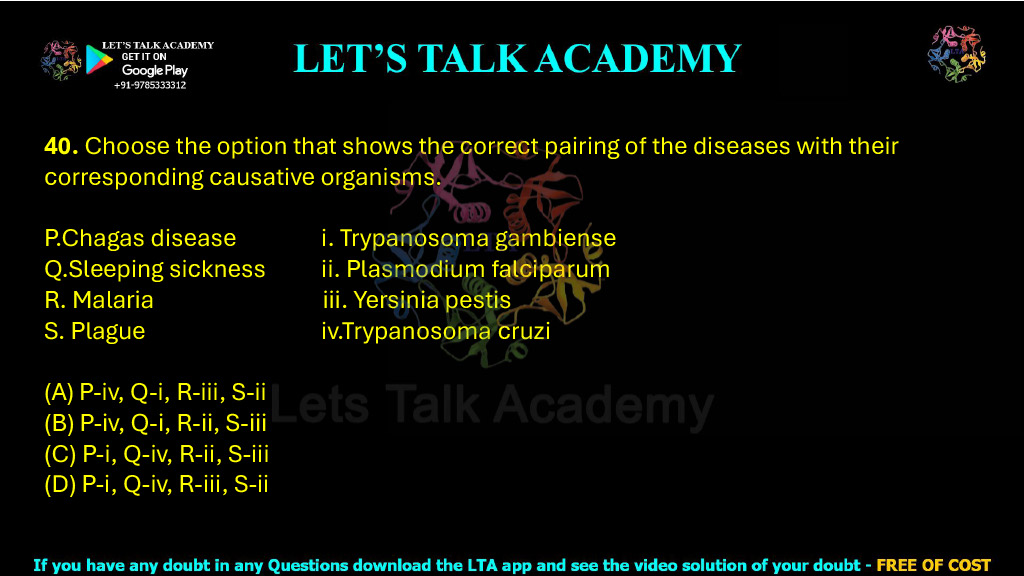
40. Choose the option that shows the correct pairing of the diseases with their corresponding causative organisms.
P. Chagas disease i. Trypanosoma gambiense
Q. Sleeping sickness ii. Plasmodium falciparum
R. Malaria iii. Yersinia pestis
S. Plague iv.Trypanosoma cruzi
(A) P-iv, Q-i, R-iii, S-ii
(B) P-iv, Q-i, R-ii, S-iii
(C) P-i, Q-iv, R-ii, S-iii
(D) P-i, Q-iv, R-iii, S-ii
Match Diseases with Their Causative Organisms: Chagas Disease, Sleeping Sickness, Malaria, and Plague Explained
Introduction
Identification of disease-causing microorganisms is one of the most fundamental concepts in microbiology, parasitology, and infectious disease biology. Every infectious disease is caused by a specific pathogen belonging to bacteria, viruses, fungi, protozoa, or helminths. Correctly matching diseases with their causative organisms is essential not only for diagnosis but also for selecting appropriate treatment, understanding disease transmission, and designing effective prevention strategies.
Among the most important diseases discussed in competitive examinations are Chagas disease, African Sleeping sickness, Malaria, and Plague. These diseases differ significantly in their causative organisms, vectors, geographical distribution, and pathogenesis. Chagas disease and Sleeping sickness are caused by different species of Trypanosoma, Malaria is caused by species of Plasmodium, whereas Plague is caused by the bacterium Yersinia pestis.
Correct Answer
Correct Option: (B)
P – iv, Q – i, R – ii, S – iii
Detailed Explanation
Chagas disease, also known as American trypanosomiasis, is caused by the protozoan parasite Trypanosoma cruzi. The disease is transmitted by triatomine bugs, commonly known as “kissing bugs.” It is endemic in Central and South America and primarily affects the heart and digestive system.
African Sleeping sickness, or Human African Trypanosomiasis, is caused by Trypanosoma gambiense (West African form) and Trypanosoma rhodesiense (East African form). In this question, the correct organism is Trypanosoma gambiense. The parasite is transmitted through the bite of the tsetse fly (Glossina species).
Malaria is caused by protozoan parasites belonging to the genus Plasmodium. Among the human malaria parasites, Plasmodium falciparum is the most virulent species and is responsible for severe and cerebral malaria. The parasite is transmitted by the female Anopheles mosquito.
Plague is caused by the Gram-negative bacterium Yersinia pestis. It is transmitted mainly by infected rat fleas (Xenopsylla cheopis) and can manifest as bubonic, septicemic, or pneumonic plague.
Therefore, the correct matching is:
- Chagas disease → Trypanosoma cruzi
- Sleeping sickness → Trypanosoma gambiense
- Malaria → Plasmodium falciparum
- Plague → Yersinia pestis
Explanation of Each Match
P. Chagas Disease → Trypanosoma cruzi
This match is correct. Chagas disease is caused by Trypanosoma cruzi, which is transmitted by reduviid (kissing) bugs.
Q. Sleeping Sickness → Trypanosoma gambiense
This match is correct. West African Sleeping sickness is caused by Trypanosoma gambiense and is transmitted by the tsetse fly.
R. Malaria → Plasmodium falciparum
This match is correct. Plasmodium falciparum is the deadliest human malaria parasite and causes severe malaria.
S. Plague → Yersinia pestis
This match is correct. Plague is a bacterial disease caused by Yersinia pestis, a Gram-negative bacillus.
Why Option (B) is Correct
Option (B) correctly pairs every disease with its respective causative organism based on standard microbiology and parasitology.
Why the Other Options are Incorrect
Option (A)
This option incorrectly matches Malaria with Yersinia pestis and Plague with Plasmodium falciparum.
Option (C)
This option interchanges the causative organisms of Chagas disease and Sleeping sickness.
Option (D)
This option incorrectly assigns both Chagas disease and Sleeping sickness to the wrong Trypanosoma species and also mismatches Malaria and Plague.
Comparison of All Options
| Option | Matching | Status |
|---|---|---|
| A | P-iv, Q-i, R-iii, S-ii | Incorrect |
| B | P-iv, Q-i, R-ii, S-iii | Correct |
| C | P-i, Q-iv, R-ii, S-iii | Incorrect |
| D | P-i, Q-iv, R-iii, S-ii | Incorrect |
Important Human Diseases and Their Causative Organisms
| Disease | Causative Organism | Type of Pathogen | Major Vector |
|---|---|---|---|
| Chagas Disease | Trypanosoma cruzi | Protozoan | Kissing bug |
| Sleeping Sickness | Trypanosoma gambiense | Protozoan | Tsetse fly |
| Malaria | Plasmodium falciparum | Protozoan | Female Anopheles mosquito |
| Plague | Yersinia pestis | Bacterium | Rat flea |
Quick Revision Table
| Disease | Common Name | Causative Organism |
|---|---|---|
| American Trypanosomiasis | Chagas Disease | Trypanosoma cruzi |
| African Trypanosomiasis | Sleeping Sickness | Trypanosoma gambiense |
| Malaria | Malaria | Plasmodium falciparum |
| Bubonic Plague | Plague | Yersinia pestis |
Biological Significance
Understanding disease-pathogen relationships is fundamental for clinical diagnosis, epidemiology, vaccine development, and public health. Since different pathogens require different therapeutic approaches, accurate identification of the causative organism directly influences treatment decisions. Protozoan diseases require antiprotozoal drugs, bacterial diseases require antibiotics, and vector control remains an important strategy for preventing diseases such as malaria, Chagas disease, and sleeping sickness.
Final Answer
Correct Option: (B)
P – iv, Q – i, R – ii, S – iii
- Chagas Disease → Trypanosoma cruzi
- Sleeping Sickness → Trypanosoma gambiense
- Malaria → Plasmodium falciparum
- Plague → Yersinia pestis


