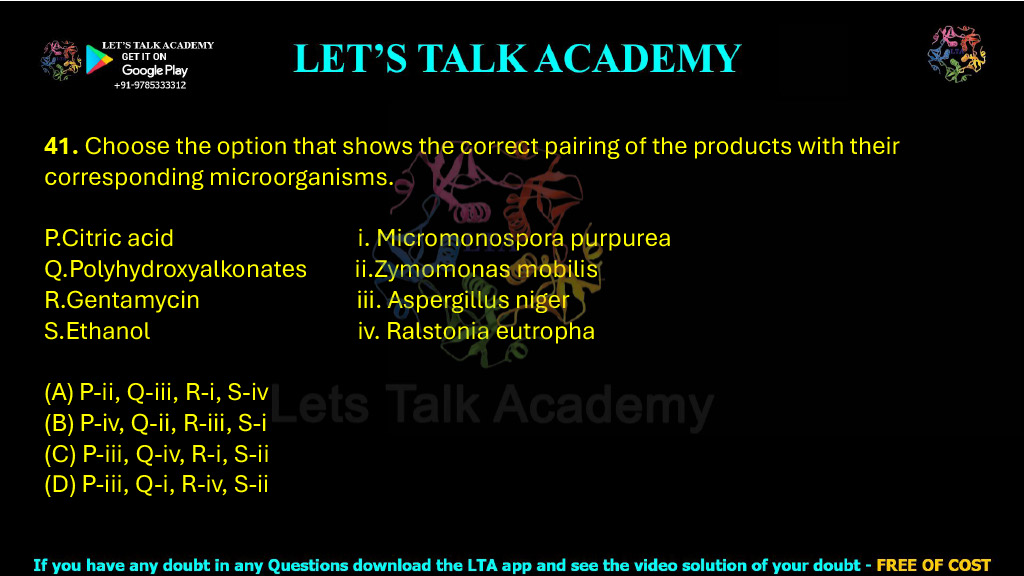
41. Choose the option that shows the correct pairing of the products with their corresponding microorganisms.
P.Citric acid i. Micromonospora purpurea
Q.Polyhydroxyalkonates ii. Zymomonas mobilis
R.Gentamycin iii. Aspergillus niger
S.Ethanol iv. Ralstonia eutropha
(A) P-ii, Q-iii, R-i, S-iv
(B) P-iv, Q-ii, R-iii, S-i
(C) P-iii, Q-iv, R-i, S-ii
(D) P-iii, Q-i, R-iv, S-ii
Industrial Microorganisms and Their Products: Citric Acid, Polyhydroxyalkanoates (PHA), Gentamycin, and Ethanol Explained
Introduction
Industrial microbiology utilizes microorganisms to manufacture a wide variety of commercially valuable products including antibiotics, organic acids, biofuels, biodegradable plastics, enzymes, vitamins, amino acids, and pharmaceuticals. These microbial fermentation processes are highly efficient, environmentally friendly, and economically sustainable, making microorganisms indispensable tools in modern biotechnology.
Each industrial microorganism possesses unique metabolic capabilities that enable the production of specific compounds. Aspergillus niger is one of the world’s leading producers of citric acid, Ralstonia eutropha synthesizes biodegradable plastics known as polyhydroxyalkanoates (PHAs), Micromonospora purpurea produces the aminoglycoside antibiotic gentamycin, and Zymomonas mobilis is widely used for high-yield ethanol production through the Entner-Doudoroff pathway.
Correct Answer
Correct Option: (C)
P – iii, Q – iv, R – i, S – ii
Detailed Explanation
Citric acid is one of the most extensively produced organic acids worldwide. Commercial production is primarily carried out using the filamentous fungus Aspergillus niger. Under high sugar concentrations and controlled fermentation conditions, this fungus efficiently converts carbohydrates into citric acid. The product is widely used in the food, pharmaceutical, cosmetic, and beverage industries.
Polyhydroxyalkanoates (PHAs) are biodegradable polyesters synthesized by several bacteria as intracellular carbon and energy storage compounds. One of the best-known industrial producers is Ralstonia eutropha (formerly Alcaligenes eutrophus). PHAs serve as environmentally friendly alternatives to petroleum-based plastics because they are completely biodegradable.
Gentamycin is a broad-spectrum aminoglycoside antibiotic produced by the actinomycete Micromonospora purpurea. It is highly effective against many Gram-negative bacterial infections and is widely used in clinical medicine.
Ethanol is produced commercially by several microorganisms. Among bacteria, Zymomonas mobilis is particularly important because it ferments sugars through the Entner-Doudoroff pathway, producing ethanol with high efficiency and minimal biomass formation.
Therefore, the correct matching is:
- Citric acid → Aspergillus niger
- Polyhydroxyalkanoates → Ralstonia eutropha
- Gentamycin → Micromonospora purpurea
- Ethanol → Zymomonas mobilis
Explanation of Each Match
P. Citric Acid → Aspergillus niger
This match is correct. Aspergillus niger is the most widely used industrial microorganism for large-scale citric acid production.
Q. Polyhydroxyalkanoates → Ralstonia eutropha
This match is correct. Ralstonia eutropha accumulates PHAs as intracellular storage polymers under nutrient-limited conditions.
R. Gentamycin → Micromonospora purpurea
This match is correct. Micromonospora purpurea naturally synthesizes the aminoglycoside antibiotic gentamycin.
S. Ethanol → Zymomonas mobilis
This match is correct. Zymomonas mobilis is an efficient ethanol-producing bacterium with high sugar-to-ethanol conversion efficiency.
Why Option (C) is Correct
Option (C) correctly pairs each industrial product with the microorganism most commonly used for its commercial production.
Why the Other Options are Incorrect
Option (A)
This option incorrectly matches citric acid with Zymomonas mobilis and ethanol with Ralstonia eutropha.
Option (B)
This option incorrectly assigns citric acid to Ralstonia eutropha and gentamycin to Aspergillus niger.
Option (D)
This option incorrectly pairs polyhydroxyalkanoates with Micromonospora purpurea and gentamycin with Ralstonia eutropha.
Comparison of All Options
| Option | Matching | Status |
|---|---|---|
| A | P-ii, Q-iii, R-i, S-iv | Incorrect |
| B | P-iv, Q-ii, R-iii, S-i | Incorrect |
| C | P-iii, Q-iv, R-i, S-ii | Correct |
| D | P-iii, Q-i, R-iv, S-ii | Incorrect |
Important Industrial Microorganisms and Their Products
| Microorganism | Major Product | Industrial Application |
|---|---|---|
| Aspergillus niger | Citric acid | Food and pharmaceutical industries |
| Ralstonia eutropha | Polyhydroxyalkanoates (PHA) | Biodegradable plastics |
| Micromonospora purpurea | Gentamycin | Antibiotic production |
| Zymomonas mobilis | Ethanol | Biofuel and industrial alcohol production |
Quick Revision Table
| Product | Microorganism |
|---|---|
| Citric acid | Aspergillus niger |
| PHA | Ralstonia eutropha |
| Gentamycin | Micromonospora purpurea |
| Ethanol | Zymomonas mobilis |
Biological Significance
Industrial microorganisms form the backbone of modern biotechnology. They provide sustainable methods for producing pharmaceuticals, biodegradable plastics, biofuels, and organic acids through fermentation. Their metabolic diversity enables industries to replace environmentally harmful chemical processes with renewable biological production systems, contributing significantly to green biotechnology and the circular bioeconomy.
Final Answer
Correct Option: (C)
P – iii, Q – iv, R – i, S – ii
- Citric acid → Aspergillus niger
- Polyhydroxyalkanoates → Ralstonia eutropha
- Gentamycin → Micromonospora purpurea
- Ethanol → Zymomonas mobilis


