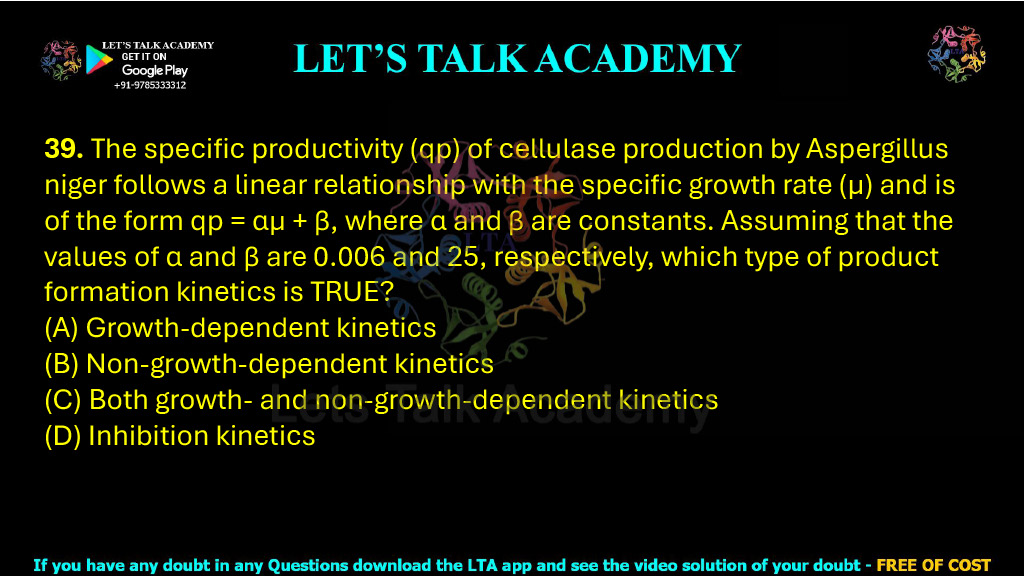
39. The specific productivity (qp) of cellulase production by Aspergillus niger follows a linear relationship with the specific growth rate (µ) and is of the form qp = αµ + β, where α and β are constants. Assuming that the values of α and β are 0.006 and 25, respectively, which type of product formation kinetics is TRUE?
(A) Growth-dependent kinetics
(B) Non-growth-dependent kinetics
(C) Both growth- and non-growth-dependent kinetics
(D) Inhibition kinetics
Luedeking-Piret Equation Explained: Growth-Dependent and Non-Growth-Dependent Product Formation Kinetics
Introduction
One of the most important concepts in industrial microbiology and biochemical engineering is the relationship between microbial growth and product formation. During fermentation, microorganisms may synthesize metabolites either while actively growing, after growth has ceased, or during both phases. Understanding these relationships helps scientists optimize fermentation conditions, improve product yield, and design efficient industrial bioprocesses.
The most widely accepted mathematical model describing this relationship is the Luedeking-Piret equation. This equation explains how the specific rate of product formation depends on the microbial growth rate. It is extensively applied in enzyme production, antibiotic fermentation, recombinant protein production, organic acid synthesis, and industrial enzyme manufacturing.
Correct Answer
Correct Option: (C) Both growth- and non-growth-dependent kinetics
Detailed Explanation
The relationship between microbial growth and product formation is commonly represented by the Luedeking-Piret equation:
qp = αμ + β
where:
- qp = Specific product formation rate
- μ = Specific growth rate
- α = Growth-associated product formation coefficient
- β = Non-growth-associated product formation coefficient
The interpretation of this equation depends entirely on the values of α and β.
Step-by-Step Interpretation
In this question:
α = 0.006
β = 25
Since α is not zero, part of the cellulase production depends on microbial growth.
Since β is also not zero, cellulase continues to be produced even when microbial growth stops.
Therefore, cellulase production occurs during both the exponential growth phase and the stationary phase.
This represents mixed product formation, also known as both growth-associated and non-growth-associated kinetics.
Hence, the correct answer is Option (C).
Explanation of Each Option
Option (A): Growth-Dependent Kinetics
This option is incorrect. Pure growth-associated kinetics occur only when:
β = 0
Since β = 25 in this question, product formation continues even without growth.
Option (B): Non-Growth-Dependent Kinetics
This option is incorrect. Pure non-growth-associated kinetics occur when:
α = 0
Since α = 0.006, product formation also depends on microbial growth.
Option (C): Both Growth- and Non-Growth-Dependent Kinetics
This option is correct. Both α and β are positive, indicating that cellulase production occurs partly during active growth and partly during the stationary phase.
Option (D): Inhibition Kinetics
This option is incorrect. The equation describes product formation kinetics and has no relation to substrate inhibition, product inhibition, or enzyme inhibition.
Why Option (C) is Correct
Both coefficients are positive:
- α ≠ 0 → Growth-associated production exists.
- β ≠ 0 → Non-growth-associated production also exists.
Therefore, cellulase synthesis follows a mixed product formation pattern.
Luedeking-Piret Model Interpretation
| Condition | Type of Product Formation |
|---|---|
| α ≠ 0, β = 0 | Growth-associated |
| α = 0, β ≠ 0 | Non-growth-associated |
| α ≠ 0, β ≠ 0 | Mixed (Both growth- and non-growth-associated) |
Comparison of All Options
| Option | Statement | Status |
|---|---|---|
| A | Growth-dependent kinetics | Incorrect |
| B | Non-growth-dependent kinetics | Incorrect |
| C | Both growth- and non-growth-dependent kinetics | Correct |
| D | Inhibition kinetics | Incorrect |
Examples of Different Product Formation Types
| Product | Typical Kinetics |
|---|---|
| Ethanol | Growth-associated |
| Lactic acid | Growth-associated |
| Penicillin | Non-growth-associated |
| Many industrial enzymes (including cellulase) | Mixed growth-associated |
| Citric acid | Mainly non-growth-associated |
About Cellulase Production by Aspergillus niger
Aspergillus niger is one of the most important industrial fungi used for large-scale enzyme production. Cellulases produced by this organism hydrolyze cellulose into glucose and are extensively used in biofuel production, textile processing, paper manufacturing, food processing, detergent formulation, and agricultural biotechnology. Cellulase synthesis is often influenced by both microbial growth and physiological state, making the Luedeking-Piret model particularly useful for describing its production kinetics.
Biological Significance
The Luedeking-Piret equation provides valuable information for optimizing industrial fermentation. By determining whether product formation is growth-associated, non-growth-associated, or mixed, process engineers can decide the best harvest time, optimize nutrient feeding strategies, improve reactor operation, and maximize product yield. This model remains one of the cornerstones of modern fermentation technology and biochemical engineering.
Final Answer
Given:
α = 0.006
β = 25
Since both α and β are non-zero, cellulase production depends on both microbial growth and non-growth-associated metabolism.
Correct Option: (C) Both growth- and non-growth-dependent kinetics.


