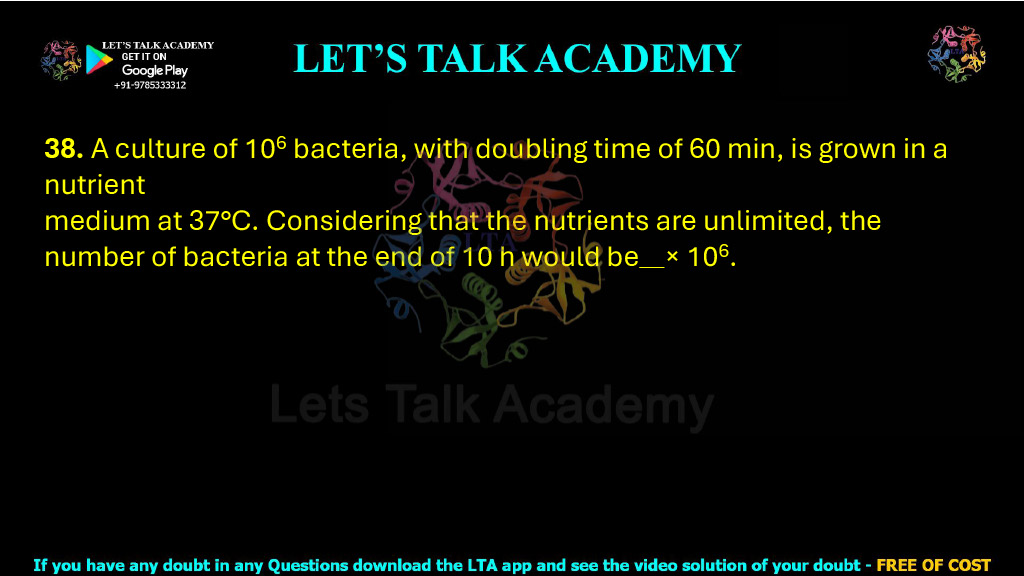
38. A culture of 106 bacteria, with doubling time of 60 min, is grown in a nutrient medium at 37°C. Considering that the nutrients are unlimited, the number of bacteria at the end of 10 h would be × 106.
Bacterial Growth Calculation: Number of Bacteria After 10 Hours Using Doubling Time Formula
Introduction
Bacteria reproduce by binary fission, an asexual process in which one bacterial cell divides into two identical daughter cells. Under ideal environmental conditions with sufficient nutrients, optimum temperature, and adequate moisture, bacterial populations increase exponentially. This rapid multiplication is known as exponential or logarithmic growth and is one of the most fundamental concepts in microbiology.
The time required for a bacterial population to double in size is called the doubling time or generation time. During the exponential phase, every generation doubles the total number of bacterial cells. Therefore, bacterial growth follows the mathematical equation N = N0 × 2n, where N is the final population, N0 is the initial population, and n is the number of generations.
Correct Answer
Correct Answer: 1024 × 106 bacteria
Detailed Explanation
Because the bacteria are growing under ideal conditions with unlimited nutrients, the culture remains in the exponential phase throughout the experiment. During exponential growth, the bacterial population doubles after every generation.
The bacterial growth equation is:
N = N0 × 2n
where:
- N = Final bacterial population
- N0 = Initial bacterial population
- n = Number of generations
Step 1: Identify the Given Data
| Parameter | Value |
|---|---|
| Initial Population (N0) | 106 bacteria |
| Doubling Time | 60 minutes |
| Total Growth Time | 10 hours = 600 minutes |
Step 2: Calculate the Number of Generations
Number of generations is calculated as:
n = Total Time ÷ Doubling Time
n = 600 ÷ 60 = 10 generations
Step 3: Calculate the Final Population
Using the exponential growth equation:
N = 106 × 210
Since,
210 = 1024
Therefore,
N = 1024 × 106 bacteria
Step-by-Step Solution Summary
| Calculation Step | Result |
|---|---|
| Initial Population | 106 |
| Total Time | 600 minutes |
| Doubling Time | 60 minutes |
| Number of Generations | 10 |
| Growth Factor | 210 = 1024 |
| Final Population | 1024 × 106 |
Formula Used in Bacterial Growth Calculations
| Formula | Purpose |
|---|---|
| N = N0 × 2n | Final bacterial population |
| n = t/g | Number of generations |
| g = t/n | Generation time |
Why Unlimited Nutrients Are Important
The question specifically states that nutrients are unlimited. This means the bacteria remain in the log (exponential) phase of growth throughout the 10-hour period. If nutrients became limiting, the bacteria would enter the stationary phase, and exponential growth would no longer occur. Therefore, the exponential growth equation is completely valid for this calculation.
Understanding Exponential Growth
| Generation | Population Multiplier |
|---|---|
| 0 | 1 |
| 1 | 2 |
| 2 | 4 |
| 3 | 8 |
| 4 | 16 |
| 5 | 32 |
| 10 | 1024 |
Biological Significance
Generation time is one of the most important parameters in microbial physiology because it reflects how rapidly microorganisms reproduce under optimal conditions. Knowledge of bacterial growth kinetics is essential in industrial fermentation, vaccine production, food microbiology, antibiotic susceptibility testing, environmental biotechnology, and infectious disease research. Mathematical models of bacterial growth also help predict contamination levels, optimize fermentation processes, and design antimicrobial treatment strategies.
Final Answer
Initial Population = 106 bacteria
Doubling Time = 60 minutes
Total Time = 10 hours = 600 minutes
Number of Generations = 600 ÷ 60 = 10
Final Population = 106 × 210 = 106 × 1024
Correct Answer = 1024 × 106 bacteria


