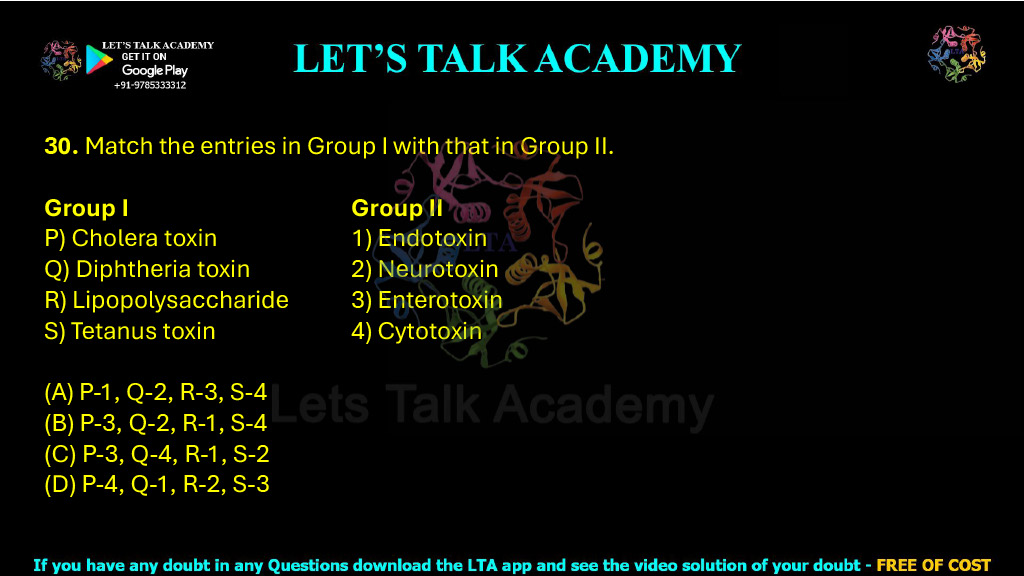
30. Match the entries in Group I with that in Group II.
Group I Group II
P) Cholera toxin 1) Endotoxin
Q) Diphtheria toxin 2) Neurotoxin
R) Lipopolysaccharide 3) Enterotoxin
S) Tetanus toxin 4) Cytotoxin
(A) P-1, Q-2, R-3, S-4
(B) P-3, Q-2, R-1, S-4
(C) P-3, Q-4, R-1, S-2
(D) P-4, Q-1, R-2, S-3
Bacterial Toxins Explained: Cholera Toxin, Diphtheria Toxin, Lipopolysaccharide, and Tetanus Toxin
Introduction
Bacterial toxins are powerful virulence factors that enable pathogenic bacteria to invade host tissues, evade immune defenses, damage cells, and produce disease symptoms. These toxins are broadly classified into exotoxins and endotoxins. Exotoxins are secreted proteins synthesized by living bacteria and usually possess highly specific biological activities. In contrast, endotoxins are structural components of the outer membrane of Gram-negative bacteria and are released mainly during bacterial lysis or membrane shedding.
Based on their target tissues and mechanisms of action, exotoxins are further classified as enterotoxins, cytotoxins, and neurotoxins. Enterotoxins primarily affect the intestinal epithelium, cytotoxins damage or kill host cells, and neurotoxins interfere with the normal functioning of the nervous system. Understanding these toxin classifications is essential in microbiology, immunology, infectious diseases, and medical biotechnology.
Correct Answer
Correct Option: (C)
P – 3, Q – 4, R – 1, S – 2
Detailed Explanation
Cholera toxin, produced by Vibrio cholerae, is a classical enterotoxin. It specifically acts on the epithelial cells of the small intestine by activating adenylate cyclase through ADP-ribosylation of the Gs protein. This increases intracellular cyclic AMP (cAMP), resulting in massive secretion of chloride ions and water into the intestinal lumen, leading to profuse watery diarrhea.
Diphtheria toxin, secreted by Corynebacterium diphtheriae, is a potent cytotoxin. It inhibits protein synthesis by ADP-ribosylating elongation factor-2 (EF-2), ultimately causing cell death. This toxin primarily damages epithelial and cardiac tissues, producing the characteristic manifestations of diphtheria.
Lipopolysaccharide (LPS) is the major structural component of the outer membrane of Gram-negative bacteria. The toxic component of LPS is lipid A, which functions as an endotoxin. Unlike exotoxins, endotoxins are not actively secreted but are released during bacterial lysis or membrane turnover. They stimulate macrophages to release inflammatory cytokines and can cause fever, septic shock, and disseminated intravascular coagulation.
Tetanus toxin, produced by Clostridium tetani, is a highly potent neurotoxin. It blocks the release of inhibitory neurotransmitters such as glycine and GABA from inhibitory interneurons, resulting in sustained muscle contraction and spastic paralysis.
Thus, the correct matching is:
- Cholera toxin → Enterotoxin
- Diphtheria toxin → Cytotoxin
- Lipopolysaccharide → Endotoxin
- Tetanus toxin → Neurotoxin
Explanation of Each Match
Cholera Toxin → Enterotoxin
This match is correct. Cholera toxin targets intestinal epithelial cells, causing excessive fluid secretion and severe watery diarrhea.
Diphtheria Toxin → Cytotoxin
This match is correct. Diphtheria toxin inhibits protein synthesis, leading to cellular damage and necrosis.
Lipopolysaccharide → Endotoxin
This match is correct. Lipid A of lipopolysaccharide is the endotoxin responsible for fever, inflammation, and septic shock.
Tetanus Toxin → Neurotoxin
This match is correct. Tetanospasmin affects neurons by blocking inhibitory neurotransmitter release, producing muscle rigidity and spasms.
Why Option (C) is Correct
Option (C) correctly matches every toxin with its biological classification based on its mechanism of action and target tissue.
Why the Other Options are Incorrect
Option (A)
This option incorrectly classifies cholera toxin as an endotoxin, diphtheria toxin as a neurotoxin, lipopolysaccharide as an enterotoxin, and tetanus toxin as a cytotoxin.
Option (B)
Although cholera toxin and lipopolysaccharide are matched correctly, diphtheria toxin is incorrectly identified as a neurotoxin and tetanus toxin as a cytotoxin.
Option (D)
This option incorrectly classifies all four toxins and therefore is completely incorrect.
Comparison of All Options
| Option | Matching | Status |
|---|---|---|
| A | P-1, Q-2, R-3, S-4 | Incorrect |
| B | P-3, Q-2, R-1, S-4 | Incorrect |
| C | P-3, Q-4, R-1, S-2 | Correct |
| D | P-4, Q-1, R-2, S-3 | Incorrect |
Summary of Important Bacterial Toxins
| Toxin | Produced By | Classification | Primary Action |
|---|---|---|---|
| Cholera toxin | Vibrio cholerae | Enterotoxin | Stimulates intestinal fluid secretion |
| Diphtheria toxin | Corynebacterium diphtheriae | Cytotoxin | Inhibits protein synthesis |
| Lipopolysaccharide | Gram-negative bacteria | Endotoxin | Triggers inflammation and septic shock |
| Tetanus toxin | Clostridium tetani | Neurotoxin | Blocks inhibitory neurotransmitters |
Exotoxins versus Endotoxins
| Feature | Exotoxins | Endotoxins |
|---|---|---|
| Chemical Nature | Proteins | Lipopolysaccharide (Lipid A) |
| Produced By | Mainly Gram-positive and some Gram-negative bacteria | Only Gram-negative bacteria |
| Heat Stability | Usually heat-labile | Heat-stable |
| Specificity | Highly specific | General inflammatory response |
| Toxoid Formation | Possible | Not possible |
Biological Significance
Bacterial toxins are central to the pathogenesis of many infectious diseases. Their diverse mechanisms enable bacteria to damage host tissues, interfere with immune responses, and establish successful infections. Understanding toxin classification is essential for vaccine development, antimicrobial therapy, and clinical diagnosis. Several bacterial vaccines, including diphtheria and tetanus vaccines, are based on inactivated exotoxins known as toxoids.
Final Answer
Correct Option: (C)
P – 3, Q – 4, R – 1, S – 2
The correct matching is:
- Cholera toxin → Enterotoxin
- Diphtheria toxin → Cytotoxin
- Lipopolysaccharide → Endotoxin
- Tetanus toxin → Neurotoxin


