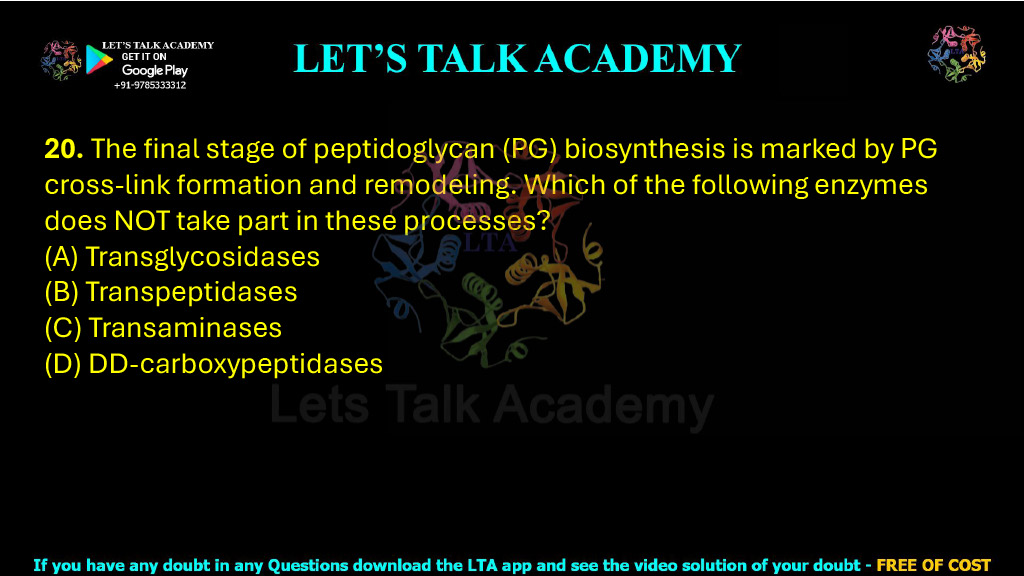
20. The final stage of peptidoglycan (PG) biosynthesis is marked by PG cross-link formation and remodeling. Which of the following enzymes does NOT take part in these processes?
(A) Transglycosidases
(B) Transpeptidases
(C) Transaminases
(D) DD-carboxypeptidases
Peptidoglycan Biosynthesis: Enzymes Involved in Cross-Link Formation and Remodeling
Introduction
The bacterial cell wall is one of the most essential structural components of bacteria because it provides rigidity, maintains cell shape, and protects cells against osmotic lysis. The major structural polymer of the bacterial cell wall is peptidoglycan (PG), a giant macromolecule composed of alternating sugar residues and peptide side chains. The synthesis of peptidoglycan is a complex, highly regulated process involving multiple enzymes that assemble glycan strands and create peptide cross-links to form a strong mesh-like structure.
The final stage of peptidoglycan biosynthesis occurs outside the cytoplasmic membrane and involves polymerization of glycan chains, formation of peptide cross-links, and remodeling of the existing cell wall. These reactions are catalyzed primarily by transglycosidases, transpeptidases, and DD-carboxypeptidases, which together belong to the family of penicillin-binding proteins (PBPs).
Correct Answer
Correct Option: (C) Transaminases
Detailed Explanation
The final stage of peptidoglycan biosynthesis involves three major enzymatic reactions. First, transglycosidases catalyze the polymerization of N-acetylglucosamine (NAG) and N-acetylmuramic acid (NAM) disaccharide units into long glycan chains. These glycan strands form the backbone of the bacterial cell wall.
Next, transpeptidases catalyze peptide cross-link formation between adjacent glycan chains. This cross-linking greatly strengthens the peptidoglycan network and enables the bacterial cell wall to resist internal osmotic pressure. Transpeptidases are the primary targets of β-lactam antibiotics, including penicillin, ampicillin, and cephalosporins.
Another important group of enzymes involved in cell wall maturation is the DD-carboxypeptidases. These enzymes remove the terminal D-alanine residue from peptide side chains, thereby regulating the degree of cross-linking and remodeling of the peptidoglycan layer during bacterial growth and division.
Transaminases, however, are completely unrelated to peptidoglycan cross-link formation. They participate in amino acid metabolism by transferring amino groups between amino acids and keto acids. Although transaminases are important metabolic enzymes, they do not contribute to the synthesis, cross-linking, or remodeling of bacterial peptidoglycan.
Explanation of Each Option
Option (A): Transglycosidases
This option is incorrect because transglycosidases are essential enzymes during the final stage of peptidoglycan biosynthesis. They polymerize glycan chains by joining NAG-NAM disaccharide units.
Option (B): Transpeptidases
This option is incorrect because transpeptidases catalyze peptide cross-link formation between neighboring peptidoglycan strands, providing mechanical strength to the bacterial cell wall.
Option (C): Transaminases
This option is correct. Transaminases participate in amino acid biosynthesis and nitrogen metabolism rather than bacterial cell wall assembly. They play no role in peptidoglycan cross-link formation or remodeling.
Option (D): DD-Carboxypeptidases
This option is incorrect. DD-carboxypeptidases modify peptide side chains by removing terminal D-alanine residues, thereby regulating peptidoglycan maturation and remodeling.
Why Option (C) is Correct
The final stage of peptidoglycan synthesis specifically requires enzymes involved in glycan polymerization, peptide cross-linking, and cell wall remodeling. Transaminases function in amino acid metabolism and therefore do not participate in any of these processes.
Why the Other Options are Incorrect
Why Option (A) is Incorrect
Transglycosidases synthesize the glycan backbone of peptidoglycan by linking NAG and NAM residues, making them indispensable for cell wall synthesis.
Why Option (B) is Incorrect
Transpeptidases catalyze peptide cross-link formation and are among the most important enzymes involved in bacterial cell wall biosynthesis.
Why Option (D) is Incorrect
DD-carboxypeptidases regulate the extent of peptidoglycan cross-linking during bacterial growth and are involved in cell wall remodeling.
Comparison of All Options
| Option | Function | Role in Final PG Biosynthesis |
|---|---|---|
| Transglycosidases | Polymerize glycan chains | Yes |
| Transpeptidases | Form peptide cross-links | Yes |
| Transaminases | Amino acid metabolism | No |
| DD-Carboxypeptidases | Peptidoglycan remodeling | Yes |
Major Steps of Peptidoglycan Biosynthesis
| Stage | Major Process | Important Enzyme |
|---|---|---|
| Cytoplasm | Synthesis of UDP-NAG and UDP-NAM precursors | Mur enzymes |
| Membrane | Formation of Lipid I and Lipid II | MraY, MurG |
| Periplasm/Cell Surface | Polymerization of glycan strands | Transglycosidase |
| Periplasm/Cell Surface | Peptide cross-link formation | Transpeptidase |
| Periplasm/Cell Surface | Cell wall remodeling | DD-Carboxypeptidase |
Functions of Penicillin-Binding Proteins (PBPs)
| Enzyme | Function |
|---|---|
| Transglycosidase | Elongates glycan chains |
| Transpeptidase | Creates peptide cross-links |
| DD-Carboxypeptidase | Regulates peptidoglycan maturation |
Antibiotics Targeting Peptidoglycan Synthesis
| Antibiotic | Target |
|---|---|
| Penicillin | Transpeptidase (PBP) |
| Cephalosporins | Transpeptidase (PBP) |
| Vancomycin | D-Ala-D-Ala terminus of peptide precursor |
| Bacitracin | Lipid carrier recycling |
| Fosfomycin | MurA enzyme |
Biological Significance
Peptidoglycan synthesis is essential for bacterial survival because it provides structural integrity and protects the cell against osmotic pressure. Since peptidoglycan is absent in human cells, the enzymes involved in its synthesis have become ideal targets for antibiotics. Drugs that inhibit transpeptidases or other peptidoglycan-synthesizing enzymes selectively kill bacteria while producing minimal toxicity in humans. Understanding these enzymatic reactions has therefore become fundamental to microbiology, pharmacology, and antibiotic development.
Final Answer
Correct Option: (C) Transaminases
During the final stage of peptidoglycan biosynthesis, transglycosidases, transpeptidases, and DD-carboxypeptidases participate in glycan polymerization, peptide cross-link formation, and cell wall remodeling. Transaminases function in amino acid metabolism and are not involved in peptidoglycan synthesis.


