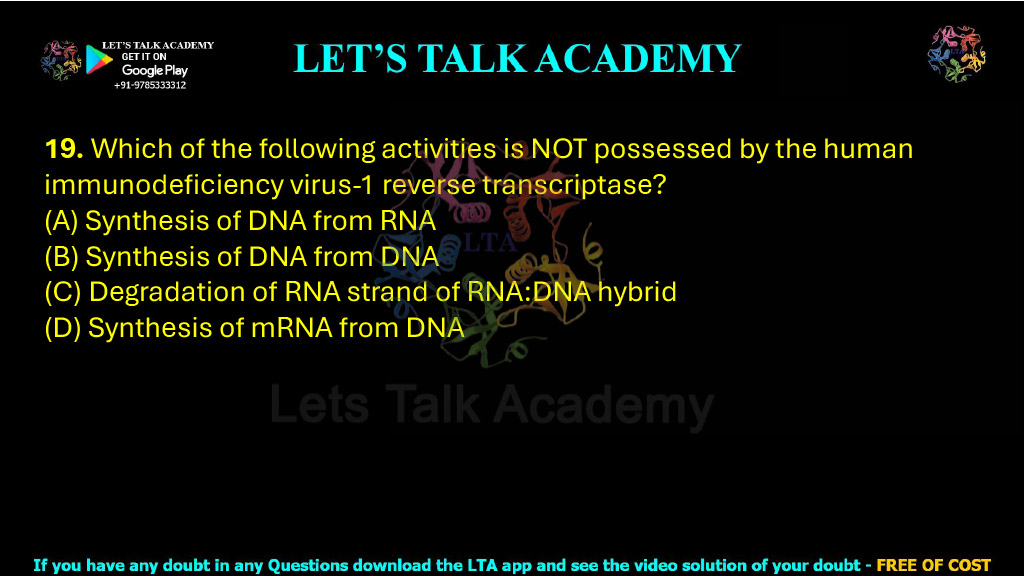
19. Which of the following activities is NOT possessed by the human immunodeficiency virus-1 reverse transcriptase?
(A) Synthesis of DNA from RNA
(B) Synthesis of DNA from DNA
(C) Degradation of RNA strand of RNA:DNA hybrid
(D) Synthesis of mRNA from DNA
HIV-1 Reverse Transcriptase Functions Explained
Introduction
Human Immunodeficiency Virus type-1 (HIV-1) belongs to the family Retroviridae and is one of the most extensively studied viruses because of its unique replication strategy. Unlike most organisms that follow the classical flow of genetic information from DNA to RNA to protein, HIV first converts its RNA genome into DNA through a process known as reverse transcription. This process is catalyzed by the viral enzyme reverse transcriptase, one of the hallmark enzymes of retroviruses.
Reverse transcriptase is a multifunctional enzyme that performs several catalytic activities essential for viral replication. It synthesizes DNA from an RNA template, synthesizes DNA using DNA as a template, and degrades the RNA strand of RNA:DNA hybrids through its RNase H activity. However, one activity it does not possess is the synthesis of messenger RNA from DNA.
Correct Answer
Correct Option: (D) Synthesis of mRNA from DNA
Detailed Explanation
HIV-1 reverse transcriptase is a multifunctional enzyme responsible for converting the viral single-stranded RNA genome into double-stranded DNA. This DNA is subsequently integrated into the host chromosome by another viral enzyme called integrase. Reverse transcriptase possesses three important enzymatic activities that together complete reverse transcription.
The first activity is RNA-dependent DNA polymerase activity, which synthesizes complementary DNA (cDNA) using the viral RNA genome as a template. This is the defining property of reverse transcriptase and is responsible for reversing the normal direction of genetic information.
The second activity is DNA-dependent DNA polymerase activity. After the first DNA strand has been synthesized and the RNA template has been removed, reverse transcriptase synthesizes the second DNA strand using the first DNA strand as a template. This produces double-stranded viral DNA that is suitable for integration into the host genome.
The third activity is RNase H activity, which specifically degrades the RNA strand of RNA:DNA hybrid molecules formed during reverse transcription. Removal of the RNA template is essential before synthesis of the second DNA strand can occur.
However, reverse transcriptase does not synthesize messenger RNA from DNA. Once viral DNA integrates into the host chromosome as a provirus, the host cell’s DNA-dependent RNA polymerase II transcribes viral mRNA. Therefore, mRNA synthesis from DNA is not a function of HIV reverse transcriptase.
Explanation of Each Option
Option (A): Synthesis of DNA from RNA
This statement is correct. Reverse transcriptase functions as an RNA-dependent DNA polymerase, synthesizing complementary DNA from the viral RNA genome.
Option (B): Synthesis of DNA from DNA
This statement is correct. Reverse transcriptase also possesses DNA-dependent DNA polymerase activity, allowing it to synthesize the second DNA strand after the RNA template has been removed.
Option (C): Degradation of RNA Strand of RNA:DNA Hybrid
This statement is correct. The enzyme contains an RNase H domain, which degrades the RNA component of RNA:DNA hybrid molecules during reverse transcription.
Option (D): Synthesis of mRNA from DNA
This statement is incorrect because reverse transcriptase does not function as a DNA-dependent RNA polymerase. Viral mRNA synthesis is carried out by the host cell’s RNA polymerase II after the viral DNA integrates into the host genome.
Why Option (D) is Correct
The synthesis of messenger RNA from DNA requires DNA-dependent RNA polymerase, an enzyme found in the host cell. HIV reverse transcriptase lacks this activity and therefore cannot directly produce viral mRNA.
Why the Other Options are Incorrect
Why Option (A) is Incorrect
This is one of the primary functions of reverse transcriptase and is essential for converting viral RNA into complementary DNA.
Why Option (B) is Incorrect
Reverse transcriptase synthesizes the second DNA strand after the RNA template has been degraded, demonstrating DNA-dependent DNA polymerase activity.
Why Option (C) is Incorrect
The RNase H domain of reverse transcriptase specifically removes the RNA strand from RNA:DNA hybrid molecules, making second-strand DNA synthesis possible.
Comparison of All Options
| Option | Activity | Present in HIV Reverse Transcriptase? |
|---|---|---|
| A | RNA-dependent DNA synthesis | Yes |
| B | DNA-dependent DNA synthesis | Yes |
| C | RNase H activity | Yes |
| D | DNA-dependent RNA synthesis (mRNA synthesis) | No |
Major Activities of HIV Reverse Transcriptase
| Enzymatic Activity | Function |
|---|---|
| RNA-dependent DNA Polymerase | Synthesizes first DNA strand from viral RNA |
| RNase H | Degrades RNA strand of RNA:DNA hybrid |
| DNA-dependent DNA Polymerase | Synthesizes complementary DNA strand |
Steps of HIV Replication
| Step | Process |
|---|---|
| 1 | Virus enters CD4+ cell |
| 2 | Reverse transcriptase synthesizes DNA from RNA |
| 3 | RNase H removes RNA template |
| 4 | Second DNA strand is synthesized |
| 5 | Integrase inserts viral DNA into host chromosome |
| 6 | Host RNA polymerase II transcribes viral mRNA |
| 7 | Translation, assembly, and release of new virions |
Comparison of Important Viral Enzymes
| Enzyme | Function | Found In |
|---|---|---|
| DNA Polymerase | DNA → DNA | Cells and DNA viruses |
| DNA-dependent RNA Polymerase | DNA → RNA | Host cells and DNA viruses |
| RNA-dependent RNA Polymerase | RNA → RNA | RNA viruses |
| Reverse Transcriptase | RNA → DNA | Retroviruses |
Biological Significance
Reverse transcriptase revolutionized molecular biology by demonstrating that genetic information can flow from RNA to DNA. Beyond its importance in HIV replication, the enzyme is indispensable in biotechnology for complementary DNA (cDNA) synthesis, reverse transcription PCR (RT-PCR), transcriptome analysis, gene expression studies, and molecular diagnostics. Because reverse transcriptase is unique to retroviruses, it is also a major target for antiretroviral drugs used in HIV treatment.
Final Answer
Correct Option: (D)
HIV-1 reverse transcriptase does not synthesize mRNA from DNA. Instead, it possesses RNA-dependent DNA polymerase activity, DNA-dependent DNA polymerase activity, and RNase H activity. Viral mRNA is synthesized later by the host cell’s DNA-dependent RNA polymerase II after the viral DNA integrates into the host genome.


