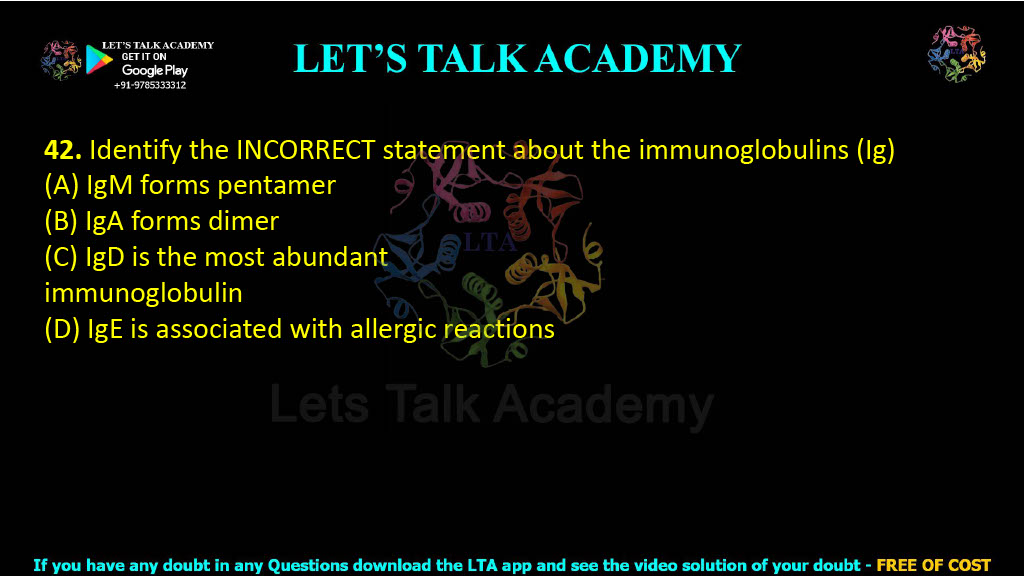
42. Identify the INCORRECT statement about the immunoglobulins (Ig)
(A) IgM forms pentamer
(B) IgA forms dimer
(C) IgD is the most abundant immunoglobulin
(D) IgE is associated with allergic reactions
Incorrect Statement About Immunoglobulins (Ig)
Introduction
Immunoglobulins, commonly known as antibodies, are specialized glycoproteins produced by plasma cells that play a central role in the adaptive immune system. Their primary function is to recognize and bind specific antigens, thereby neutralizing pathogens, activating the complement system, promoting phagocytosis, and preventing microbial infections. Every antibody possesses a unique antigen-binding site capable of recognizing a particular epitope, making antibody-mediated immunity highly specific and effective.
Humans possess five major classes of immunoglobulins: IgG, IgA, IgM, IgD, and IgE. Each class differs in structure, distribution, abundance, and biological function. IgG is the most abundant immunoglobulin in serum and provides long-term systemic immunity. IgA protects mucosal surfaces, IgM is the first antibody produced during a primary immune response, IgD functions mainly as a B-cell receptor, and IgE mediates allergic reactions and defense against parasitic infections.
Correct Answer
Correct Option: (C) IgD is the most abundant immunoglobulin
Detailed Explanation
The five classes of immunoglobulins differ significantly in their structure and physiological functions. Among them, IgG is the most abundant antibody in human serum, accounting for approximately 75–80% of total circulating immunoglobulins. IgG is responsible for secondary immune responses, neutralization of toxins and viruses, complement activation, opsonization, and passive immunity transferred from mother to fetus through the placenta.
IgD, in contrast, is one of the least abundant immunoglobulins in serum, constituting less than 1% of circulating antibodies. Its primary role is to function as a membrane-bound antigen receptor on mature naïve B lymphocytes, where it participates in B-cell activation and differentiation. Therefore, the statement claiming that IgD is the most abundant immunoglobulin is incorrect.
IgM exists predominantly as a pentamer in the bloodstream, containing five antibody units linked by disulfide bonds and a joining (J) chain. Because of its pentameric structure, IgM possesses ten antigen-binding sites and is highly efficient at activating the classical complement pathway. It is the first antibody produced during a primary immune response.
IgA is the principal immunoglobulin of mucosal secretions such as saliva, tears, intestinal secretions, and breast milk. Secretory IgA exists mainly as a dimer connected by a J chain and a secretory component, providing protection against pathogens at mucosal surfaces.
IgE binds with high affinity to Fc receptors present on mast cells and basophils. During allergic reactions, allergens cross-link IgE molecules bound to these cells, triggering degranulation and the release of histamine, leukotrienes, and other inflammatory mediators. IgE also contributes to immunity against parasitic helminths.
Explanation of Each Option
Option (A): IgM Forms Pentamer
This statement is correct. Circulating IgM exists mainly as a pentamer consisting of five monomeric antibody units joined together by disulfide bonds and a J chain. This multimeric structure gives IgM exceptional ability to agglutinate pathogens and activate complement.
Option (B): IgA Forms Dimer
This statement is correct. Secretory IgA is predominantly present as a dimer in mucosal secretions and plays a vital role in protecting respiratory, gastrointestinal, and urogenital mucosal surfaces from microbial invasion.
Option (C): IgD is the Most Abundant Immunoglobulin
This statement is incorrect. IgG, not IgD, is the most abundant immunoglobulin in human serum. IgD is present in very low concentrations and primarily functions as a B-cell receptor.
Option (D): IgE is Associated with Allergic Reactions
This statement is correct. IgE mediates immediate hypersensitivity (Type I allergic reactions) by binding to mast cells and basophils, leading to histamine release upon allergen exposure.
Why Option (C) is Correct
IgG constitutes nearly four-fifths of all circulating antibodies and is the dominant immunoglobulin in blood plasma. IgD represents only a very small fraction of serum antibodies and mainly functions on the surface of mature B cells. Therefore, the statement that IgD is the most abundant immunoglobulin is incorrect.
Why the Other Options are Correct
Why Option (A) is Correct
IgM naturally exists as a pentamer, making it highly effective in complement activation and pathogen agglutination.
Why Option (B) is Correct
Secretory IgA forms dimers that protect mucosal surfaces against pathogens.
Why Option (D) is Correct
IgE is responsible for allergic reactions and defense against parasitic worm infections by activating mast cells and basophils.
Comparison of All Immunoglobulin Classes
| Immunoglobulin | Structure | Main Function | Relative Abundance |
|---|---|---|---|
| IgG | Monomer | Secondary immune response, placental transfer, opsonization | Most Abundant (~75–80%) |
| IgA | Dimer (Secretory) | Mucosal immunity | Second Most Abundant |
| IgM | Pentamer | Primary immune response, complement activation | Moderate |
| IgD | Monomer | B-cell receptor | Very Low |
| IgE | Monomer | Allergic reactions and parasite defense | Lowest Serum Concentration |
Major Characteristics of Immunoglobulins
| Antibody | Important Feature |
|---|---|
| IgG | Crosses placenta and provides passive immunity to fetus |
| IgA | Protects mucosal surfaces and is abundant in breast milk |
| IgM | First antibody produced during primary immune response |
| IgD | Functions mainly as antigen receptor on mature B cells |
| IgE | Triggers allergic reactions through mast cell activation |
Distribution of Immunoglobulins in the Human Body
| Immunoglobulin | Primary Location |
|---|---|
| IgG | Blood and extracellular fluids |
| IgA | Saliva, tears, mucus, breast milk and intestinal secretions |
| IgM | Blood plasma |
| IgD | Surface of mature B lymphocytes |
| IgE | Bound to mast cells and basophils |
Biological Significance of Immunoglobulins
Each immunoglobulin class performs a specialized function that contributes to effective immune protection. IgM rapidly responds during the initial stages of infection, IgG provides long-term immunity and immunological memory, IgA protects vulnerable mucosal surfaces, IgE mediates defense against parasites and allergic reactions, while IgD regulates B-cell activation. The coordinated action of these antibodies enables efficient elimination of pathogens while establishing long-lasting adaptive immunity.
Final Answer
Correct Option: (C) IgD is the most abundant immunoglobulin
The statement is incorrect because IgG, not IgD, is the most abundant immunoglobulin in human serum. IgD is present in very low concentrations and primarily functions as an antigen receptor on mature B lymphocytes.


