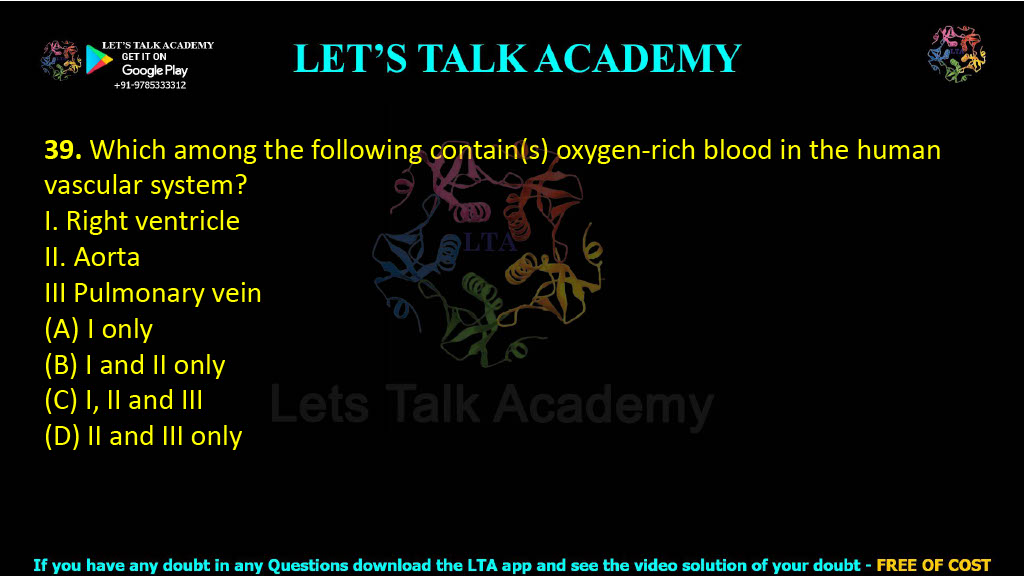
39. Which among the following contain(s) oxygen-rich blood in the human vascular system?
I. Right ventricle
II. Aorta
III. Pulmonary vein
(A) I only
(B) I and II only
(C) I, II and III
(D) II and III only
Oxygen-Rich Blood in the Human Vascular System
Introduction
The human circulatory system is a highly efficient transport network responsible for delivering oxygen, nutrients, hormones, and immune cells to every tissue of the body while simultaneously removing carbon dioxide and metabolic waste products. Humans possess a double circulatory system, meaning that blood passes through the heart twice during one complete circulation. This arrangement ensures efficient oxygen delivery to body tissues while maintaining complete separation between oxygen-rich and oxygen-poor blood.
The heart consists of four chambers—two atria and two ventricles—that coordinate pulmonary and systemic circulation. Oxygen-poor blood returning from body tissues enters the right side of the heart and is pumped to the lungs through the pulmonary artery. After oxygenation in the lungs, oxygen-rich blood returns to the left side of the heart via the pulmonary veins and is subsequently pumped into the aorta for distribution throughout the body.
Correct Answer
Correct Option: (D) II and III only
Detailed Explanation
Oxygen-rich blood is the blood that has recently undergone oxygenation in the lungs. After gas exchange in the pulmonary capillaries, oxygen diffuses into the blood while carbon dioxide diffuses into the alveoli for exhalation. This oxygenated blood is transported back to the heart by the pulmonary veins, making them the only veins in the adult human body that normally carry oxygen-rich blood.
The pulmonary veins empty into the left atrium. From there, blood passes into the left ventricle, which pumps it into the aorta, the largest artery in the body. The aorta distributes oxygen-rich blood to all organs and tissues through systemic circulation.
The right ventricle, however, contains oxygen-poor (deoxygenated) blood. It receives blood from the right atrium and pumps it into the pulmonary artery, which carries blood to the lungs for oxygenation. Therefore, the right ventricle does not contain oxygen-rich blood.
Consequently, only the aorta and the pulmonary vein carry oxygen-rich blood.
Explanation of Each Statement
Statement I: Right Ventricle
This statement is incorrect. The right ventricle contains deoxygenated blood received from the right atrium and pumps it to the lungs through the pulmonary artery.
Statement II: Aorta
This statement is correct. The aorta receives oxygenated blood from the left ventricle and distributes it throughout the systemic circulation.
Statement III: Pulmonary Vein
This statement is correct. Pulmonary veins carry oxygen-rich blood from the lungs to the left atrium. They are unique because, unlike most veins, they transport oxygenated blood.
Why Option (D) is Correct
The aorta and pulmonary veins both carry oxygen-rich blood. The aorta distributes oxygenated blood from the left ventricle to the body, while pulmonary veins transport oxygenated blood from the lungs to the left atrium. The right ventricle contains only deoxygenated blood destined for pulmonary circulation.
Why the Other Options are Incorrect
Why Option (A) is Incorrect
The right ventricle carries deoxygenated blood rather than oxygenated blood.
Why Option (B) is Incorrect
The right ventricle is incorrectly included. Only the aorta contains oxygen-rich blood among these two structures.
Why Option (C) is Incorrect
The right ventricle does not carry oxygenated blood, making this combination incorrect.
Comparison of the Given Structures
| Structure | Type | Blood Carried | Correct or Incorrect |
|---|---|---|---|
| Right Ventricle | Heart Chamber | Deoxygenated Blood | Incorrect |
| Aorta | Artery | Oxygenated Blood | Correct |
| Pulmonary Vein | Vein | Oxygenated Blood | Correct |
Blood Flow Through the Human Heart
| Sequence | Blood Flow | Oxygen Status |
|---|---|---|
| 1 | Body → Superior and Inferior Vena Cava | Deoxygenated |
| 2 | Right Atrium | Deoxygenated |
| 3 | Right Ventricle | Deoxygenated |
| 4 | Pulmonary Artery | Deoxygenated |
| 5 | Lungs | Blood Becomes Oxygenated |
| 6 | Pulmonary Veins | Oxygenated |
| 7 | Left Atrium | Oxygenated |
| 8 | Left Ventricle | Oxygenated |
| 9 | Aorta | Oxygenated |
Oxygenated and Deoxygenated Blood Vessels
| Structure | Blood Type |
|---|---|
| Aorta | Oxygenated |
| Pulmonary Vein | Oxygenated |
| Pulmonary Artery | Deoxygenated |
| Superior Vena Cava | Deoxygenated |
| Inferior Vena Cava | Deoxygenated |
Double Circulation in Humans
| Circulation | Pathway | Function |
|---|---|---|
| Pulmonary Circulation | Right Heart → Lungs → Left Heart | Oxygenation of Blood |
| Systemic Circulation | Left Heart → Body → Right Heart | Distribution of Oxygen and Nutrients |
Biological Significance of Double Circulation
Double circulation enables complete separation of oxygenated and deoxygenated blood, allowing mammals to maintain high metabolic rates. Efficient oxygen delivery supports active tissues such as the brain, skeletal muscles, liver, and kidneys. This arrangement also maintains higher systemic blood pressure while protecting the delicate pulmonary capillaries from excessive pressure.
Final Answer
Correct Option: (D) II and III only
The aorta and the pulmonary vein both contain oxygen-rich blood. The right ventricle contains deoxygenated blood, which is pumped to the lungs through the pulmonary artery for oxygenation. Therefore, the correct answer is Option (D).


