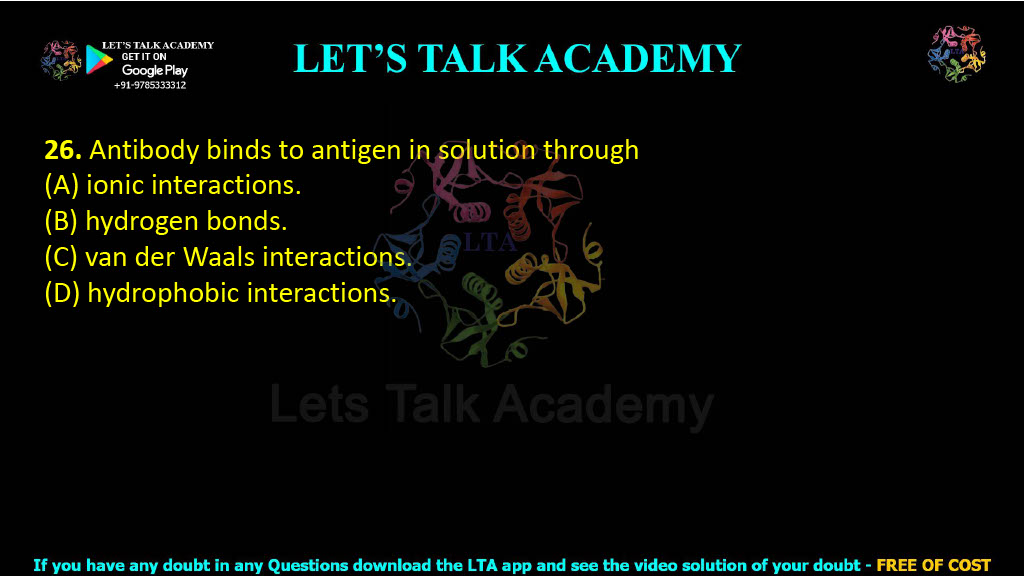
26. Antibody binds to antigen in solution through
(A) ionic interactions.
(B) hydrogen bonds.
(C) van der Waals interactions.
(D) hydrophobic interactions.
Antibody-Antigen Binding Through Non-Covalent Interactions
Introduction
The interaction between an antibody and an antigen is one of the most specific molecular recognition events in biology. This highly selective binding enables the immune system to identify and neutralize bacteria, viruses, toxins, parasites, and other foreign molecules. Every antibody possesses a unique antigen-binding site called the paratope, which recognizes a specific region of an antigen known as the epitope. The extraordinary specificity of this interaction forms the basis of humoral immunity and is extensively utilized in diagnostic tests, vaccine development, therapeutic monoclonal antibodies, and biomedical research.
Unlike many biochemical reactions that involve strong covalent bonds, antigen-antibody binding depends entirely on multiple non-covalent interactions. These weak forces act together to produce strong overall binding affinity while allowing reversible binding. The major forces responsible for antigen-antibody interaction include ionic interactions, hydrogen bonds, van der Waals interactions, and hydrophobic interactions.
Correct Answer
Correct Options: (A), (B), (C) and (D)
Detailed Explanation
Antibodies recognize antigens through highly complementary molecular surfaces formed by the antibody variable region and the antigenic epitope. Importantly, this binding does not involve covalent bond formation. Instead, the stability of the antigen-antibody complex depends on the cumulative effect of several weak non-covalent forces. Although each individual interaction is relatively weak, together they generate high affinity and remarkable specificity.
Ionic interactions, also known as electrostatic interactions, occur between oppositely charged amino acid side chains present on the antibody and antigen. These interactions contribute significantly to the strength of binding when charged residues are positioned appropriately.
Hydrogen bonds form between hydrogen donor and acceptor atoms located on amino acid side chains or peptide backbones. These bonds stabilize the antigen-antibody complex and help maintain precise molecular orientation.
Van der Waals interactions arise when atoms are positioned extremely close to one another. Although individually very weak, the large number of van der Waals contacts generated at the antibody-antigen interface makes a substantial contribution to overall binding affinity.
Hydrophobic interactions occur when nonpolar amino acid residues cluster together to avoid contact with surrounding water molecules. These interactions reduce free energy and further stabilize the immune complex.
Since all four types of non-covalent interactions work together during antigen recognition, the correct answer includes every option.
Explanation of Each Option
Option (A): Ionic Interactions
This statement is correct. Ionic or electrostatic interactions occur between positively and negatively charged amino acid residues on the antigen and antibody. These interactions strengthen binding when complementary charges are present.
Option (B): Hydrogen Bonds
This statement is correct. Hydrogen bonds help stabilize the antigen-antibody complex by providing directional interactions between donor and acceptor groups. They play a major role in determining binding specificity.
Option (C): Van der Waals Interactions
This statement is correct. Van der Waals forces develop when atoms are closely packed within the antigen-binding site. Although individually weak, thousands of these interactions contribute significantly to the stability of the immune complex.
Option (D): Hydrophobic Interactions
This statement is correct. Hydrophobic amino acid residues at the binding interface tend to cluster together, excluding water molecules and increasing the stability of antigen-antibody binding.
Why All Options Are Correct
Antigen-antibody binding depends on the combined action of ionic interactions, hydrogen bonds, van der Waals forces, and hydrophobic interactions. No single force alone is sufficient to produce the high specificity and affinity observed during immune recognition. The cumulative contribution of all four interactions creates a stable yet reversible antigen-antibody complex.
Comparison of All Options
| Option | Interaction Type | Role in Antigen-Antibody Binding | Correct or Incorrect |
|---|---|---|---|
| A | Ionic Interactions | Electrostatic attraction between charged groups | Correct |
| B | Hydrogen Bonds | Stabilize molecular orientation | Correct |
| C | Van der Waals Interactions | Close atomic contacts increase affinity | Correct |
| D | Hydrophobic Interactions | Stabilize nonpolar regions by excluding water | Correct |
Major Non-Covalent Forces in Antigen-Antibody Binding
| Interaction | Nature | Contribution |
|---|---|---|
| Ionic Interaction | Electrostatic attraction | Enhances binding strength |
| Hydrogen Bond | Hydrogen donor-acceptor interaction | Provides specificity and stability |
| Van der Waals Force | Transient atomic attraction | Improves close molecular fitting |
| Hydrophobic Interaction | Association of nonpolar groups | Stabilizes the immune complex |
Factors Affecting Antigen-Antibody Binding
| Factor | Effect on Binding |
|---|---|
| Shape Complementarity | Increases specificity |
| Charge Distribution | Enhances ionic interactions |
| Hydrogen Bond Formation | Improves stability |
| Hydrophobic Surface Area | Strengthens complex formation |
| Temperature and pH | Influence interaction strength |
Affinity and Avidity in Antibody Binding
| Term | Definition |
|---|---|
| Affinity | Strength of binding between one antibody-binding site and one epitope |
| Avidity | Overall strength of multiple antigen-antibody interactions |
Biological Significance of Antigen-Antibody Interactions
The reversible nature of antigen-antibody binding allows antibodies to recognize pathogens efficiently while permitting immune complexes to be removed after their function is complete. These interactions neutralize toxins and viruses, promote complement activation, enhance phagocytosis through opsonization, and provide the molecular basis for diagnostic techniques such as ELISA, Western blotting, immunofluorescence, immunohistochemistry, and rapid antigen tests. Modern monoclonal antibody therapies used in cancer, autoimmune diseases, and infectious diseases also rely on these highly specific non-covalent interactions.
Final Answer
Correct Options: (A), (B), (C) and (D)
Antibodies bind antigens through the combined action of ionic interactions, hydrogen bonds, van der Waals interactions, and hydrophobic interactions. These non-covalent forces collectively provide the high specificity, affinity, and reversible binding that characterize antigen-antibody recognition in the adaptive immune system.


