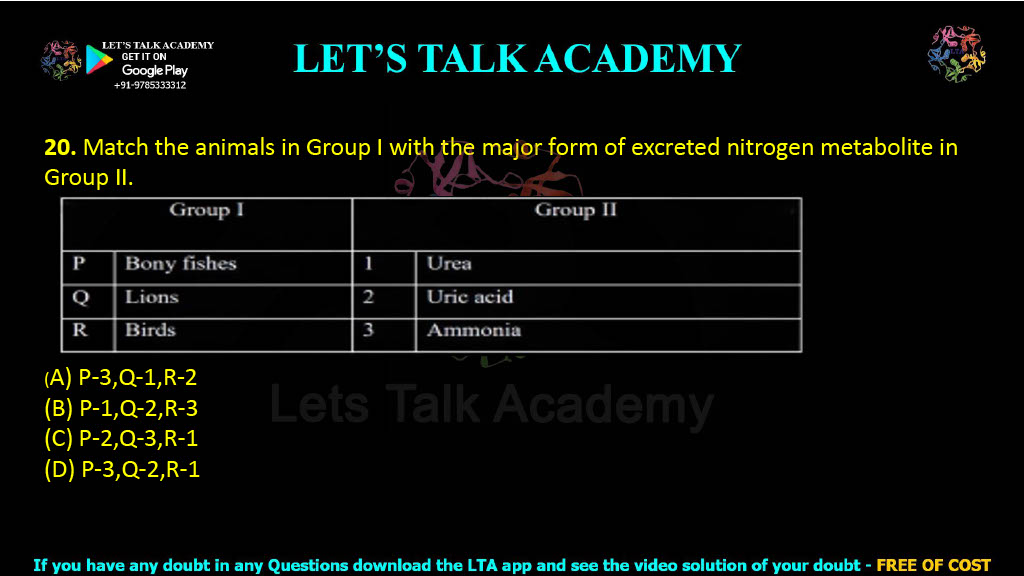
20. Match animals in Group I with major form of excreted nitrogen metabolite in Group II.
| Group I | Group II |
| P. Bony fishes | 1. Urea |
| Q. Lions | 2. Uric acid |
| R. Birds | 3. Ammonia |
(A) P-3, Q-1, R-2
(B) P-1, Q-2, R-3
(C) P-2, Q-3, R-1
(D) P-3, Q-2, R-1
Nitrogenous Waste Excretion in Animals
Introduction
Nitrogen metabolism is an essential physiological process in all living organisms. During the breakdown of amino acids and nucleic acids, nitrogen-containing waste products are generated. Since these compounds are toxic, animals must efficiently eliminate them to maintain internal homeostasis. Depending on habitat, water availability, and evolutionary adaptation, different groups of animals excrete nitrogen primarily as ammonia, urea, or uric acid. This classification forms the basis of three major physiological categories: ammonotelic, ureotelic, and uricotelic animals.
Aquatic animals generally excrete ammonia because abundant water rapidly dilutes this highly toxic compound. Terrestrial mammals convert ammonia into the less toxic urea before excretion, while birds convert nitrogen into uric acid, which conserves water by being excreted as a semi-solid paste.
Correct Answer
Correct Option: (A) P-3, Q-1, R-2
Detailed Explanation
Animals eliminate nitrogenous waste in different chemical forms depending on their habitat and evolutionary adaptations. The three principal nitrogenous waste products are ammonia, urea, and uric acid.
Bony fishes are ammonotelic animals. They excrete ammonia directly into the surrounding water through their gills and kidneys. Because ammonia is highly toxic but highly soluble in water, aquatic organisms can eliminate it rapidly without significant water conservation issues.
Lions, like other mammals, are ureotelic. Ammonia produced during protein metabolism is converted into urea in the liver through the urea cycle (ornithine cycle). Urea is less toxic than ammonia and can be stored temporarily before being excreted by the kidneys.
Birds are uricotelic. They convert nitrogenous waste into uric acid, which is only sparingly soluble in water. Uric acid is excreted as a semi-solid white paste, minimizing water loss. This adaptation is particularly beneficial for flight and embryonic development inside shelled eggs.
Therefore, the correct matching is:
P → 3 (Ammonia)
Q → 1 (Urea)
R → 2 (Uric acid)
Hence, Option (A) is the correct answer.
Explanation of Each Option
Option (A): P-3, Q-1, R-2
This statement is correct. Bony fishes excrete ammonia, lions excrete urea, and birds excrete uric acid. This follows the standard classification of ammonotelic, ureotelic, and uricotelic animals.
Option (B): P-1, Q-2, R-3
This statement is incorrect. Bony fishes do not primarily excrete urea, lions do not excrete uric acid, and birds do not excrete ammonia.
Option (C): P-2, Q-3, R-1
This statement is incorrect. None of the organisms are matched with their correct nitrogenous waste products.
Option (D): P-3, Q-2, R-1
This statement is incorrect. Although bony fishes are correctly matched with ammonia, lions excrete urea rather than uric acid, and birds excrete uric acid rather than urea.
Why Option (A) is Correct
Bony fishes are ammonotelic, mammals such as lions are ureotelic, and birds are uricotelic. These adaptations reflect the availability of water and the need to conserve body fluids during evolution.
Why the Other Options are Incorrect
Why Option (B) is Incorrect
The nitrogenous waste products are incorrectly assigned to all three animal groups.
Why Option (C) is Incorrect
The entire matching sequence is incorrect because each organism is paired with the wrong metabolite.
Why Option (D) is Incorrect
Only the first pairing is correct; lions and birds are incorrectly matched.
Comparison of All Options
| Option | Matching | Correct or Incorrect |
|---|---|---|
| A | P-3, Q-1, R-2 | Correct |
| B | P-1, Q-2, R-3 | Incorrect |
| C | P-2, Q-3, R-1 | Incorrect |
| D | P-3, Q-2, R-1 | Incorrect |
Types of Nitrogenous Excretion
| Type | Main Nitrogenous Waste | Examples |
|---|---|---|
| Ammonotelic | Ammonia | Bony fishes, aquatic amphibians |
| Ureotelic | Urea | Mammals, adult amphibians, sharks |
| Uricotelic | Uric Acid | Birds, reptiles, insects |
Comparison of Nitrogenous Waste Products
| Waste Product | Toxicity | Water Requirement | Energy Required |
|---|---|---|---|
| Ammonia | Very High | Very High | Lowest |
| Urea | Moderate | Moderate | Moderate |
| Uric Acid | Lowest | Very Low | Highest |
Biological Significance of Different Nitrogenous Waste Products
The form of nitrogen excretion represents an important evolutionary adaptation to different environments. Aquatic organisms can safely eliminate highly toxic ammonia because it is immediately diluted in water. Terrestrial mammals conserve water by converting ammonia into urea, which is less toxic and requires less water for excretion. Birds and reptiles further minimize water loss by converting nitrogen into uric acid, making survival possible in dry habitats and allowing embryos to develop safely inside shelled eggs without accumulating toxic ammonia.
Final Answer
Correct Option: (A) P-3, Q-1, R-2
The correct matching is:
P. Bony fishes → Ammonia (3)
Q. Lions → Urea (1)
R. Birds → Uric acid (2)
Bony fishes are ammonotelic, mammals such as lions are ureotelic, and birds are uricotelic, reflecting their evolutionary adaptations for nitrogen excretion and water conservation.


