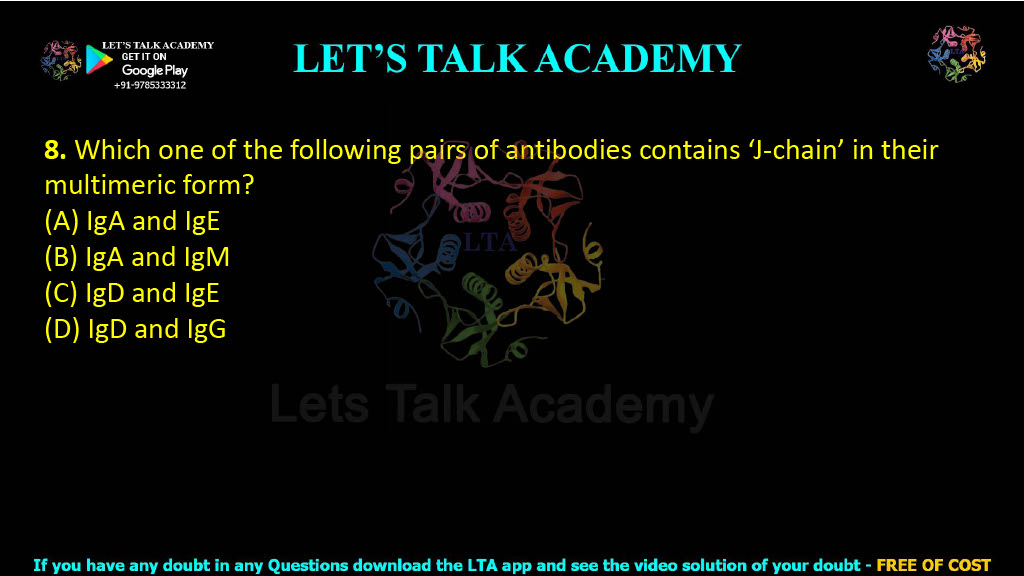
8. Which one of the following pairs of antibodies contains ‘J-chain’ in their multimeric form?
(A) IgA and IgE
(B) IgA and IgM
(C) IgD and IgE
(D) IgD and IgG
J Chain Containing Antibodies (IgA and IgM)
Introduction
Antibodies, also known as immunoglobulins, are glycoproteins produced by plasma cells that specifically recognize and neutralize foreign antigens. They play a central role in humoral immunity by eliminating bacteria, viruses, toxins, and other pathogens. Humans possess five major classes of immunoglobulins—IgG, IgA, IgM, IgD, and IgE—each having distinct structural characteristics, biological functions, and tissue distribution.
Among these antibody classes, only IgA and IgM exist naturally in multimeric forms. Their multimeric assembly requires a small polypeptide known as the Joining (J) chain. The J chain is synthesized by plasma cells and plays an essential role in polymerization, secretion, and transport of these antibodies across epithelial surfaces.
Correct Answer
Correct Option: (B) IgA and IgM
Detailed Explanation
The Joining chain (J chain) is a small glycoprotein consisting of approximately 15 kDa that is synthesized by plasma cells. It is responsible for linking individual immunoglobulin monomers to form polymeric antibodies. The J chain is present only in the multimeric forms of IgA and IgM.
Secretory IgA usually exists as a dimer composed of two IgA monomers joined together by one J chain. This J chain is essential for binding the polymeric immunoglobulin receptor (pIgR), allowing IgA to be transported across epithelial cells into secretions such as saliva, tears, mucus, colostrum, and intestinal fluid. The secretory component acquired during this transport protects IgA from enzymatic degradation.
IgM is normally secreted as a pentamer consisting of five IgM monomers connected through disulfide bonds and a single J chain. The pentameric structure gives IgM ten potential antigen-binding sites, making it highly efficient in agglutination and activation of the classical complement pathway.
In contrast, IgG, IgD, and IgE exist predominantly as monomers and therefore do not contain a J chain.
Explanation of Each Option
Option (A): IgA and IgE
This statement is incorrect. IgA contains a J chain only in its secretory dimeric form. However, IgE is a monomeric antibody involved in allergic reactions and defense against parasitic infections. Since IgE does not polymerize, it does not contain a J chain.
Option (B): IgA and IgM
This statement is correct. Both IgA and IgM require the J chain for multimer formation. Dimeric IgA contains one J chain, whereas pentameric IgM also contains one J chain that stabilizes the polymeric antibody structure.
Option (C): IgD and IgE
This statement is incorrect. Both IgD and IgE are monomeric immunoglobulins. Neither undergoes polymerization, and therefore neither contains a J chain.
Option (D): IgD and IgG
This statement is incorrect. IgD and IgG are monomeric antibodies. Although IgG is the most abundant antibody in serum and IgD functions mainly as a B-cell receptor, neither contains a J chain.
Why Option (B) is Correct
The J chain is specifically associated with polymeric immunoglobulins. Secretory IgA forms a dimer, while IgM forms a pentamer. In both cases, the J chain links antibody monomers together and facilitates their biological functions, particularly mucosal transport in the case of IgA.
Why the Other Options are Incorrect
Why Option (A) is Incorrect
IgE is a monomeric antibody and therefore lacks a J chain.
Why Option (C) is Incorrect
Neither IgD nor IgE forms multimers, so both lack the J chain.
Why Option (D) is Incorrect
IgG and IgD remain monomeric under physiological conditions and do not require a J chain.
Comparison of All Options
| Option | Antibody Pair | Contains J Chain? | Correct or Incorrect |
|---|---|---|---|
| A | IgA and IgE | Only IgA | Incorrect |
| B | IgA and IgM | Both | Correct |
| C | IgD and IgE | Neither | Incorrect |
| D | IgD and IgG | Neither | Incorrect |
Structure of Human Immunoglobulins
| Immunoglobulin | Structure | J Chain Present? | Main Function |
|---|---|---|---|
| IgG | Monomer | No | Secondary immune response, placental immunity |
| IgA | Dimer (secretory form) | Yes | Mucosal immunity |
| IgM | Pentamer | Yes | Primary immune response and complement activation |
| IgD | Monomer | No | B-cell receptor |
| IgE | Monomer | No | Allergic reactions and parasite defense |
Functions of the J Chain
| Function | Importance |
|---|---|
| Polymerization | Joins IgA and IgM monomers together |
| Stabilization | Maintains multimeric antibody structure |
| Epithelial Transport | Allows IgA binding to polymeric Ig receptor (pIgR) |
| Mucosal Immunity | Facilitates secretion of IgA into body fluids |
Biological Significance of the J Chain
The J chain is essential for the biological activity of polymeric antibodies. In IgM, it contributes to pentamer formation, enabling efficient agglutination and strong activation of the complement system. In IgA, the J chain allows binding to the polymeric immunoglobulin receptor, enabling transport across epithelial cells into mucosal secretions. Secretory IgA then protects mucosal surfaces such as the gastrointestinal, respiratory, and genitourinary tracts against microbial invasion. Thus, the J chain is indispensable for effective mucosal immunity and early humoral immune responses.
Final Answer
Correct Option: (B) IgA and IgM
The J chain is present only in the multimeric forms of IgA and IgM. It links antibody monomers together, stabilizes polymeric antibodies, and facilitates epithelial transport of secretory IgA. Therefore, the correct antibody pair containing the J chain is IgA and IgM.


