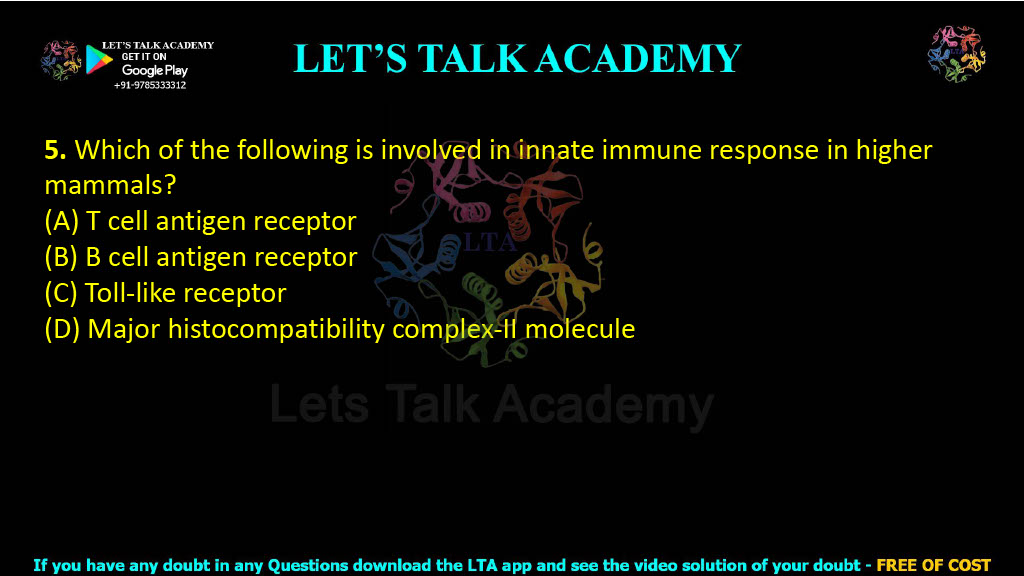
5. Which of the following is involved in innate immune response in higher mammals?
(A) T cell antigen receptor
(B) B cell antigen receptor
(C) Toll-like receptor
(D) Major histocompatibility complex-II molecule
Toll-Like Receptors (TLRs) in Innate Immunity
Introduction
The immune system protects the body against invading microorganisms through two major defense mechanisms: innate immunity and adaptive immunity. Innate immunity serves as the first line of defense and responds rapidly to invading pathogens without requiring prior exposure. Adaptive immunity, on the other hand, develops more slowly but provides highly specific responses and long-lasting immunological memory.
A key feature of innate immunity is the presence of Pattern Recognition Receptors (PRRs), which detect conserved molecular structures known as Pathogen-Associated Molecular Patterns (PAMPs). Among these receptors, Toll-like Receptors (TLRs) are the best-characterized PRRs. They recognize bacterial, viral, fungal, and parasitic components and rapidly activate inflammatory and antimicrobial responses.
Correct Answer
Correct Option: (C) Toll-like Receptor
Detailed Explanation
Toll-like receptors (TLRs) are transmembrane proteins that function as Pattern Recognition Receptors (PRRs). They recognize conserved microbial molecules called Pathogen-Associated Molecular Patterns (PAMPs), such as bacterial lipopolysaccharide (LPS), flagellin, viral double-stranded RNA, unmethylated CpG DNA, and fungal cell wall components. Unlike adaptive immune receptors, Toll-like receptors do not recognize unique antigens but instead detect common molecular signatures shared by many pathogens.
After recognizing a pathogen, Toll-like receptors activate intracellular signaling pathways involving adaptor proteins such as MyD88 and TRIF. These pathways stimulate transcription factors including NF-κB and IRFs, resulting in the production of inflammatory cytokines, interferons, chemokines, and antimicrobial molecules. Consequently, TLRs initiate the innate immune response and help activate adaptive immunity by stimulating antigen-presenting cells.
Since Toll-like receptors respond immediately without prior sensitization and recognize conserved microbial molecules, they are considered hallmark receptors of innate immunity.
Explanation of Each Option
Option (A): T Cell Antigen Receptor (TCR)
This statement is incorrect. The T-cell receptor is a highly specific receptor expressed on T lymphocytes. It recognizes peptide antigens presented by Major Histocompatibility Complex (MHC) molecules and functions exclusively in the adaptive immune response. TCR diversity is generated through V(D)J gene rearrangement, allowing recognition of an enormous variety of specific antigens.
Option (B): B Cell Antigen Receptor (BCR)
This statement is incorrect. The B-cell receptor is a membrane-bound immunoglobulin that specifically binds foreign antigens. Like the T-cell receptor, it belongs to the adaptive immune system and undergoes gene rearrangement to generate highly diverse antigen specificity. It is not a component of innate immunity.
Option (C): Toll-Like Receptor (TLR)
This statement is correct. Toll-like receptors are Pattern Recognition Receptors that detect conserved microbial structures and rapidly activate innate immune responses. They are expressed by macrophages, dendritic cells, neutrophils, epithelial cells, and several other immune cells. Activation of TLRs induces cytokine production, inflammation, phagocytosis, and antimicrobial defense.
Option (D): Major Histocompatibility Complex-II (MHC-II) Molecule
This statement is incorrect. MHC class II molecules present processed extracellular peptide antigens to CD4+ helper T cells. Although MHC-II participates in immune activation, its principal role is in antigen presentation during the adaptive immune response rather than innate pathogen recognition.
Why Option (C) is Correct
Toll-like receptors are specialized receptors of the innate immune system that recognize conserved microbial molecules immediately after infection. Their activation initiates inflammatory responses and bridges innate and adaptive immunity by activating antigen-presenting cells. Therefore, Toll-like receptors are the correct answer.
Why the Other Options are Incorrect
Why Option (A) is Incorrect
T-cell receptors recognize specific peptide-MHC complexes and function only in adaptive immunity.
Why Option (B) is Incorrect
B-cell receptors recognize specific antigens and mediate antibody responses as part of adaptive immunity.
Why Option (D) is Incorrect
MHC class II molecules present antigens to helper T cells but do not directly recognize pathogens as innate immune receptors.
Comparison of All Options
| Option | Molecule | Immune System | Correct or Incorrect |
|---|---|---|---|
| A | T Cell Antigen Receptor | Adaptive Immunity | Incorrect |
| B | B Cell Antigen Receptor | Adaptive Immunity | Incorrect |
| C | Toll-Like Receptor | Innate Immunity | Correct |
| D | MHC Class II Molecule | Adaptive Immunity | Incorrect |
Major Components of Innate and Adaptive Immunity
| Component | Immune System | Main Function |
|---|---|---|
| Toll-Like Receptors (TLRs) | Innate | Recognize PAMPs and initiate inflammation |
| T Cell Receptors (TCRs) | Adaptive | Recognize peptide-MHC complexes |
| B Cell Receptors (BCRs) | Adaptive | Recognize specific antigens |
| MHC Class II Molecules | Adaptive | Present extracellular antigens to CD4+ T cells |
Important Toll-Like Receptors and Their Ligands
| TLR | Recognized Molecule | Source |
|---|---|---|
| TLR2 | Peptidoglycan, lipoproteins | Gram-positive bacteria |
| TLR3 | Double-stranded RNA | Viruses |
| TLR4 | Lipopolysaccharide (LPS) | Gram-negative bacteria |
| TLR5 | Flagellin | Bacterial flagella |
| TLR9 | Unmethylated CpG DNA | Bacteria and viruses |
Biological Significance of Toll-Like Receptors
Toll-like receptors are indispensable for the early detection of invading pathogens. They activate macrophages, dendritic cells, neutrophils, and epithelial cells, leading to the production of inflammatory cytokines, interferons, and antimicrobial peptides. TLR signaling also enhances antigen presentation and stimulates adaptive immune responses, thereby providing an essential link between innate and adaptive immunity. Defects in TLR signaling increase susceptibility to infections, whereas excessive activation contributes to autoimmune diseases and chronic inflammatory disorders.
Final Answer
Correct Option: (C) Toll-Like Receptor
Toll-like receptors (TLRs) are Pattern Recognition Receptors of the innate immune system that recognize conserved microbial molecules and rapidly activate immune responses. Unlike T-cell receptors, B-cell receptors, and MHC class II molecules, which participate mainly in adaptive immunity, TLRs provide the first line of defense against invading pathogens.


