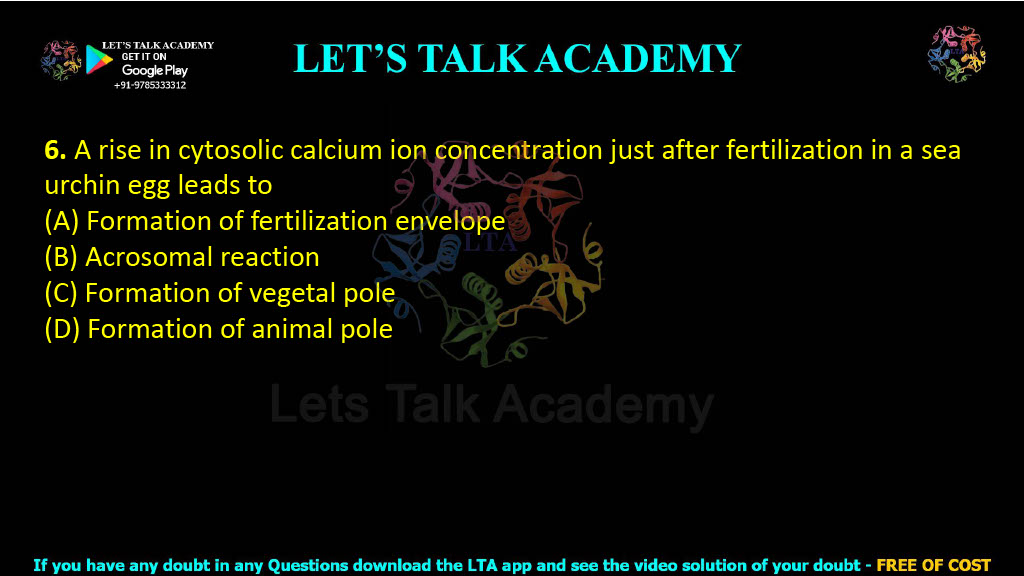
6. A rise in cytosolic calcium ion concentration just after fertilization in a sea urchin egg leads to
(A) Formation of fertilization envelope
(B) Acrosomal reaction
(C) Formation of vegetal pole
(D) Formation of animal pole
Rise in Cytosolic Calcium After Fertilization in Sea Urchin Egg
Introduction
Fertilization is the process through which a sperm cell fuses with an egg cell to form a diploid zygote. This event not only restores the diploid chromosome number but also activates the egg to begin embryonic development. One of the earliest and most important intracellular events following sperm entry is a rapid increase in the concentration of cytosolic calcium ions (Ca2+). This calcium wave acts as a universal second messenger that initiates numerous biochemical and structural changes required for successful fertilization.
In sea urchins, fertilization has been extensively studied because the eggs are large, transparent, and develop externally. Following sperm-egg fusion, a calcium wave spreads throughout the egg cytoplasm within seconds. This rise in intracellular calcium triggers exocytosis of cortical granules, modifies the vitelline layer, and results in the formation of the fertilization envelope, which prevents additional sperm from entering the egg.
Correct Answer
Correct Option: (A) Formation of Fertilization Envelope
Detailed Explanation
Immediately after a sperm fuses with a sea urchin egg, phospholipase C becomes activated, resulting in the production of inositol 1,4,5-trisphosphate (IP3). IP3 stimulates the release of calcium ions from the endoplasmic reticulum into the egg cytoplasm. The resulting calcium wave spreads rapidly throughout the egg and serves as the primary signal for egg activation.
The elevated calcium concentration triggers the cortical reaction, during which cortical granules located beneath the plasma membrane undergo exocytosis. Enzymes and glycoproteins released from these granules modify the vitelline layer, causing it to lift away from the plasma membrane and form the fertilization envelope. This envelope acts as a permanent block to polyspermy by preventing additional sperm from penetrating the egg.
Besides forming the fertilization envelope, the calcium wave also activates protein synthesis, stimulates DNA replication, initiates metabolic activity, and prepares the egg for cleavage divisions. However, the immediate and characteristic consequence of the calcium rise in sea urchin eggs is the formation of the fertilization envelope.
Explanation of Each Option
Option (A): Formation of Fertilization Envelope
This statement is correct. The increase in intracellular calcium initiates cortical granule exocytosis, leading to elevation of the vitelline layer and formation of the fertilization envelope. This process establishes the slow block to polyspermy and protects the developing embryo from fertilization by additional sperm.
Option (B): Acrosomal Reaction
This statement is incorrect. The acrosomal reaction occurs in the sperm before fusion with the egg. Contact between sperm and egg jelly induces exocytosis of the acrosome, releasing enzymes that help the sperm penetrate the egg coverings. Since this reaction occurs before fertilization, it is not triggered by the calcium increase inside the egg.
Option (C): Formation of Vegetal Pole
This statement is incorrect. The vegetal pole is established during oogenesis before fertilization. It represents the region rich in yolk and developmental determinants. The calcium wave after fertilization does not create the vegetal pole.
Option (D): Formation of Animal Pole
This statement is incorrect. The animal pole is also established during oocyte development prior to fertilization. It contains the nucleus and exhibits relatively less yolk than the vegetal pole. Fertilization-induced calcium signaling does not determine animal pole formation.
Why Option (A) is Correct
The rapid rise in cytosolic calcium concentration activates cortical granule exocytosis, which modifies the egg surface and produces the fertilization envelope. This structural barrier prevents polyspermy and is considered the hallmark event immediately following calcium release in sea urchin fertilization.
Why the Other Options are Incorrect
Why Option (B) is Incorrect
The acrosomal reaction occurs in the sperm before sperm-egg fusion and is independent of the calcium wave inside the egg.
Why Option (C) is Incorrect
The vegetal pole is established during oogenesis, long before fertilization takes place.
Why Option (D) is Incorrect
The animal pole is determined during egg formation and is not produced by calcium signaling after fertilization.
Comparison of All Options
| Option | Event | Occurs Due to Post-Fertilization Calcium Rise? | Correct or Incorrect |
|---|---|---|---|
| A | Formation of Fertilization Envelope | Yes | Correct |
| B | Acrosomal Reaction | No | Incorrect |
| C | Formation of Vegetal Pole | No | Incorrect |
| D | Formation of Animal Pole | No | Incorrect |
Sequence of Events During Sea Urchin Fertilization
| Step | Major Event |
|---|---|
| 1 | Sperm binds to egg jelly coat |
| 2 | Acrosomal reaction occurs |
| 3 | Sperm fuses with egg plasma membrane |
| 4 | Intracellular calcium wave spreads through egg |
| 5 | Cortical granules undergo exocytosis |
| 6 | Fertilization envelope is formed |
| 7 | Egg activation and first cleavage begin |
Functions of the Calcium Wave After Fertilization
| Function | Importance |
|---|---|
| Cortical granule exocytosis | Initiates cortical reaction |
| Formation of fertilization envelope | Prevents polyspermy |
| Activation of protein synthesis | Supports embryonic development |
| Initiation of DNA replication | Prepares for first cell division |
| Activation of metabolism | Supports rapid embryonic growth |
Biological Significance of the Fertilization Envelope
The fertilization envelope is essential for ensuring monospermy, allowing only one sperm to fertilize the egg. Without this protective barrier, multiple sperm could enter the egg, producing abnormal chromosome numbers and nonviable embryos. The calcium-triggered cortical reaction therefore represents one of the most critical protective mechanisms during fertilization and early embryonic development.
Final Answer
Correct Option: (A) Formation of Fertilization Envelope
The rapid rise in cytosolic calcium concentration immediately after fertilization triggers the cortical reaction, causing cortical granules to release their contents and convert the vitelline layer into the fertilization envelope. This envelope forms the permanent block to polyspermy and is the characteristic immediate response of the sea urchin egg following fertilization.


