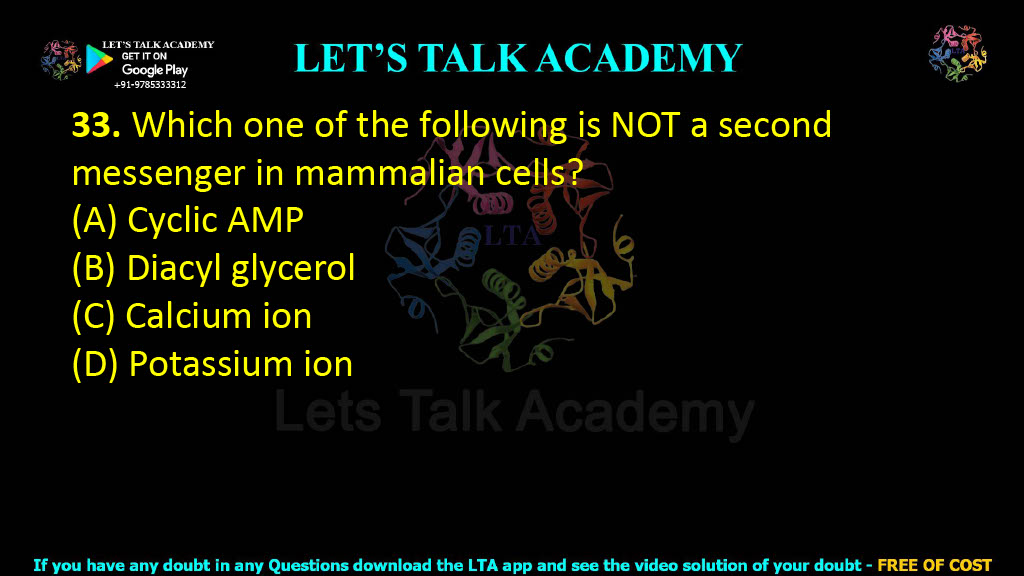
33. Which one of the following is NOT a second messenger in mammalian cells?
(A) Cyclic AMP
(B) Diacyl glycerol
(C) Calcium ion
(D) Potassium ion
Second Messengers in Mammalian Cells
Introduction
Cells constantly receive signals from hormones, neurotransmitters, growth factors, cytokines, and other extracellular molecules. However, these signaling molecules usually cannot cross the plasma membrane. Instead, they bind to specific cell surface receptors that initiate intracellular signaling pathways. The information carried by the extracellular signal is then transmitted inside the cell through small intracellular signaling molecules known as second messengers.
Second messengers amplify and distribute signals throughout the cell, allowing a single receptor activation event to produce a large biological response. The major second messengers in mammalian cells include cyclic AMP (cAMP), cyclic GMP (cGMP), inositol 1,4,5-trisphosphate (IP3), diacylglycerol (DAG), and calcium ions (Ca2+). These molecules regulate numerous cellular processes such as gene expression, metabolism, muscle contraction, secretion, neurotransmission, apoptosis, and cell proliferation.
Correct Answer
Correct Option: (D) Potassium Ion
Detailed Explanation
Second messengers are intracellular molecules generated or released after activation of cell surface receptors. Their primary function is to relay and amplify extracellular signals inside the cell. Among the best-known second messengers are cyclic AMP (cAMP), cyclic GMP (cGMP), inositol trisphosphate (IP3), diacylglycerol (DAG), and calcium ions (Ca2+).
Potassium ions (K+) are essential for maintaining the resting membrane potential, regulating nerve impulse conduction, controlling muscle contraction, and maintaining osmotic balance. However, potassium ions do not function as intracellular second messengers in classical signal transduction pathways. Therefore, potassium ion is the only option that is not classified as a second messenger.
Explanation of Each Option
Option (A): Cyclic AMP (cAMP)
This statement is incorrect because cyclic AMP is a classical second messenger. It is synthesized from ATP by adenylyl cyclase following activation of G protein-coupled receptors (GPCRs). cAMP activates Protein Kinase A (PKA), regulates gene expression through CREB, and controls glycogen metabolism, hormone action, and numerous physiological processes.
Option (B): Diacyl Glycerol (DAG)
This statement is incorrect because DAG is an important lipid-derived second messenger. It is produced when phospholipase C cleaves phosphatidylinositol 4,5-bisphosphate (PIP2) into DAG and IP3. DAG remains within the plasma membrane and activates Protein Kinase C (PKC), regulating cell growth, differentiation, secretion, and immune responses.
Option (C): Calcium Ion (Ca2+)
This statement is incorrect because calcium ion is one of the most versatile second messengers in mammalian cells. Intracellular calcium concentration rises after stimulation by IP3, opening calcium channels on the endoplasmic reticulum. Calcium subsequently regulates muscle contraction, neurotransmitter release, enzyme activation, fertilization, apoptosis, gene expression, and many other cellular functions.
Option (D): Potassium Ion (K+)
This statement is correct. Potassium ions are essential for maintaining membrane potential, nerve conduction, cardiac rhythm, and osmotic balance, but they are not recognized as second messengers in intracellular signaling pathways. Unlike calcium ions, potassium ions do not act as intracellular signaling molecules that relay receptor-generated signals.
Why Option (D) is Correct
Potassium ions participate primarily in maintaining electrical properties of cells rather than transmitting intracellular signaling cascades. In contrast, cAMP, DAG, and calcium ions directly mediate intracellular communication following receptor activation. Therefore, potassium ion is correctly identified as the molecule that is not a second messenger.
Why the Other Options are Incorrect
Why Option (A) is Incorrect
cAMP is one of the first discovered and most extensively studied second messengers. It activates Protein Kinase A and regulates numerous metabolic and transcriptional pathways.
Why Option (B) is Incorrect
DAG functions together with IP3 following phospholipase C activation and plays a central role in Protein Kinase C signaling.
Why Option (C) is Incorrect
Calcium ion serves as a universal intracellular second messenger controlling diverse physiological processes in nearly every mammalian cell.
Comparison of All Options
| Option | Molecule | Second Messenger? | Major Function |
|---|---|---|---|
| A | Cyclic AMP (cAMP) | Yes | Activates Protein Kinase A |
| B | Diacylglycerol (DAG) | Yes | Activates Protein Kinase C |
| C | Calcium Ion (Ca2+) | Yes | Regulates numerous intracellular processes |
| D | Potassium Ion (K+) | No | Maintains membrane potential |
Major Second Messengers in Mammalian Cells
| Second Messenger | Generated By | Primary Target |
|---|---|---|
| cAMP | Adenylyl cyclase | Protein Kinase A |
| cGMP | Guanylyl cyclase | Protein Kinase G |
| IP3 | Phospholipase C | Calcium release from ER |
| DAG | Phospholipase C | Protein Kinase C |
| Ca2+ | ER calcium channels and extracellular influx | Calmodulin and numerous enzymes |
Comparison Between Calcium and Potassium Ions
| Feature | Calcium Ion (Ca2+) | Potassium Ion (K+) |
|---|---|---|
| Acts as Second Messenger | Yes | No |
| Major Function | Intracellular signaling | Membrane potential maintenance |
| Concentration Change | Rapid transient increase after signaling | Maintained for electrical balance |
| Role in Signal Transduction | Direct intracellular signaling | Not a classical signaling molecule |
Biological Significance of Second Messengers
Second messengers allow cells to amplify extracellular signals rapidly and efficiently. A single activated receptor can generate thousands of second messenger molecules, leading to activation of protein kinases, transcription factors, metabolic enzymes, and ion channels. These signaling pathways regulate virtually every aspect of cellular physiology, including metabolism, growth, differentiation, secretion, neuronal communication, immune responses, and apoptosis.
Final Answer
Correct Option: (D) Potassium Ion
Among the given options, potassium ion (K+) is not a second messenger. In contrast, cyclic AMP (cAMP), diacylglycerol (DAG), and calcium ions (Ca2+) are well-established intracellular second messengers that transmit and amplify extracellular signals to regulate numerous cellular processes.


