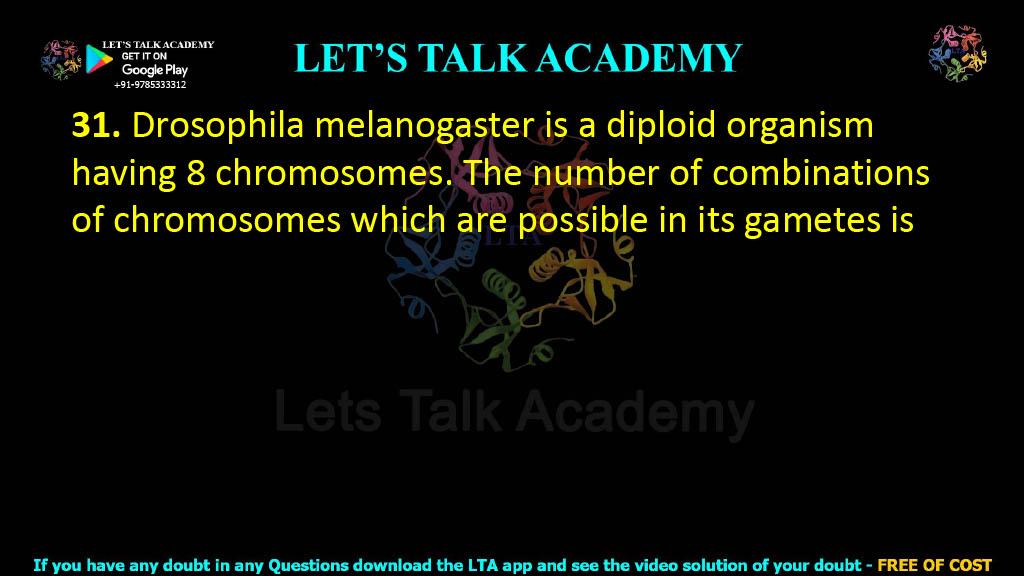
31. Drosophila melanogaster is a diploid organism having 8 chromosomes. The number of combinations of chromosomes which are possible in its gametes is
Number of Chromosome Combinations in Drosophila Gametes
Introduction
One of the most important consequences of meiosis is the production of genetically diverse gametes. During meiosis I, homologous chromosomes separate independently into daughter cells, generating numerous combinations of maternal and paternal chromosomes. This phenomenon, known as independent assortment, was first described by Gregor Mendel and later explained by the behavior of chromosomes during meiosis.
The number of possible chromosome combinations produced through independent assortment depends entirely on the number of homologous chromosome pairs present in a diploid organism. The greater the number of chromosome pairs, the larger the number of genetically distinct gametes that can be produced even before crossing over is considered.
Correct Answer
Correct Answer: 16 Combinations
Formula Used: Number of chromosome combinations = 2n
Where n = haploid chromosome number (number of homologous chromosome pairs).
Step-by-Step Solution
Drosophila melanogaster has a diploid chromosome number of 2n = 8.
Therefore, the haploid chromosome number is:
n = 8 ÷ 2 = 4
The total number of chromosome combinations produced due to independent assortment is calculated using the formula:
Number of combinations = 2n
Substituting the value:
= 24
= 16
Thus, Drosophila melanogaster can produce 16 different chromosomal combinations in its gametes due to independent assortment alone.
Detailed Explanation
Drosophila possesses four pairs of homologous chromosomes. During metaphase I of meiosis, each homologous pair aligns independently of every other pair. At anaphase I, one chromosome from each homologous pair moves toward each pole. Since each chromosome pair has two equally probable orientations, every pair contributes two possible outcomes.
Because the orientation of one chromosome pair does not influence the orientation of another, the total number of combinations is obtained by multiplying the possibilities for each chromosome pair.
For Drosophila:
2 × 2 × 2 × 2 = 24 = 16
This calculation includes only independent assortment. In reality, genetic diversity is even greater because homologous chromosomes also undergo crossing over during prophase I, generating additional recombinant chromosomes.
Why the Answer is 16
The diploid chromosome number of Drosophila is eight, meaning there are four homologous chromosome pairs. Since each pair segregates independently during meiosis I, the total number of chromosomal combinations equals 2 raised to the power of the haploid chromosome number.
Therefore:
24 = 16
Formula for Chromosome Combinations
| Parameter | Formula |
|---|---|
| Diploid chromosome number | 2n |
| Haploid chromosome number | n = Diploid number ÷ 2 |
| Number of gamete combinations | 2n |
Calculation for Drosophila melanogaster
| Feature | Value |
|---|---|
| Diploid chromosome number (2n) | 8 |
| Haploid chromosome number (n) | 4 |
| Formula | 2n |
| Total chromosome combinations | 24 = 16 |
Examples in Different Organisms
| Organism | Diploid Number (2n) | Haploid Number (n) | Possible Gamete Combinations |
|---|---|---|---|
| Drosophila melanogaster | 8 | 4 | 16 |
| Maize | 20 | 10 | 1,024 |
| Pea Plant | 14 | 7 | 128 |
| Human | 46 | 23 | 223 = 8,388,608 |
Independent Assortment and Genetic Variation
Independent assortment ensures that maternal and paternal chromosomes are distributed randomly into gametes. As a result, siblings inherit different combinations of chromosomes even when they have the same parents. When this process is combined with crossing over and random fertilization, it produces enormous genetic diversity within populations, which serves as the raw material for natural selection and evolution.
Difference Between Independent Assortment and Crossing Over
| Feature | Independent Assortment | Crossing Over |
|---|---|---|
| Occurs During | Metaphase I and Anaphase I | Prophase I |
| Mechanism | Random segregation of homologous chromosomes | Exchange of chromosome segments |
| Produces | Different chromosome combinations | Recombinant chromosomes |
| Formula | 2n | No fixed mathematical formula |
Biological Significance
Independent assortment is one of the primary mechanisms responsible for genetic variation in sexually reproducing organisms. Even without crossing over, each meiotic division produces genetically unique gametes because homologous chromosome pairs segregate independently. This variation increases adaptability, enhances survival of populations under changing environmental conditions, and provides the genetic diversity required for evolution.
Final Answer
Correct Answer: 16 Combinations
Drosophila melanogaster has a diploid chromosome number of 8 (2n = 8), which means it possesses 4 homologous chromosome pairs (n = 4). According to Mendel’s Law of Independent Assortment, the number of possible chromosome combinations in gametes is calculated using the formula 2n. Therefore, the total number of chromosomal combinations produced is 24 = 16.


