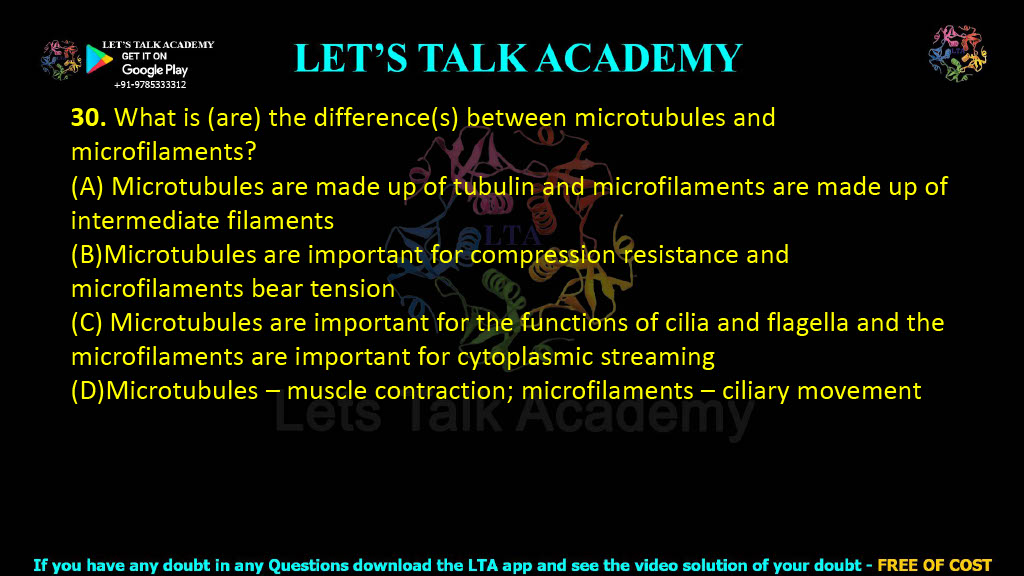
30. What is (are) the difference(s) between microtubules and microfilaments?
(A) Microtubules are made up of tubulin and microfilaments are made up of intermediate filaments
(B)Microtubules are important for compression resistance and microfilaments bear tension
(C) Microtubules are important for the functions of cilia and flagella and the microfilaments are important for cytoplasmic streaming
(D)Microtubules – muscle contraction; microfilaments – ciliary movement
Difference Between Microtubules and Microfilaments
Introduction
The cytoskeleton is a dynamic network of protein filaments that provides structural support, maintains cell shape, facilitates intracellular transport, enables cell movement, and participates in chromosome segregation during cell division. It is composed of three major filament systems: microtubules, microfilaments (actin filaments), and intermediate filaments. Each component has a distinct molecular composition and performs specialized cellular functions.
Correct Answer
Correct Option: (B) and (C)
Detailed Explanation
Microtubules and microfilaments perform distinct but complementary roles within the cytoskeleton. Microtubules are hollow tubes composed of α- and β-tubulin dimers. They provide rigidity, resist compressive forces, form the mitotic spindle, participate in intracellular transport, and constitute the structural framework of cilia and flagella.
Microfilaments, also known as actin filaments, are composed of globular actin (G-actin) polymerized into filamentous actin (F-actin). They provide tensile strength, participate in muscle contraction, cytokinesis, amoeboid movement, cell migration, microvilli formation, and cytoplasmic streaming in plant cells.
Therefore, the statements describing compression resistance by microtubules and tension-bearing by microfilaments, as well as the roles of microtubules in cilia and flagella and microfilaments in cytoplasmic streaming, are both correct.
Explanation of Each Option
Option (A): Microtubules are Made Up of Tubulin and Microfilaments are Made Up of Intermediate Filaments
This statement is incorrect. The first part is correct because microtubules are composed of α- and β-tubulin dimers. However, the second part is incorrect because microfilaments are composed of actin, not intermediate filaments. Intermediate filaments constitute an entirely separate cytoskeletal system composed of proteins such as keratin, vimentin, desmin, neurofilaments, and lamins.
Option (B): Microtubules are Important for Compression Resistance and Microfilaments Bear Tension
This statement is correct. Microtubules possess high rigidity and function as compression-resistant elements that prevent cellular collapse. In contrast, actin microfilaments are flexible structures that resist tensile forces generated during cell movement, muscle contraction, cytokinesis, and maintenance of cell shape.
Option (C): Microtubules are Important for the Functions of Cilia and Flagella and Microfilaments are Important for Cytoplasmic Streaming
This statement is correct. Cilia and flagella possess a characteristic 9+2 arrangement of microtubules, and dynein-driven microtubule sliding generates their beating movement. Cytoplasmic streaming in plant cells depends primarily on actin microfilaments interacting with myosin motor proteins, facilitating intracellular transport of organelles and nutrients.
Option (D): Microtubules – Muscle Contraction; Microfilaments – Ciliary Movement
This statement is incorrect. Muscle contraction is mediated by interactions between actin microfilaments and myosin, whereas ciliary and flagellar movement depends on microtubules and dynein. Therefore, the functions listed in this option are reversed.
Why Options (B) and (C) are Correct
Microtubules serve as rigid structural elements that resist compression and provide the framework for cilia, flagella, and the mitotic spindle. Microfilaments provide tensile strength and are essential for cytoplasmic streaming, cell movement, cytokinesis, and muscle contraction. These functional differences distinguish the two cytoskeletal systems.
Why the Other Options are Incorrect
Why Option (A) is Incorrect
Microfilaments are composed of actin proteins rather than intermediate filament proteins.
Why Option (D) is Incorrect
The biological functions are interchanged. Muscle contraction requires actin microfilaments, whereas ciliary and flagellar movement requires microtubules and dynein.
Comparison of All Options
| Option | Statement | Correct or Incorrect | Reason |
|---|---|---|---|
| A | Microfilaments are made of intermediate filaments. | Incorrect | Microfilaments are composed of actin. |
| B | Microtubules resist compression and microfilaments bear tension. | Correct | Represents the mechanical roles of the cytoskeleton. |
| C | Microtubules function in cilia and flagella; microfilaments function in cytoplasmic streaming. | Correct | Accurately describes their physiological functions. |
| D | Microtubules perform muscle contraction; microfilaments perform ciliary movement. | Incorrect | The functions are reversed. |
Comparison Between Microtubules and Microfilaments
| Feature | Microtubules | Microfilaments |
|---|---|---|
| Major Protein | α- and β-Tubulin | Actin |
| Diameter | Approximately 25 nm | Approximately 7 nm |
| Mechanical Role | Compression resistance | Tension bearing |
| Motor Protein | Kinesin and Dynein | Myosin |
| Major Functions | Mitotic spindle, intracellular transport, cilia and flagella | Muscle contraction, cytokinesis, cell migration, cytoplasmic streaming |
Functions of the Three Cytoskeletal Components
| Cytoskeletal Component | Major Protein | Main Functions |
|---|---|---|
| Microtubules | Tubulin | Chromosome movement, intracellular transport, cilia, flagella |
| Microfilaments | Actin | Muscle contraction, cytokinesis, cell motility, cytoplasmic streaming |
| Intermediate Filaments | Keratin, Vimentin, Desmin, Lamins | Mechanical strength and structural stability |
Biological Significance of Microtubules and Microfilaments
Microtubules and microfilaments cooperate to maintain cellular architecture and coordinate numerous physiological processes. Microtubules organize the intracellular transport system, position organelles, assemble the mitotic spindle, and drive ciliary and flagellar movement. Microfilaments generate mechanical force required for muscle contraction, cytokinesis, phagocytosis, wound healing, cell migration, and cytoplasmic streaming. Together, these cytoskeletal elements enable cells to grow, divide, move, and respond dynamically to environmental changes.
Final Answer
Correct Option: (B) and (C)
Microtubules are rigid tubulin-based structures that resist compression and form the structural framework of cilia and flagella. Microfilaments are actin-based filaments that bear tensile forces and are responsible for muscle contraction, cytokinesis, cell motility, and cytoplasmic streaming. Therefore, statements (B) and (C) correctly describe the differences between microtubules and microfilaments.


