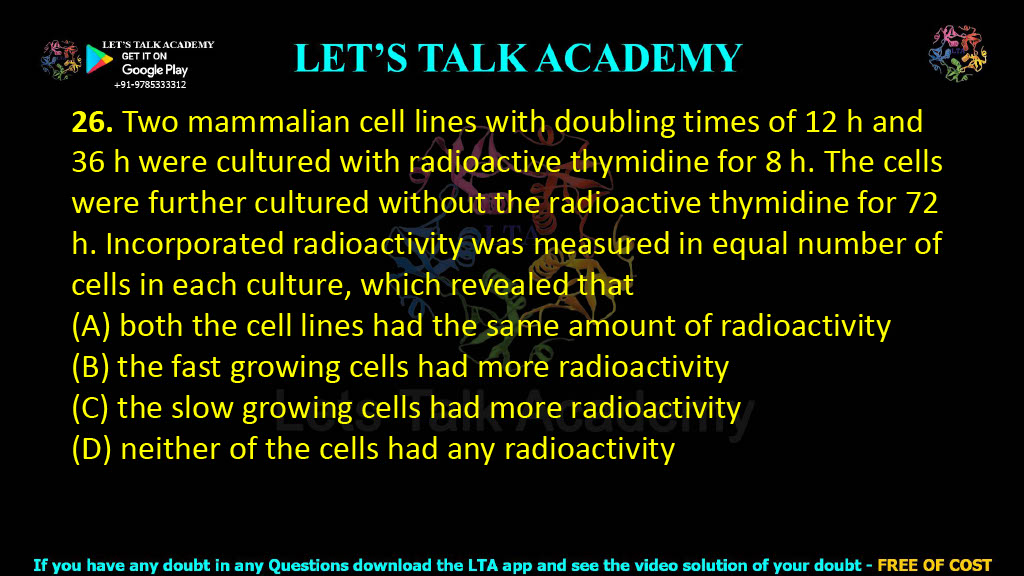
26. Two mammalian cell lines with doubling times of 12 h and 36 h were cultured with radioactive thymidine for 8 h. The cells were further cultured without the radioactive thymidine for 72 h. Incorporated radioactivity was measured in equal number of cells in each culture, which revealed that
(A) both the cell lines had the same amount of radioactivity
(B) the fast growing cells had more radioactivity
(C) the slow growing cells had more radioactivity
(D) neither of the cells had any radioactivity
Radioactive Thymidine Labeling and Cell Doubling Time
Introduction
Radioactive thymidine labeling is one of the most widely used experimental techniques for studying DNA replication, cell proliferation, and cell cycle kinetics. Since thymidine is incorporated exclusively into newly synthesized DNA during the S phase, radioactive forms such as 3H-thymidine (tritiated thymidine) or 14C-thymidine act as highly specific markers of DNA synthesis. By exposing cells to radioactive thymidine for a defined period (pulse) and then growing them in non-radioactive medium (chase), researchers can follow the movement and dilution of labeled DNA through successive rounds of cell division.
The amount of radioactivity remaining in cells after several generations depends primarily on the number of cell divisions that occur during the chase period. Every time a labeled cell divides, the radioactive DNA is distributed equally between the two daughter cells, causing the radioactivity per cell to decrease by approximately one-half with each division. Consequently, rapidly dividing cells dilute the radioactive label much faster than slowly dividing cells.
Correct Answer
Correct Option: (C) The slow-growing cells had more radioactivity.
Detailed Explanation
During the initial 8-hour incubation, cells that enter the S phase incorporate radioactive thymidine into newly synthesized DNA. After this pulse, the radioactive thymidine is removed and replaced with normal, non-radioactive thymidine for the next 72 hours. During this chase period, DNA replication continues using non-radioactive nucleotides.
The crucial concept is that radioactive DNA is inherited by daughter cells during cell division. Each mitotic division distributes the labeled DNA equally between two daughter cells, reducing the radioactivity present in each individual cell. Therefore, cells that divide more frequently dilute the radioactive label much more rapidly than cells that divide slowly.
The fast-growing cell line has a doubling time of 12 hours. During the 72-hour chase period, these cells complete approximately 6 rounds of cell division (72 ÷ 12 = 6). After six divisions, the radioactive label is divided among many generations of daughter cells, greatly reducing the radioactivity measured in each individual cell.
The slow-growing cell line has a doubling time of 36 hours. During the same 72-hour chase period, these cells undergo only about 2 rounds of cell division (72 ÷ 36 = 2). Since the radioactive DNA has been diluted only twice, each cell retains a much larger amount of radioactive thymidine.
Consequently, when equal numbers of cells are analyzed after 72 hours, the slow-growing cell population exhibits a higher level of radioactivity than the rapidly dividing cell population.
Explanation of Each Option
Option (A): Both the Cell Lines Had the Same Amount of Radioactivity
This statement is incorrect. Although both cell lines initially incorporate radioactive thymidine during the pulse period, the extent of radioactive label retained after the chase depends on how many times the cells divide. Since the two cell lines have very different doubling times, they cannot retain equal radioactivity after 72 hours.
Option (B): The Fast-Growing Cells Had More Radioactivity
This statement is incorrect. Fast-growing cells divide more frequently, causing repeated dilution of radioactive DNA among daughter cells. After multiple rounds of mitosis, each cell contains much less radioactivity than a slowly dividing cell.
Option (C): The Slow-Growing Cells Had More Radioactivity
This statement is correct. Slow-growing cells undergo fewer rounds of DNA replication and mitosis during the chase period. Because radioactive DNA is diluted fewer times, each cell retains a greater proportion of the original radioactive thymidine incorporated during the pulse. Therefore, equal numbers of slow-growing cells exhibit higher radioactivity.
Option (D): Neither of the Cells Had Any Radioactivity
This statement is incorrect. Radioactive thymidine becomes permanently incorporated into DNA during the S phase. Although repeated cell division dilutes the radioactive label, it does not eliminate it completely after only 72 hours. Therefore, both cell populations still contain measurable radioactivity.
Why Option (C) is Correct
The radioactive DNA synthesized during the pulse is inherited by daughter cells throughout successive cell divisions. Since the fast-growing cell line divides approximately six times whereas the slow-growing cell line divides only twice, the radioactive label becomes much more diluted in the rapidly proliferating cells. Consequently, the slow-growing cells retain more radioactivity per cell and produce a stronger radioactive signal.
Why the Other Options are Incorrect
Why Option (A) is Incorrect
The number of cell divisions differs substantially between the two cell lines, producing different levels of radioactive label dilution.
Why Option (B) is Incorrect
Rapid proliferation causes repeated dilution of radioactive DNA, resulting in lower—not higher—radioactivity per cell.
Why Option (D) is Incorrect
Radioactive thymidine incorporated into DNA remains detectable even after several rounds of cell division because the label is diluted rather than destroyed.
Comparison of All Options
| Option | Statement | Correct or Incorrect | Reason |
|---|---|---|---|
| A | Both cell lines have equal radioactivity. | Incorrect | Different doubling times produce different degrees of label dilution. |
| B | Fast-growing cells retain more radioactivity. | Incorrect | Frequent divisions dilute radioactive DNA more rapidly. |
| C | Slow-growing cells retain more radioactivity. | Correct | Fewer divisions result in less dilution of labeled DNA. |
| D | No radioactivity remains. | Incorrect | Radioactivity is diluted but not completely eliminated. |
Radioactivity Dilution During Cell Division
| Cell Line | Doubling Time | Divisions in 72 Hours | Radioactivity per Cell |
|---|---|---|---|
| Fast-growing | 12 hours | 6 divisions | Very Low |
| Slow-growing | 36 hours | 2 divisions | High |
Principle of the Pulse-Chase Experiment
| Step | Purpose |
|---|---|
| Pulse | Radioactive thymidine labels DNA synthesized during the S phase. |
| Chase | Non-radioactive thymidine replaces radioactive thymidine, allowing tracking of labeled DNA. |
| Cell Division | Radioactive DNA is equally inherited by daughter cells. |
| Measurement | Remaining radioactivity reflects the number of cell divisions. |
Biological Significance of Radioactive Thymidine Labeling
Radioactive thymidine labeling has been instrumental in understanding DNA replication, stem cell biology, embryonic development, cancer cell proliferation, tissue regeneration, and cell cycle kinetics. Pulse-chase experiments enable researchers to determine the duration of different cell cycle phases, identify rapidly proliferating tissues, measure DNA synthesis rates, and trace the fate of dividing cells over time. Although radioactive methods have largely been complemented by BrdU and EdU labeling techniques, the underlying principles remain fundamental in modern cell biology.
Final Answer
Correct Option: (C) The slow-growing cells had more radioactivity.
Because radioactive thymidine is incorporated into DNA only during the pulse period, subsequent cell divisions dilute the radioactive label among daughter cells. The fast-growing cell line undergoes many more divisions during the 72-hour chase, resulting in much greater dilution of radioactivity. The slow-growing cell line divides fewer times and therefore retains significantly more radioactive DNA per cell.


