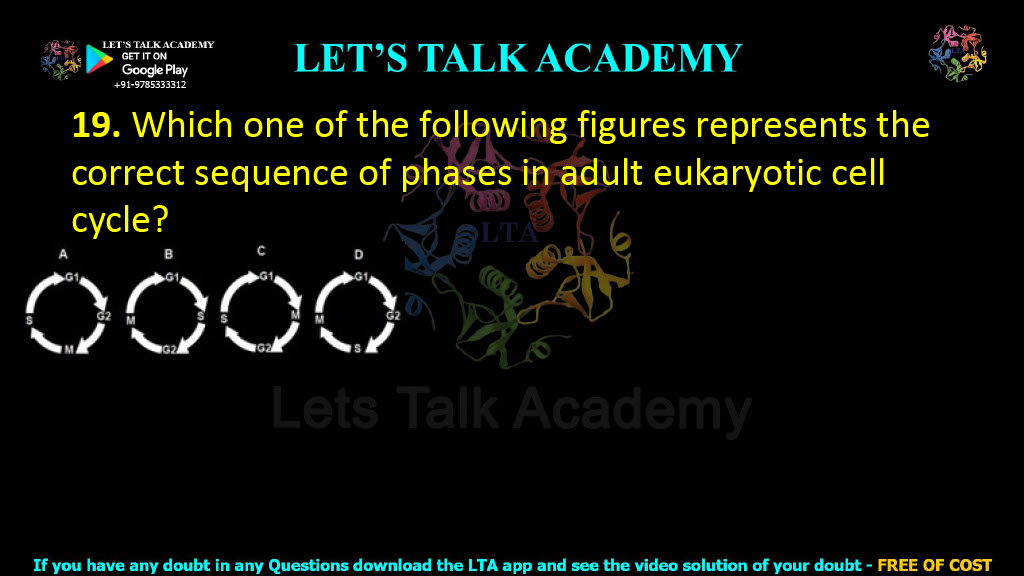
19. Which one of the following figures represents the correct sequence of phases in adult eukaryotic cell cycle?
Correct Sequence of Phases in the Adult Eukaryotic Cell Cycle
Introduction
The eukaryotic cell cycle is a carefully regulated sequence of events that allows a cell to grow, replicate its DNA, and divide into two genetically identical daughter cells. Every dividing somatic cell follows a specific order of phases so that DNA replication occurs only once during each cycle and chromosomes are accurately distributed during mitosis.
Correct Answer
Correct Option: (B)
Detailed Explanation
The normal sequence of the eukaryotic cell cycle is G1 → S → G2 → M. The cell first enters the G1 phase, where it increases in size, synthesizes RNA and proteins, duplicates organelles, and prepares for DNA replication. Once the G1 checkpoint confirms that growth conditions are favorable and DNA is undamaged, the cell enters the S phase.
During the S phase, DNA replication takes place, producing identical sister chromatids for every chromosome. After DNA synthesis is completed, the cell progresses into the G2 phase, where it synthesizes proteins required for mitosis, repairs any remaining DNA damage, and prepares the spindle apparatus. Finally, the cell enters the M phase, during which mitosis and cytokinesis produce two genetically identical daughter cells.
Among the four diagrams provided, only Figure B correctly represents the sequence G1 → S → G2 → M.
Explanation of Each Option
Option (A)
This figure is incorrect because it shows the sequence G1 → G2 → M → S. The G2 phase cannot occur immediately after G1 because DNA replication during the S phase must occur before the cell enters G2. Therefore, this sequence violates the normal order of the eukaryotic cell cycle.
Option (B)
This figure is correct. It accurately represents the sequence G1 → S → G2 → M. This is the universally accepted order followed by proliferating eukaryotic cells. Cell growth occurs first, followed by DNA replication, preparation for mitosis, and finally chromosome segregation and cytokinesis.
Option (C)
This figure is incorrect because it represents the sequence G1 → M → G2 → S. Mitosis cannot occur immediately after G1 because DNA replication must first be completed during the S phase. Likewise, G2 always occurs before mitosis rather than after it.
Option (D)
This figure is incorrect because it represents the sequence G1 → G2 → S → M. The G2 phase is a post-replication stage and therefore cannot occur before the S phase. DNA synthesis must always precede G2.
Why Option (B) is Correct
Option (B) correctly illustrates the normal progression of the eukaryotic cell cycle. Cells begin with growth and metabolic preparation during G1, duplicate their DNA during the S phase, prepare for mitosis during G2, and finally divide during the M phase. This sequence ensures faithful transmission of genetic material to both daughter cells.
Comparison of All Options
| Option | Sequence Shown | Correct or Incorrect | Reason |
|---|---|---|---|
| A | G1 → G2 → M → S | Incorrect | G2 cannot occur before DNA replication. |
| B | G1 → S → G2 → M | Correct | Represents the normal eukaryotic cell cycle. |
| C | G1 → M → G2 → S | Incorrect | Mitosis cannot occur before DNA replication. |
| D | G1 → G2 → S → M | Incorrect | G2 always follows the S phase. |
Functions of Each Phase of the Cell Cycle
| Phase | Major Events |
|---|---|
| G1 Phase | Cell growth, protein synthesis, RNA synthesis, organelle duplication, G1 checkpoint |
| S Phase | DNA replication, chromosome duplication, histone synthesis |
| G2 Phase | DNA repair, spindle protein synthesis, preparation for mitosis, G2 checkpoint |
| M Phase | Mitosis and cytokinesis resulting in two daughter cells |
Major Cell Cycle Checkpoints
| Checkpoint | Main Function |
|---|---|
| G1/S Checkpoint | Checks cell size, nutrients, growth factors, and DNA damage before DNA replication. |
| G2/M Checkpoint | Ensures DNA replication is complete and DNA damage has been repaired. |
| Spindle Assembly Checkpoint | Verifies proper chromosome attachment before sister chromatid separation. |
Biological Significance of the Correct Cell Cycle Sequence
The sequence G1 → S → G2 → M ensures that each cell grows adequately before DNA replication, duplicates its genome only once, repairs replication errors before mitosis, and equally distributes chromosomes to daughter cells. This precise order maintains genomic stability and prevents mutations that could lead to developmental abnormalities or cancer.
Final Answer
Correct Option: (B)
The correct sequence of phases in the adult eukaryotic cell cycle is G1 → S → G2 → M. Figure B accurately represents this order, beginning with cell growth, followed by DNA replication, preparation for mitosis, and finally cell division.


