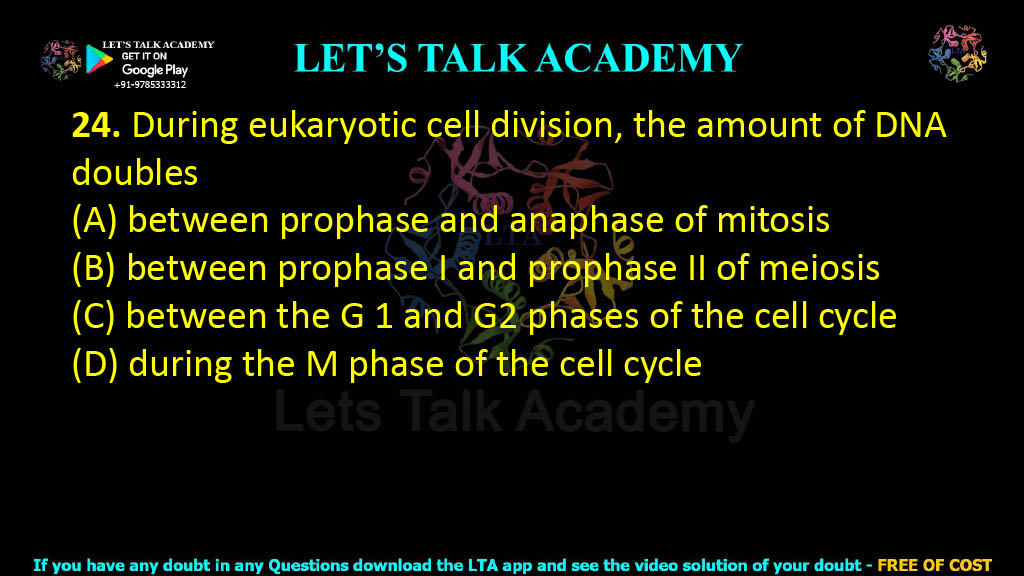
24. During eukaryotic cell division, the amount of DNA doubles
(A) between prophase and anaphase of mitosis
(B) between prophase I and prophase II of meiosis
(C) between the G 1 and G2 phases of the cell cycle
(D) during the M phase of the cell cycle
DNA Doubling During the Eukaryotic Cell Cycle
Introduction
The eukaryotic cell cycle is a precisely regulated sequence of events that ensures accurate duplication and distribution of genetic material from one generation of cells to the next. Every dividing cell must replicate its DNA exactly once before mitosis or meiosis so that each daughter cell receives a complete set of chromosomes. Failure to duplicate DNA correctly can lead to mutations, chromosomal abnormalities, genomic instability, developmental defects, and cancer.
The cell cycle consists of four major phases: G1 (Gap 1), S (Synthesis), G2 (Gap 2), and M (Mitosis). Among these phases, DNA replication occurs exclusively during the S phase, which lies between G1 and G2. As DNA replication proceeds, the amount of DNA in the nucleus doubles, although the chromosome number remains unchanged because each chromosome now consists of two identical sister chromatids.
Correct Answer
Correct Option: (C) Between the G1 and G2 phases of the cell cycle
Detailed Explanation
DNA replication occurs exclusively during the S (Synthesis) phase of interphase. The S phase is positioned between the G1 and G2 phases, making Option (C) the correct answer. During this stage, DNA polymerases synthesize an identical copy of every chromosome, producing two sister chromatids joined together at the centromere.
At the beginning of the G1 phase, a diploid cell contains a normal amount of DNA, represented as 2C. During the S phase, DNA replication doubles the DNA content to 4C, while the chromosome number remains 2n because sister chromatids are still attached. The G2 phase follows DNA replication and serves primarily for DNA repair, synthesis of mitotic proteins, and preparation for mitosis. No additional DNA replication occurs during G2 or M phase.
Therefore, DNA doubling occurs during the interval between G1 and G2, specifically in the S phase.
Explanation of Each Option
Option (A): Between Prophase and Anaphase of Mitosis
This statement is incorrect. Mitosis is responsible for separating already duplicated chromosomes into two daughter cells. Between prophase and anaphase, chromosomes condense, align at the metaphase plate, and sister chromatids separate. DNA replication has already been completed before mitosis begins, so no increase in DNA content occurs during this interval.
Option (B): Between Prophase I and Prophase II of Meiosis
This statement is incorrect. DNA replication occurs only once before meiosis I. There is no S phase between meiosis I and meiosis II. After prophase I and completion of meiosis I, cells proceed toward meiosis II without another round of DNA synthesis. Therefore, DNA content does not double between prophase I and prophase II.
Option (C): Between the G1 and G2 Phases of the Cell Cycle
This statement is correct. The S phase lies between G1 and G2 and is the only phase during which DNA replication occurs. Every chromosome is duplicated to form two sister chromatids, doubling the total DNA content while maintaining the same chromosome number.
Option (D): During the M Phase of the Cell Cycle
This statement is incorrect. The M phase includes mitosis and cytokinesis, during which duplicated chromosomes are distributed equally between two daughter cells. DNA synthesis does not occur during mitosis. Instead, the DNA content per daughter cell decreases as chromosomes are partitioned into separate nuclei.
Why Option (C) is Correct
The S phase is located between G1 and G2 and is exclusively dedicated to DNA synthesis. During this phase, every chromosome replicates, doubling the total DNA content from 2C to 4C. Since no DNA replication occurs during mitosis or meiosis II, Option (C) correctly identifies the interval during which DNA doubles.
Why the Other Options are Incorrect
Why Option (A) is Incorrect
Prophase through anaphase represents chromosome segregation, not DNA synthesis. DNA replication is completed before mitosis begins.
Why Option (B) is Incorrect
There is no DNA replication between meiosis I and meiosis II. Meiosis II begins directly after meiosis I without an intervening S phase.
Why Option (D) is Incorrect
The M phase distributes duplicated DNA into daughter cells rather than increasing the amount of DNA present within the cell.
Comparison of All Options
| Option | Statement | Correct or Incorrect | Reason |
|---|---|---|---|
| A | Between prophase and anaphase of mitosis | Incorrect | Chromosome segregation occurs, not DNA replication. |
| B | Between prophase I and prophase II of meiosis | Incorrect | No S phase occurs between meiosis I and meiosis II. |
| C | Between G1 and G2 phases | Correct | S phase occurs between G1 and G2 where DNA replication takes place. |
| D | During M phase | Incorrect | Mitosis separates chromosomes instead of replicating DNA. |
DNA Content During the Cell Cycle
| Phase | Chromosome Number | DNA Content | Major Event |
|---|---|---|---|
| G1 | 2n | 2C | Cell growth and preparation for DNA replication |
| S | 2n | 2C → 4C | DNA replication and sister chromatid formation |
| G2 | 2n | 4C | Preparation for mitosis and DNA repair |
| M | 2n | 4C → 2C per daughter cell | Chromosome segregation and cytokinesis |
Comparison Between DNA Replication and Chromosome Segregation
| Feature | DNA Replication | Chromosome Segregation |
|---|---|---|
| Occurs During | S Phase | M Phase |
| Main Purpose | Duplicate DNA molecules | Separate sister chromatids |
| DNA Polymerase Required | Yes | No |
| Spindle Apparatus Required | No | Yes |
| DNA Content | Doubles | Distributed equally to daughter cells |
Biological Significance of DNA Doubling
DNA replication during the S phase ensures that every daughter cell receives a complete and identical genome after cell division. High-fidelity DNA polymerases, proofreading enzymes, and checkpoint proteins minimize replication errors and maintain genomic stability. Accurate DNA duplication is essential for growth, tissue repair, embryonic development, and inheritance of genetic information across generations.
Final Answer
Correct Option: (C) Between the G1 and G2 phases of the cell cycle
DNA doubles during the S phase, which occurs between the G1 and G2 phases of interphase. During this period, every chromosome replicates to form two identical sister chromatids, increasing the DNA content from 2C to 4C while maintaining the same chromosome number.


