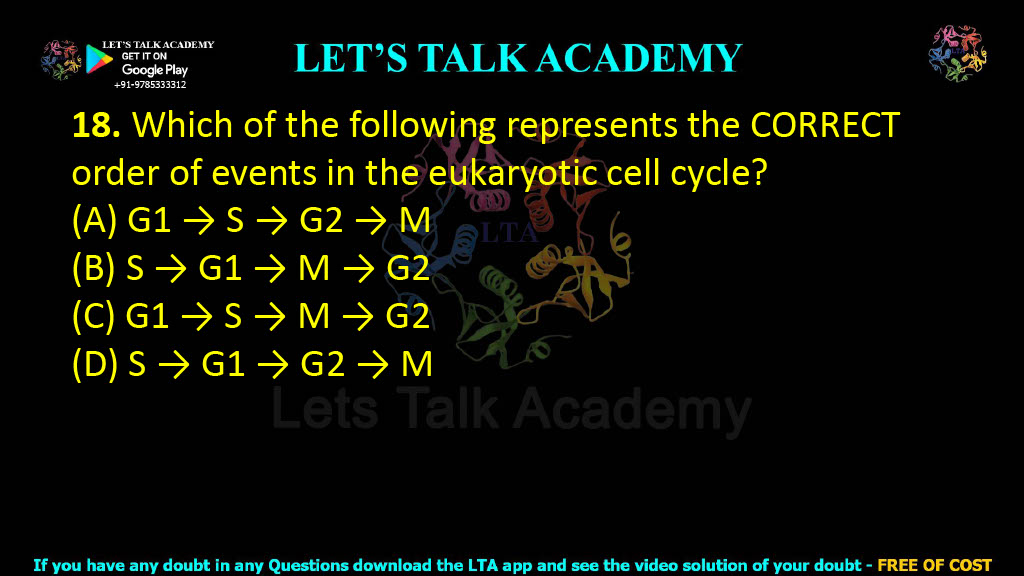
18. Which of the following represents the CORRECT order of events in the eukaryotic cell cycle?
(A) G1 → S → G2 → M
(B) S → G1 → M → G2
(C) G1 → S → M → G2
(D) S → G1 → G2 → M
Eukaryotic Cell Cycle: Correct Order of G1, S, G2 and M Phases
Introduction
The eukaryotic cell cycle is a highly organized sequence of events that enables cells to grow, duplicate their genetic material, and divide into two genetically identical daughter cells. Proper progression through the cell cycle is essential for growth, tissue repair, embryonic development, and maintenance of normal cellular function. Every stage of the cell cycle is tightly regulated by cyclins, cyclin-dependent kinases (CDKs), checkpoint proteins, and signaling pathways that ensure DNA is accurately replicated and faithfully transmitted to daughter cells.
The cell cycle is broadly divided into Interphase and the M phase. Interphase occupies nearly 90% of the total cell cycle and consists of three sequential phases: G1 (Gap 1), S (Synthesis), and G2 (Gap 2).
Correct Answer
Correct Option: (A) G1 → S → G2 → M
Detailed Explanation
The eukaryotic cell cycle follows a precise sequence of phases to ensure that every daughter cell receives an identical set of chromosomes. The cycle begins with the G1 phase, during which the cell grows, synthesizes RNA and proteins, increases its organelle content, and prepares for DNA replication. Once the cell successfully passes the G1 checkpoint, it enters the S phase, where DNA replication occurs. During this stage, every chromosome is duplicated to produce two identical sister chromatids joined at the centromere.
After DNA synthesis is completed, the cell enters the G2 phase. During this period, the cell verifies that DNA replication has been completed accurately, repairs any remaining DNA damage, synthesizes proteins required for mitosis, and prepares the mitotic spindle apparatus. Finally, the cell enters the M phase, which includes mitosis and cytokinesis. During mitosis, duplicated chromosomes are equally segregated into two daughter nuclei, followed by division of the cytoplasm to produce two genetically identical daughter cells.
Therefore, the correct chronological order of the eukaryotic cell cycle is G1 → S → G2 → M.
Explanation of Each Option
Option (A): G1 → S → G2 → M
This statement is correct. The cell first grows during G1, then replicates its DNA during the S phase, prepares for mitosis during G2, and finally undergoes chromosome segregation and cell division during the M phase. This sequence ensures proper genome duplication and equal distribution of chromosomes to daughter cells.
Option (B): S → G1 → M → G2
This statement is incorrect. DNA replication cannot occur before the G1 growth phase because the cell must first synthesize the proteins, enzymes, nucleotides, and organelles required for DNA synthesis. Additionally, G2 always occurs before mitosis rather than after it.
Option (C): G1 → S → M → G2
This statement is incorrect. After DNA replication, the cell must pass through the G2 phase before entering mitosis. G2 provides time for DNA repair, synthesis of mitotic proteins, and activation of the G2/M checkpoint. Omitting G2 before mitosis would compromise chromosome segregation.
Option (D): S → G1 → G2 → M
This statement is incorrect. DNA replication cannot be the first event of the cell cycle because the cell must first grow and prepare during G1. Therefore, placing the S phase before G1 is biologically incorrect.
Why Option (A) is Correct
The sequence G1 → S → G2 → M accurately represents the normal progression of the eukaryotic cell cycle. Each phase prepares the cell for the next stage, ensuring accurate DNA replication, proper chromosome segregation, and successful formation of two genetically identical daughter cells. This order is universally conserved in proliferating eukaryotic cells.
Why the Other Options are Incorrect
Why Option (B) is Incorrect
The S phase cannot precede G1, and G2 cannot occur after mitosis. This sequence violates the normal order of cell cycle progression.
Why Option (C) is Incorrect
The G2 phase is essential before mitosis because it allows DNA repair and preparation of the mitotic machinery. Therefore, M phase cannot occur immediately after the S phase.
Why Option (D) is Incorrect
The G1 phase always precedes DNA synthesis. Cells must grow and prepare metabolically before initiating chromosome duplication.
Comparison of All Options
| Option | Sequence | Correct or Incorrect | Reason |
|---|---|---|---|
| A | G1 → S → G2 → M | Correct | Represents the normal eukaryotic cell cycle. |
| B | S → G1 → M → G2 | Incorrect | DNA replication cannot occur before G1; G2 must precede M. |
| C | G1 → S → M → G2 | Incorrect | G2 is essential before mitosis. |
| D | S → G1 → G2 → M | Incorrect | Cell growth must occur before DNA synthesis. |
Functions of Each Phase of the Cell Cycle
| Phase | Major Events |
|---|---|
| G1 Phase | Cell growth, RNA synthesis, protein synthesis, organelle duplication, G1 checkpoint |
| S Phase | DNA replication, chromosome duplication, histone synthesis |
| G2 Phase | DNA repair, spindle protein synthesis, preparation for mitosis, G2 checkpoint |
| M Phase | Mitosis and cytokinesis producing two daughter cells |
Major Cell Cycle Checkpoints
| Checkpoint | Main Function |
|---|---|
| G1/S Checkpoint | Checks cell size, nutrients, growth factors, and DNA damage |
| G2/M Checkpoint | Ensures DNA replication is complete and DNA damage is repaired |
| Spindle Assembly Checkpoint | Confirms proper attachment of chromosomes before anaphase |
Biological Significance of the Correct Cell Cycle Sequence
The orderly progression of G1, S, G2, and M phases ensures accurate transmission of genetic information from one generation of cells to the next. Each phase performs specialized functions that prepare the cell for subsequent events while multiple checkpoints monitor genomic integrity. Disruption of this sequence can result in DNA mutations, chromosomal instability, uncontrolled proliferation, or cancer. Therefore, strict regulation of the cell cycle is essential for normal development, tissue homeostasis, and organismal survival.
Final Answer
Correct Option: (A) G1 → S → G2 → M
The correct order of the eukaryotic cell cycle is G1 → S → G2 → M. During G1, the cell grows and prepares for DNA replication. The S phase duplicates the chromosomes, G2 prepares the cell for mitosis and verifies DNA integrity, and the M phase completes chromosome segregation and cytokinesis to produce two genetically identical daughter cells.


