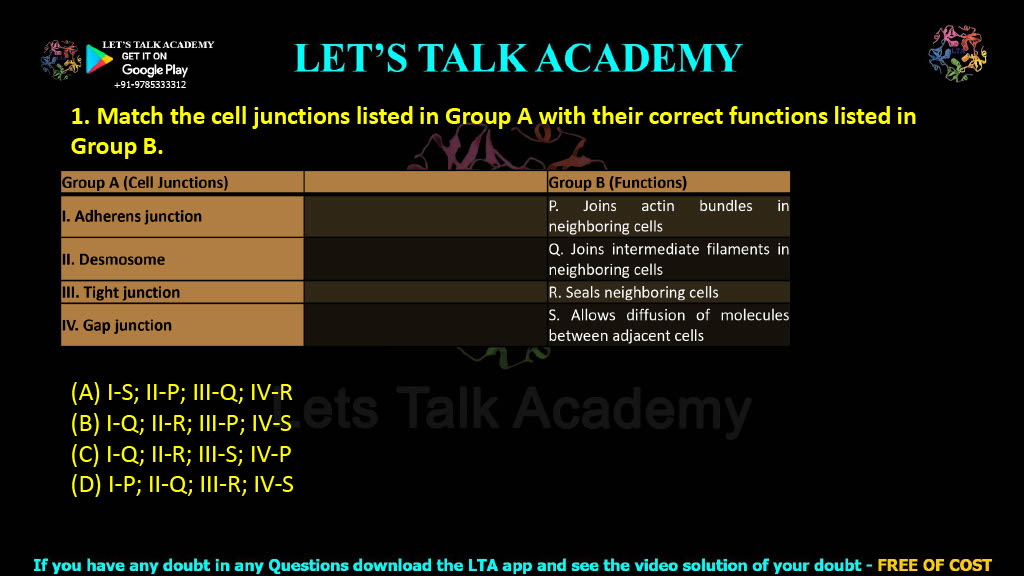
1. Match the cell junctions listed in Group A with their correct functions listed in Group B.
| Group A | Group B |
| (I) Adherens junction | (P) Joins actin bundles in neighboring cells |
| (II) Desmosome | (Q) Joins intermediate filaments in neighboring cells |
| (III) Tight junction | (R) Seals neighboring cells |
| (IV) Gap junction | (S) Allows diffusion of molecules between adjacent cells |
(A) I-S; II-P; III-Q; IV-R
(B) I-Q; II-R; III-P; IV-S
(C) I-Q; II-R; III-S; IV-P
(D) I-P; II-Q; III-R; IV-S
Cell Junctions and Their Functions: Complete Explanation of Adherens Junction, Desmosome, Tight Junction, and Gap Junction
Introduction
Cell junctions are specialized structures that connect neighboring cells in multicellular organisms. These junctions play an essential role in maintaining tissue architecture, providing mechanical strength, regulating the movement of molecules between cells, and enabling communication among adjacent cells. They are particularly abundant in epithelial tissues, where cells must remain tightly connected while carrying out functions such as protection, secretion, and absorption.
Correct Answer
Correct Option: (D)
I → P, II → Q, III → R, IV → S
Detailed Explanation
Cell junctions are specialized protein complexes that connect adjacent cells and help tissues function as a coordinated unit. Depending on their structure, each junction performs a unique role. Some junctions provide mechanical support by connecting cytoskeletal filaments between neighboring cells, whereas others prevent leakage between cells or permit direct communication through the exchange of ions and small molecules. The easiest way to answer this question is by remembering the cytoskeletal component or physiological function associated with each type of junction.
Understanding Each Cell Junction
Adherens Junction – Joins Actin Bundles in Neighboring Cells (P)
Adherens junctions are anchoring junctions that mechanically connect neighboring cells through bundles of actin microfilaments. These junctions are formed by calcium-dependent adhesion proteins known as cadherins. On the intracellular side, cadherins interact with proteins such as catenins and vinculin, which anchor them to the actin cytoskeleton. This arrangement provides flexibility while maintaining tissue integrity during cell movement, embryonic development, wound healing, and tissue remodeling. Since adherens junctions specifically connect actin filaments between adjacent cells, they correctly match with “Joins actin bundles in neighboring cells.”
Desmosome – Joins Intermediate Filaments in Neighboring Cells (Q)
Desmosomes are strong anchoring junctions that provide exceptional mechanical strength to tissues subjected to continuous physical stress, such as the skin and cardiac muscle. Unlike adherens junctions, desmosomes connect intermediate filaments rather than actin filaments. Their transmembrane proteins, desmogleins and desmocollins, belong to the cadherin family and attach to intracellular plaque proteins, which in turn anchor intermediate filaments like keratin. This strong linkage prevents neighboring cells from separating under mechanical stress. Therefore, desmosomes correctly correspond to the function of joining intermediate filaments in neighboring cells.
Tight Junction – Seals Neighboring Cells (R)
Tight junctions form continuous sealing belts around adjacent epithelial cells. Their primary function is to prevent the movement of water, ions, and dissolved molecules through the intercellular space, thereby maintaining selective permeability across epithelial tissues. Proteins such as claudins and occludins bring neighboring plasma membranes extremely close together, creating an effective seal. Tight junctions are particularly important in the intestinal epithelium, kidney tubules, and blood-brain barrier, where they regulate transport and preserve tissue polarity. Hence, tight junctions correctly match with the function of sealing neighboring cells.
Gap Junction – Allows Diffusion of Molecules Between Adjacent Cells (S)
Gap junctions are communication junctions that establish direct cytoplasmic channels between neighboring cells. Each channel is formed by paired connexons composed of connexin proteins. These channels allow ions, ATP, glucose, cyclic AMP, calcium ions, and other small signaling molecules to pass directly from one cell to another. Gap junctions enable rapid electrical and metabolic communication, making them particularly important in cardiac muscle, smooth muscle, and embryonic tissues. Therefore, gap junctions correctly correspond to allowing diffusion of molecules between adjacent cells.
Why Option (D) is Correct
Option (D) correctly matches every cell junction with its respective function. Adherens junctions connect actin filaments, desmosomes connect intermediate filaments, tight junctions create impermeable seals between neighboring cells, and gap junctions permit direct communication through the diffusion of ions and small molecules. Since every pairing is biologically accurate, Option (D) is the correct answer.
Why the Other Options are Incorrect
Why Option (A) is Incorrect
Option (A) incorrectly assigns the function of molecular diffusion to adherens junctions and associates desmosomes with actin bundles. In reality, gap junctions allow molecular diffusion, while adherens junctions specifically connect actin filaments. Tight junctions also do not connect intermediate filaments because their primary role is sealing adjacent cells. Therefore, every pairing in this option is incorrect.
Why Option (B) is Incorrect
Option (B) incorrectly matches adherens junctions with intermediate filaments and tight junctions with actin bundles. Adherens junctions always attach to actin filaments, whereas desmosomes are responsible for connecting intermediate filaments. Since multiple associations are biologically incorrect, this option cannot be the correct answer.
Why Option (C) is Incorrect
Option (C) incorrectly states that tight junctions allow diffusion of molecules and that gap junctions join actin bundles. Tight junctions actually prevent the passage of substances between neighboring cells, whereas gap junctions facilitate intercellular communication by allowing small molecules and ions to pass directly between adjacent cells. Therefore, this option is also incorrect.
Comparison of All Four Cell Junctions
| Cell Junction | Cytoskeleton Attached | Main Function | Major Proteins |
|---|---|---|---|
| Adherens Junction | Actin Filaments | Mechanical attachment between neighboring cells | Cadherins |
| Desmosome | Intermediate Filaments | Provides strong cell-to-cell adhesion | Desmogleins and Desmocollins |
| Tight Junction | Actin-associated proteins | Seals neighboring cells and prevents leakage | Claudins and Occludins |
| Gap Junction | No direct cytoskeletal attachment | Allows communication between adjacent cells | Connexins |
Biological Significance of Cell Junctions
Each type of cell junction performs a unique but complementary role in maintaining tissue organization and physiological function. Adherens junctions and desmosomes provide mechanical strength by linking the cytoskeletons of neighboring cells, ensuring tissues remain intact during stretching and movement. Tight junctions create selective barriers that regulate the passage of substances across epithelial layers, while gap junctions enable rapid intercellular communication through the exchange of ions and signaling molecules. Together, these junctions maintain tissue integrity, coordinate cellular activities, and support normal organ function.
Final Answer
Correct Option: (D)
Adherens Junction → Joins Actin Bundles in Neighboring Cells (P)
Desmosome → Joins Intermediate Filaments in Neighboring Cells (Q)
Tight Junction → Seals Neighboring Cells (R)
Gap Junction → Allows Diffusion of Molecules Between Adjacent Cells (S)


