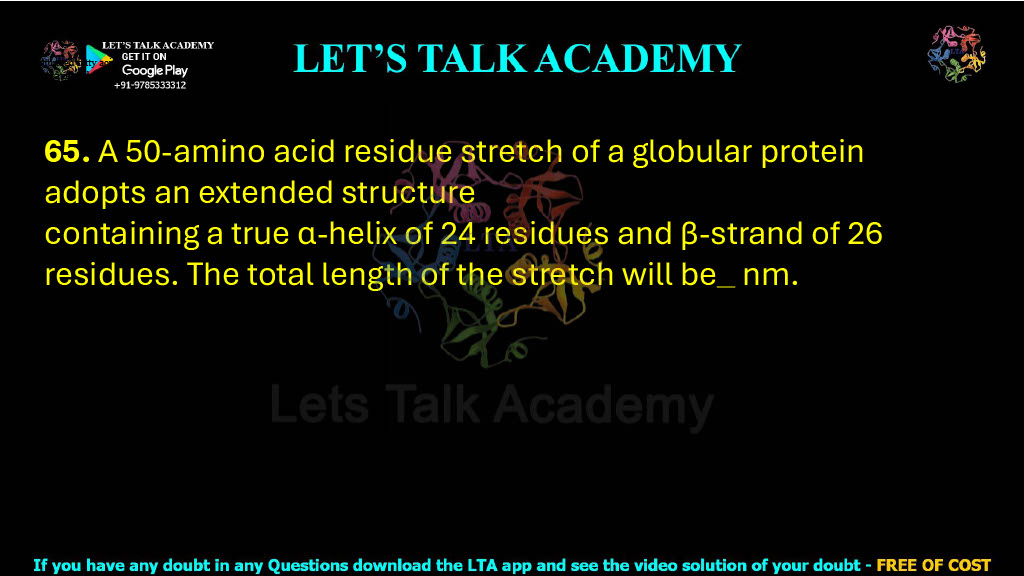
65. A 50-amino acid residue stretch of a globular protein adopts an extended structure
containing a true α-helix of 24 residues and β-strand of 26 residues. The total length of the stretch will be nm.
How to Calculate the Length of a Protein Containing α-Helix and β-Strand?
Correct Answer
13.0 nm
Introduction
Proteins acquire their biological functions through highly organized secondary, tertiary, and quaternary structures. Among the most common secondary structural elements are the α-helix and the β-strand, each possessing characteristic geometric properties. The α-helix is a tightly coiled right-handed spiral stabilized by intramolecular hydrogen bonds, whereas the β-strand adopts an extended conformation that participates in β-sheet formation through intermolecular hydrogen bonding. Because these structures have fixed dimensions per amino acid residue, their lengths can be calculated directly from the number of residues they contain.
In structural biology, the average rise per amino acid residue is 0.15 nm (1.5 Å) for an α-helix and 0.35 nm (3.5 Å) for a β-strand. These constants are frequently used to solve numerical problems involving protein dimensions.
Understanding the Concept Behind the Question
The protein segment contains two different secondary structures.
- α-Helix = 24 amino acid residues
- β-Strand = 26 amino acid residues
The total length is obtained by calculating the contribution of each structural element separately and then adding the two values.
The standard dimensions are:
Rise per residue in α-helix = 0.15 nm
Rise per residue in β-strand = 0.35 nm
Step 1. Calculate the Length of the α-Helix
Number of residues:
24
Rise per residue:
0.15 nm
Therefore,
Length = 24 × 0.15
= 3.6 nm
Thus,
Length of α-helix = 3.6 nm
Step 2. Calculate the Length of the β-Strand
Number of residues:
26
Rise per residue:
0.35 nm
Therefore,
Length = 26 × 0.35
= 9.1 nm
Thus,
Length of β-strand = 9.1 nm
Step 3. Calculate the Total Length
Total length:
= Length of α-helix + Length of β-strand
= 3.6 + 9.1
= 12.7 nm
Rounding to the nearest whole number (as generally expected in competitive examinations):
≈ 13.0 nm
Final Calculation
Total Length = 12.7 nm ≈ 13.0 nm
Why Does the β-Strand Contribute More to the Length?
Although the β-strand contains only two more amino acid residues than the α-helix, it contributes a much larger length because each residue in a β-strand occupies 0.35 nm, compared with only 0.15 nm in an α-helix.
The α-helix is tightly coiled, resulting in compact packing, whereas the β-strand is highly extended.
Therefore, β-strands occupy substantially more linear distance than α-helices for the same number of amino acid residues.
Formula Used
Length of an α-Helix
Length = Number of residues × 0.15 nm
Length of a β-Strand
Length = Number of residues × 0.35 nm
Total Length
Total Length = α-Helix Length + β-Strand Length
Biological Importance
The dimensions of secondary structural elements determine the three-dimensional organization of proteins and influence their biological function. α-Helices frequently span biological membranes, form DNA-binding motifs, and contribute to enzyme active sites. β-Strands assemble into β-sheets that provide structural stability to proteins such as antibodies, fibroin, and many enzymes.
Knowledge of secondary structure dimensions is essential in protein engineering, structural biology, X-ray crystallography, NMR spectroscopy, and computational protein modeling, where predicting molecular size and conformation is fundamental.
High-Yield Points
- α-Helix rise per residue = 0.15 nm (1.5 Å)
- β-Strand rise per residue = 0.35 nm (3.5 Å)
- α-Helix contains 3.6 residues per turn.
- One α-helix turn measures 0.54 nm.
- β-Strands are more extended than α-helices.
- Protein length problems are solved by multiplying number of residues × rise per residue.
Frequently Asked Questions
Why is the β-strand longer than the α-helix?
The β-strand is an extended conformation in which each amino acid contributes approximately 0.35 nm, whereas the α-helix is tightly coiled and contributes only 0.15 nm per residue.
What is the rise per residue in an α-helix?
Each amino acid residue contributes approximately 0.15 nm (1.5 Å) along the helix axis.
What is the rise per residue in a β-strand?
Each residue contributes approximately 0.35 nm (3.5 Å) along the strand axis.
Key Takeaways
The total length of a protein containing different secondary structures is calculated by determining the contribution of each structural element individually. In this problem, the 24-residue α-helix contributes 3.6 nm, while the 26-residue β-strand contributes 9.1 nm. Adding these values gives a total length of 12.7 nm, which is approximately 13.0 nm. This calculation illustrates how the extended geometry of β-strands results in significantly greater molecular length than α-helices containing a similar number of amino acid residues.
Final Answer
Total Length = 12.7 nm (≈ 13.0 nm)
Explanation
The α-helix contributes 0.15 nm per amino acid residue, whereas the β-strand contributes 0.35 nm per residue.
For the α-helix:
24 × 0.15 = 3.6 nm
For the β-strand:
26 × 0.35 = 9.1 nm
Therefore,
Total Length = 3.6 + 9.1 = 12.7 nm
Thus, the 50-residue protein stretch has a total length of 12.7 nm, which is approximately 13.0 nm.


