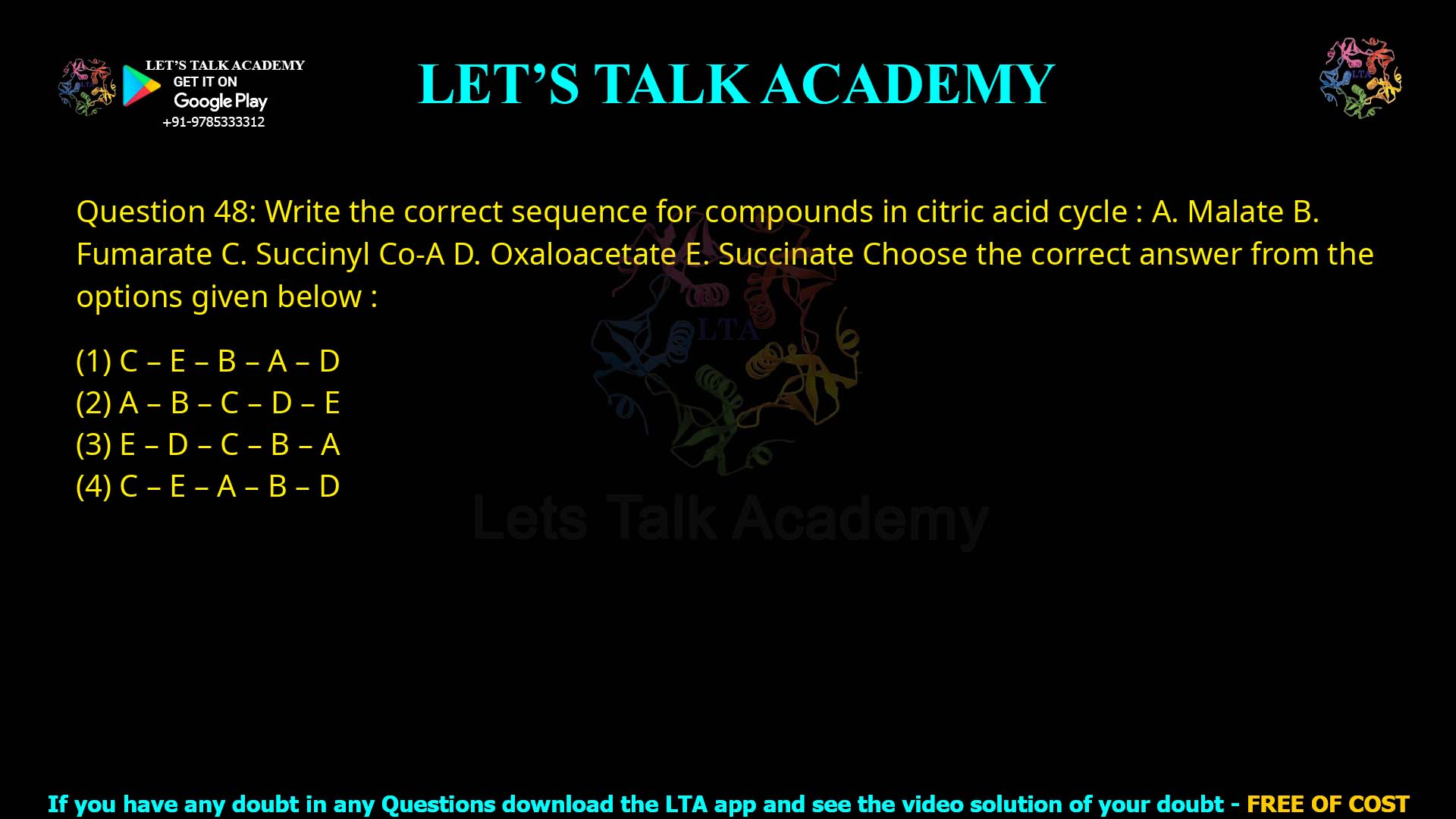
Q.48 Write the correct sequence for compounds in citric acid cycle :
- A. Malate
- B. Fumarate
- C. Succinyl Co-A
- D. Oxaloacetate
- E. Succinate
Choose the correct answer from the options given below :
- C – E – B – A – D
- A – B – C – D – E
- E – D – C – B – A
- C – E – A – B – D
The correct sequence of compounds in the citric acid cycle from the given options is C – E – B – A – D (Succinyl Co-A → Succinate → Fumarate → Malate → Oxaloacetate).
Question Breakdown
This multiple-choice question tests the order of key intermediates in the later half of the citric acid cycle (also known as the Krebs or TCA cycle), a central pathway in cellular respiration for oxidizing acetyl-CoA to produce energy carriers like NADH and FADH2.
Correct Sequence Explanation
The citric acid cycle proceeds as follows for these compounds:
-
Succinyl Co-A (C) forms first from alpha-ketoglutarate via alpha-ketoglutarate dehydrogenase; it then reacts with GDP and Pi to yield Succinate (E), CoA, and GTP.
-
Succinate (E) oxidizes to Fumarate (B) by succinate dehydrogenase, producing FADH2.
-
Fumarate (B) hydrates to Malate (A) via fumarase.
-
Malate (A) oxidizes to Oxaloacetate (D) by malate dehydrogenase, producing NADH and regenerating the cycle starter.
Thus, C – E – B – A – D matches this exact order.
Why Other Options Are Wrong
-
A – B – C – D – E (Malate → Fumarate → Succinyl Co-A → Oxaloacetate → Succinate): Reverses the flow; Fumarate follows, not precedes, Succinate.
-
E – D – C – B – A (Succinate → Oxaloacetate → Succinyl Co-A → Fumarate → Malate): Jumps illogically; Oxaloacetate is last, not after Succinate, and Succinyl Co-A precedes Succinate.
-
C – E – A – B – D (Succinyl Co-A → Succinate → Malate → Fumarate → Oxaloacetate): Swaps Malate and Fumarate; Malate forms from Fumarate, not before it.
The citric acid cycle sequence is a cornerstone of biochemistry, powering ATP production in mitochondria. This guide breaks down the correct sequence for compounds in citric acid cycle—focusing on Succinyl Co-A, Succinate, Fumarate, Malate, and Oxaloacetate—for students prepping for competitive exams.
Citric Acid Cycle Overview
The citric acid cycle (TCA/Krebs cycle) oxidizes acetyl-CoA through eight steps, generating 3 NADH, 1 FADH2, 1 GTP, and 2 CO2 per turn. Key four-carbon intermediates include those listed, cycling from oxaloacetate back to itself.
Step-by-Step Sequence (C-E-B-A-D)
-
Succinyl Co-A (C): Formed from alpha-ketoglutarate; substrate-level phosphorylation yields Succinate.
-
Succinate (E): Oxidized to Fumarate by succinate dehydrogenase (Complex II).
-
Fumarate (B): Hydrated to L-Malate by fumarase.
-
Malate (A): Oxidized to Oxaloacetate by malate dehydrogenase (NADH produced).
-
Oxaloacetate (D): Combines with acetyl-CoA to restart the cycle.
Compound Enzyme Product Energy Yield Succinyl Co-A (C) Succinyl-CoA synthetase Succinate (E) GTP Succinate (E) Succinate dehydrogenase Fumarate (B) FADH2 Fumarate (B) Fumarase Malate (A) None Malate (A) Malate dehydrogenase Oxaloacetate (D) NADH This citric acid cycle compounds sequence ensures efficient electron transfer to the ETC for oxidative phosphorylation.
-


