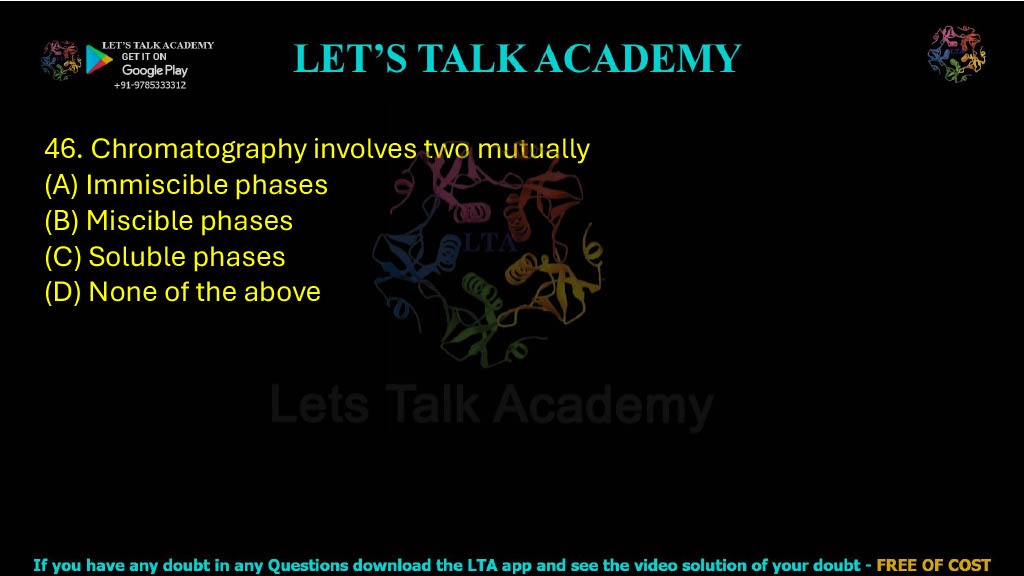
46. Chromatography involves two mutually:
A. Immiscible phases
B. Miscible phases
C. Soluble phases
D. None of the above
Correct Answer: A. Immiscible phases
Chromatography requires two phases that do not mix, allowing components to partition selectively between them for effective separation.
Option Analysis
A. Immiscible phases (Correct)
Chromatography fundamentally uses one stationary phase and one mobile phase that are immiscible, meaning they do not dissolve into each other. This creates a stable interface where mixture components distribute based on differential affinities, enabling purification and analysis. Examples include water (stationary in paper chromatography) and organic solvent (mobile).
B. Miscible phases
Miscible phases fully mix, eliminating the distinct boundary needed for partitioning. This would prevent separation as components could not selectively retain in one phase over the other, making the process ineffective.
C. Soluble phases
“Soluble phases” implies mutual solubility (miscibility), which disrupts the equilibrium partitioning essential for chromatography. Solubility differences apply to extraction but not the phase system itself.
D. None of the above
Incorrect, as chromatography is explicitly defined by immiscible phases across techniques like partition, adsorption, and HPLC.
Chromatography involves two mutually immiscible phases—stationary and mobile—that do not mix, powering separation in biochemistry and GATE Life Sciences exams.
Core Principle
The stationary phase remains fixed while the immiscible mobile phase flows through, carrying sample components. Differential partitioning between these non-mixing phases separates mixtures precisely, unlike miscible systems.
Phase Comparisons
| Property | Immiscible Phases | Miscible Phases |
|---|---|---|
| Mixing | None | Complete |
| Separation | Effective | Impossible |
| Examples | Water-cellulose, hexane-silica | N/A |
GATE Relevance
Essential for molecular biology questions on purification techniques like HPLC and paper chromatography. Immiscible phases ensure resolution in protein and nucleic acid analysis.


2 Comments
Vanshika Sharma
February 4, 2026Immisicible phases
Kanica Sunwalka
June 26, 2026immisicible phases [ does not dissolve into each other ]