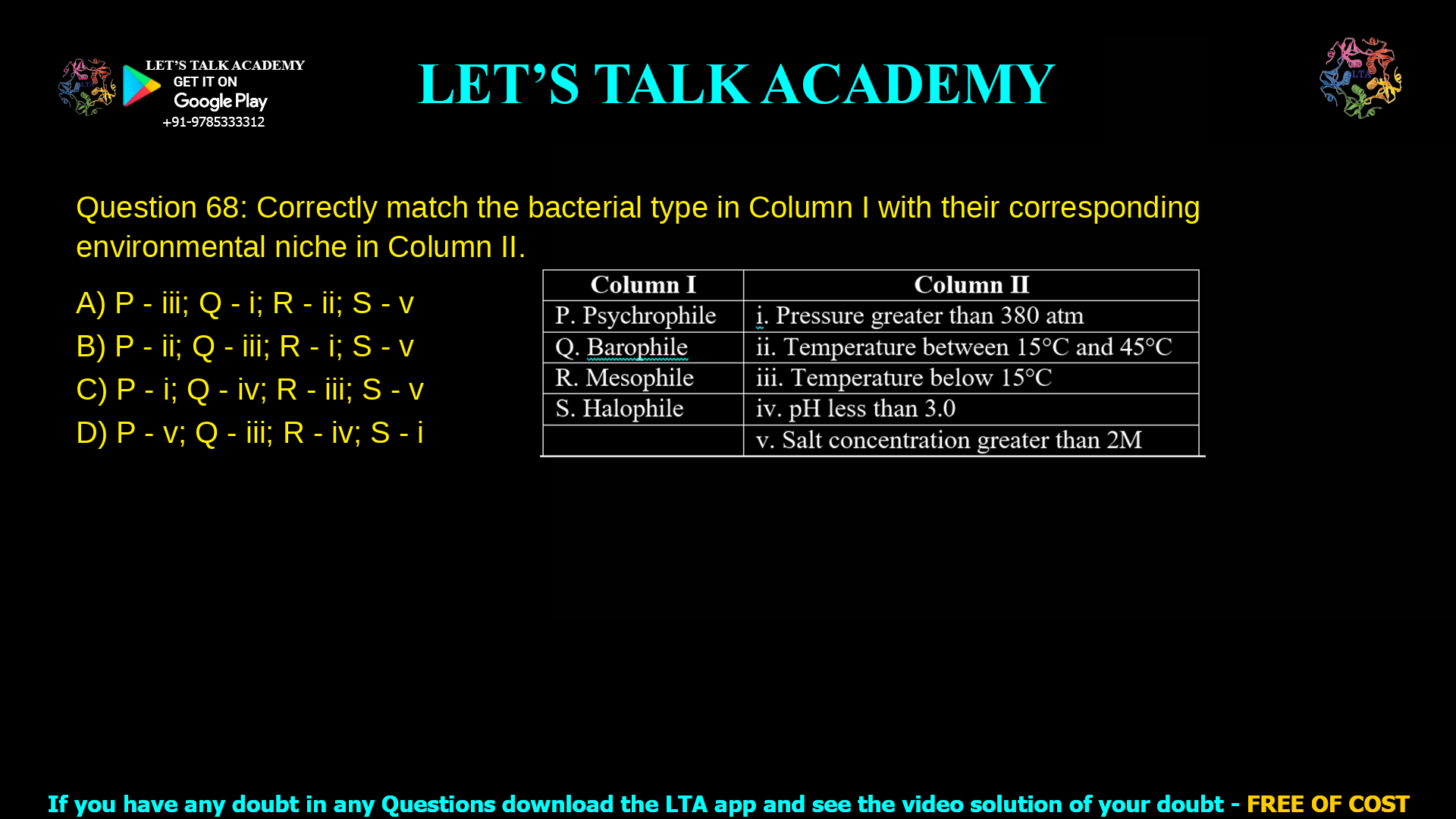
Q.68 Correctly match the bacterial type in Column I with their corresponding environmental niche in Column II.
| Column I | Column II |
|---|---|
| P. Psychrophile | i. Pressure greater than 380 atm |
| Q. Barophile | ii. Temperature between 15°C and 45°C |
| R. Mesophile | iii. Temperature below 15°C |
| S. Halophile | iv. pH less than 3.0 |
| v. Salt concentration greater than 2M |
Matching Bacterial Types to Extreme Environments: CSIR NET Life Sciences Guide
Bacterial types in Column I (A: pH ≤ 3; Q: pH ≥ 9; R: S ≤ 2M; S: V > 2M) match Column II conditions based on extremophile classifications. Correct pairings are A-P (acidophile), Q-U (alkaliphile), R-V (halophile), and S-T (barophile).
Option Analysis
Column I lists bacterial preferences: A for low pH (acidic), Q for high pH (alkaline), R for low salt, S for high salt, with V indicating pressure adaptation. Column II describes extremes: P for pH ≤3 (acidic habitats like mine drainage), U for pH ≥9 (alkaline like soda lakes), V for salt >2M (hypersaline), T for high pressure (deep-sea). R matches low salt as non-halophilic baseline, but pairing focuses on extremophiles.
Detailed Matching
Acidophiles (A) thrive at pH ≤3 by stabilizing proteins against proton influx. Alkaliphiles (Q) grow at pH ≥9 using sodium pumps for pH homeostasis. Halophiles require salt >2M (V), accumulating compatible solutes like ectoine. Barophiles (S, often piezophiles) need high hydrostatic pressure (>400 atm) for membrane fluidity.
Bacterial types matching pH temperature salt pressure is crucial for CSIR NET Life Sciences, classifying extremophiles by optimal growth conditions. These microbes adapt to harsh environments through unique membrane lipids and enzymes.
pH-Based Classification
Acidophiles grow optimally at pH ≤3, found in acidic hot springs; examples include Thiobacillus. Alkaliphiles prefer pH ≥9, like Bacillus firmus in soda lakes. Neutrophiles handle pH 5.5-8, but extremes define A (acidophile to P) and Q (alkaliphile to U).
Temperature Extremophiles
Psychrophiles grow below 15°C to 20°C max, optimal 0-15°C in polar ice. Thermophiles thrive above 45-50°C, up to 80°C in hot springs; no direct match here, but distinguishes from barophile pressure needs.
Salt and Pressure Adaptations
Halophiles require salt >2M (V, ~12% NaCl), extreme types >15-30%; they use K+ influx for osmosis. Barophiles (S to T) grow under high pressure (>100 atm, deep ocean), with optimal >400-500 atm; cells elongate under low pressure.
| Bacterial Type | Key Condition | Optimal Range | Example Habitat |
|---|---|---|---|
| Acidophile (A-P) | Low pH | pH ≤3 | Mine drainage |
| Alkaliphile (Q-U) | High pH | pH ≥9 | Soda lakes |
| Halophile (R/S-V) | High salt | >2M NaCl | Salt lakes |
| Barophile (S-T) | High pressure | >400 atm | Deep sea |


1 Comment
Sonal Nagar
January 8, 2026Option A