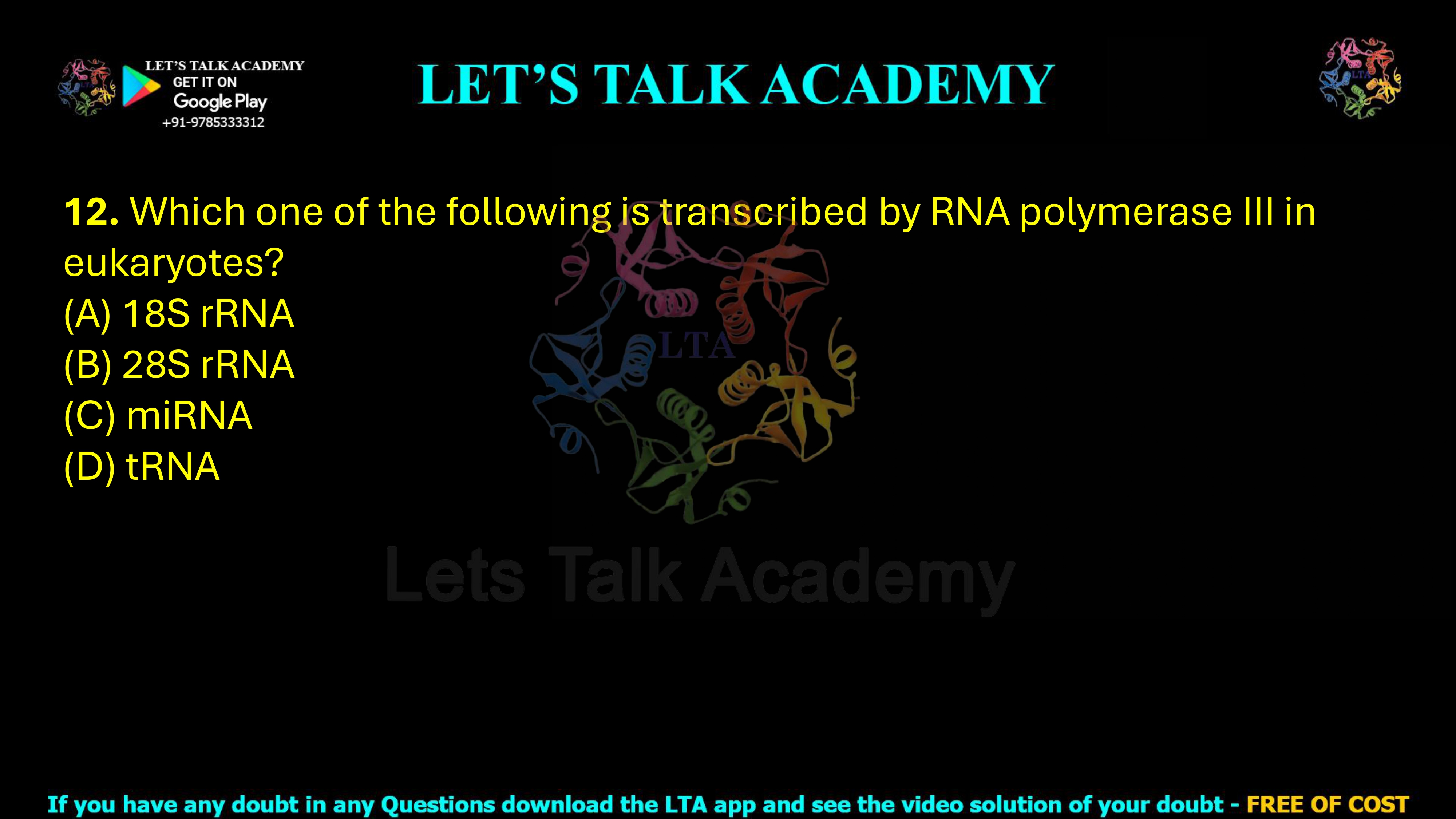
12. Which one of the following is transcribed by RNA polymerase III in eukaryotes?
(A) 18S rRNA
(B) 28S rRNA
(C) miRNA
(D) tRNA
RNA Polymerase III in Eukaryotes: Which RNA Is Transcribed by RNA Polymerase III?
Introduction
Transcription is the biological process through which genetic information stored in DNA is copied into RNA. In bacteria, a single major RNA polymerase is responsible for synthesizing most cellular RNAs. Eukaryotic cells, however, use three major nuclear RNA polymerases known as RNA polymerase I, RNA polymerase II, and RNA polymerase III. Each polymerase recognizes different promoters and transcribes a characteristic group of genes.
RNA polymerase I mainly produces the large ribosomal RNA precursor that gives rise to 18S, 5.8S, and 28S rRNAs. RNA polymerase II transcribes protein-coding genes into precursor mRNAs and also produces many regulatory RNAs, including most microRNAs. RNA polymerase III primarily transcribes small structural and functional RNAs, particularly tRNAs and 5S rRNA.
Correct Answer
Correct Answer: (D) tRNA
Detailed Explanation
In eukaryotic cells, RNA polymerase III is specialized for the transcription of several small, abundant, and functionally important non-coding RNAs. Its best-known products are transfer RNAs (tRNAs) and 5S ribosomal RNA (5S rRNA). It also transcribes some other small RNAs, including U6 snRNA and selected additional non-coding RNAs.
Among the four choices given in the question, only tRNA is a classical product of RNA polymerase III. The 18S and 28S rRNAs are produced through RNA polymerase I transcription, whereas most miRNA genes are transcribed by RNA polymerase II. Therefore, option (D) is the correct answer.
Explanation of Option (A): 18S rRNA
This option is incorrect.
The 18S rRNA is not transcribed by RNA polymerase III. It is derived from a large precursor rRNA synthesized by RNA polymerase I in the nucleolus. RNA polymerase I produces a 45S pre-rRNA in mammals, which is subsequently processed to generate 18S, 5.8S, and 28S rRNAs.
The 18S rRNA becomes an essential structural and functional component of the 40S small subunit of the eukaryotic ribosome. It participates in ribosome assembly and contributes to accurate decoding of mRNA during protein synthesis. Since its precursor is synthesized by RNA polymerase I, option (A) is incorrect.
Explanation of Option (B): 28S rRNA
This option is incorrect.
Like 18S rRNA, the 28S rRNA is also produced from the large precursor rRNA transcribed by RNA polymerase I. The 45S pre-rRNA undergoes extensive processing and cleavage to generate mature 18S, 5.8S, and 28S rRNAs.
The 28S rRNA is a major component of the 60S large ribosomal subunit in eukaryotes. It contributes to the structural organization and catalytic functions of the ribosome. Therefore, 28S rRNA is not a product of RNA polymerase III, making option (B) incorrect.
Explanation of Option (C): miRNA
This option is incorrect.
Most microRNA genes are transcribed by RNA polymerase II. The initial transcript is known as a primary miRNA (pri-miRNA). This transcript is processed in the nucleus by the Drosha-DGCR8 complex to produce a precursor miRNA (pre-miRNA), which is then exported to the cytoplasm and further processed by Dicer to generate the mature miRNA.
Mature miRNAs regulate gene expression by associating with Argonaute proteins and guiding the RNA-induced silencing complex to target mRNAs. This can result in translational repression or mRNA degradation. Since most miRNAs are products of RNA polymerase II rather than RNA polymerase III, option (C) is incorrect.
Explanation of Option (D): tRNA
This option is correct.
Transfer RNAs are transcribed by RNA polymerase III. tRNAs play a central role in translation because they act as adaptor molecules connecting the nucleotide sequence of mRNA with the amino acid sequence of a protein. Each tRNA contains an anticodon that recognizes a complementary codon on mRNA and an acceptor end that carries the corresponding amino acid.
RNA polymerase III transcribes tRNA genes to produce precursor tRNAs, which subsequently undergo several processing steps. These include removal of extra sequences from the 5′ and 3′ ends, addition of the CCA sequence at the 3′ end when it is not genomically encoded, base modification, and removal of introns from certain tRNAs. The mature tRNA then participates in protein synthesis.
Summary of Each Option
| Option | RNA | Major RNA Polymerase | Correct/Incorrect |
|---|---|---|---|
| (A) | 18S rRNA | RNA Polymerase I | Incorrect |
| (B) | 28S rRNA | RNA Polymerase I | Incorrect |
| (C) | miRNA | RNA Polymerase II | Incorrect |
| (D) | tRNA | RNA Polymerase III | Correct |
Major Eukaryotic RNA Polymerases and Their Products
| RNA Polymerase | Major Transcription Products | Main Site of Transcription |
|---|---|---|
| RNA Polymerase I | 18S, 5.8S, and 28S rRNAs through a common precursor | Nucleolus |
| RNA Polymerase II | mRNA, most miRNAs, and many snRNAs | Nucleoplasm |
| RNA Polymerase III | tRNA, 5S rRNA, U6 snRNA, and other small RNAs | Nucleoplasm |
Why Is 5S rRNA Different from Other Major rRNAs?
An important feature of eukaryotic transcription is that all ribosomal RNAs are not transcribed by the same RNA polymerase. RNA polymerase I transcribes the precursor that produces 18S, 5.8S, and 28S rRNAs, whereas 5S rRNA is transcribed separately by RNA polymerase III. This distinction is frequently tested in molecular biology examinations.
The 5S rRNA later becomes a component of the large ribosomal subunit. Therefore, when a question asks which ribosomal RNA is synthesized by RNA polymerase III, the expected answer is generally 5S rRNA.
Transcription of tRNA Genes by RNA Polymerase III
Many tRNA genes possess unusual promoter elements because important promoter sequences are located inside the transcribed region rather than entirely upstream of the transcription start site. These internal promoter elements are commonly called the A box and B box.
During transcription initiation, TFIIIC recognizes the internal promoter elements and helps recruit TFIIIB. TFIIIB then positions RNA polymerase III at the transcription start site. Once the transcription complex is assembled, RNA polymerase III synthesizes the precursor tRNA molecule.
Major Factors Involved in tRNA Transcription
| Component | Function |
|---|---|
| A Box and B Box | Internal promoter elements within many tRNA genes. |
| TFIIIC | Recognizes internal promoter sequences. |
| TFIIIB | Recruits and positions RNA polymerase III. |
| RNA Polymerase III | Synthesizes the precursor tRNA transcript. |
Processing of Precursor tRNA
The initial RNA produced by RNA polymerase III is usually not immediately functional. It undergoes a series of maturation events before becoming a mature tRNA. The 5′ leader sequence is removed primarily by RNase P, while extra nucleotides at the 3′ end are removed by processing enzymes. A CCA sequence is present at the mature 3′ end and provides the site where the amino acid is attached.
Many unusual bases are also generated through post-transcriptional modification. These modifications contribute to correct tRNA folding, codon recognition, interaction with aminoacyl-tRNA synthetases, and efficient translation. Some precursor tRNAs additionally contain introns that must be removed before the tRNA becomes functional.
RNA Polymerase I, II, and III: Functional Comparison
| Feature | RNA Polymerase I | RNA Polymerase II | RNA Polymerase III |
|---|---|---|---|
| Major Product | Large rRNA precursor | Pre-mRNA | tRNA and 5S rRNA |
| 18S rRNA | Yes | No | No |
| 28S rRNA | Yes | No | No |
| Most miRNAs | No | Yes | No |
| tRNA | No | No | Yes |
| 5S rRNA | No | No | Yes |
Biological Significance
The division of transcriptional work among three different nuclear RNA polymerases allows eukaryotic cells to regulate different classes of genes independently. Ribosome production, protein-coding gene expression, regulatory RNA synthesis, and tRNA production can therefore respond differently to cellular growth, nutrient availability, developmental signals, and environmental stress.
RNA polymerase III is particularly important because protein synthesis depends on a continuous supply of functional tRNAs. Without adequate tRNA production, amino acids cannot be efficiently delivered to ribosomes, and translation cannot proceed normally. The activity of RNA polymerase III is therefore closely connected to cell growth and biosynthetic capacity.
Final Answer
In eukaryotes, RNA polymerase III transcribes tRNA genes and produces precursor tRNAs that are subsequently processed into mature functional tRNAs.
RNA Polymerase III → tRNA
Correct Answer: (D) tRNA


