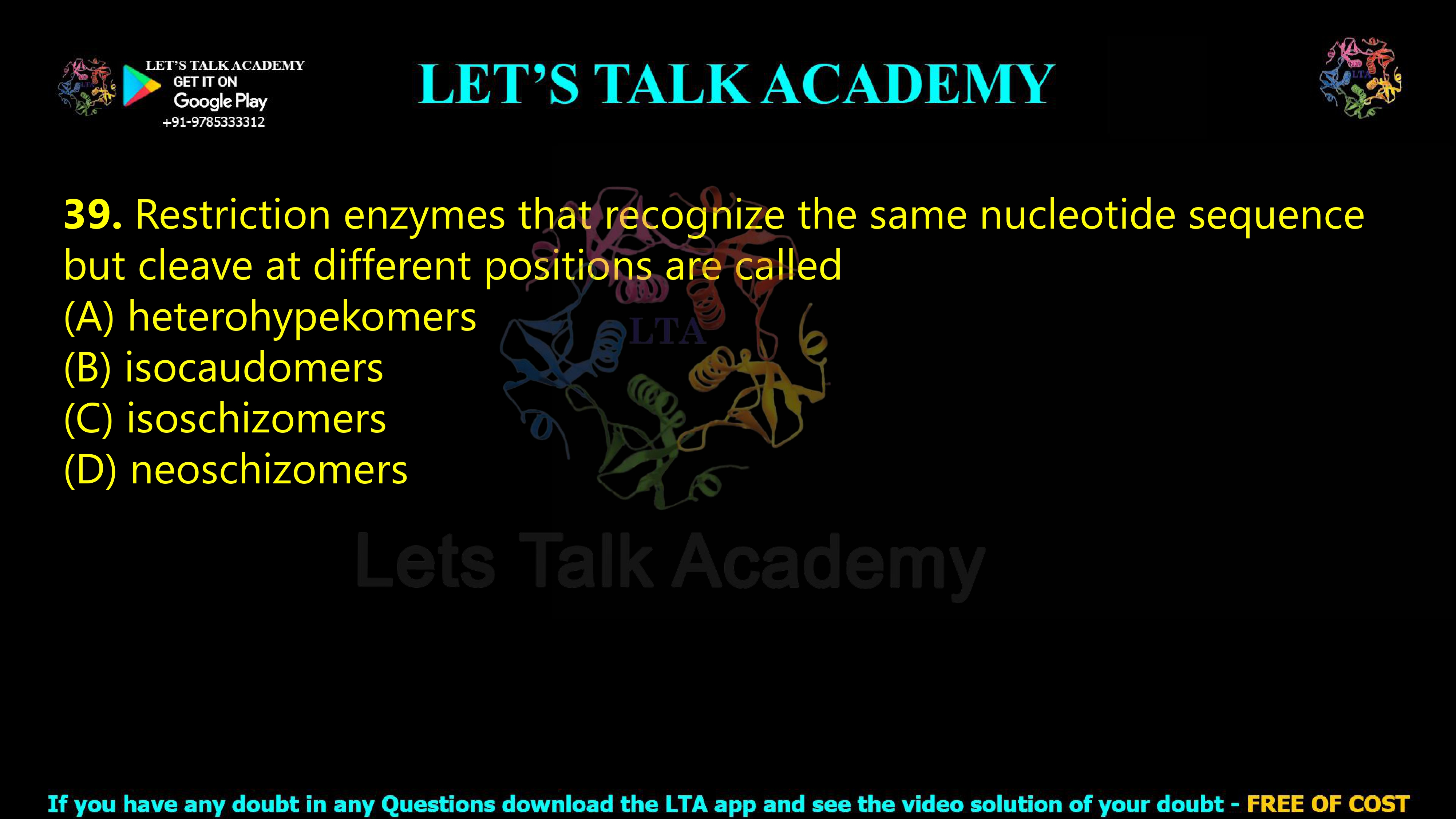
38. Restriction enzymes that recognize the same nucleotide sequence but cleave at different positions are called
(A) heterohypekomers
(B) isocaudomers
(C) isoschizomers
(D) neoschizomers
Restriction Enzymes Recognizing the Same Nucleotide Sequence but Cleaving at Different Positions
Understanding Restriction Enzymes and Recognition Sequences
Restriction enzymes, also known as restriction endonucleases, are enzymes that recognize specific nucleotide sequences in double-stranded DNA and cleave the phosphodiester backbone at defined positions. These enzymes are naturally found mainly in bacteria, where they function as part of a defense system against invading foreign DNA, particularly bacteriophage DNA. In molecular biology and recombinant DNA technology, restriction enzymes are essential tools for DNA cloning, gene mapping, construction of recombinant DNA molecules, and analysis of genome organization.
Each restriction enzyme recognizes a particular DNA sequence known as a recognition sequence or restriction site. Many restriction enzymes recognize short palindromic sequences, meaning that the sequence reads the same in the 5′→3′ direction on both complementary strands. However, different restriction enzymes may show interesting relationships with one another. Some recognize exactly the same sequence and cut at the same position, some recognize the same sequence but cut at different positions, and some recognize different sequences but generate identical DNA ends.
These differences form the basis for terms such as isoschizomers, neoschizomers, and isocaudomers. Understanding the distinction among these terms is essential for answering questions in molecular biology and biotechnology examinations.
Why Neoschizomers Are the Correct Answer
Definition of Neoschizomers
Neoschizomers are pairs of restriction enzymes that recognize the same nucleotide sequence but cleave that sequence at different positions. The prefix “neo” indicates a different or new cleavage pattern compared with another enzyme recognizing the same DNA sequence.
The most important point is that the recognition sequence remains the same, but the position of DNA cleavage is different. This is exactly the condition described in the question.
For example, the restriction enzymes SmaI and XmaI recognize the same DNA sequence:
5′-CCCGGG-3′
3′-GGGCCC-5′
Although both enzymes recognize this identical sequence, they do not cleave DNA at the same position. SmaI cleaves in the middle of the recognition sequence and produces blunt ends, whereas XmaI cleaves at a different position and produces cohesive or sticky ends. Because they recognize the same nucleotide sequence but cut at different positions, SmaI and XmaI are neoschizomers.
Therefore:
Same recognition sequence + different cleavage position = Neoschizomers
Detailed Explanation of Every Option
Option (A): Heterohypekomers
Option (A) is incorrect. The term “heterohypekomers,” as written in the question, is not the standard term used for restriction enzymes that recognize the same DNA sequence but cleave at different positions. In restriction enzyme classification, several specialized terms describe relationships between enzymes based on recognition sites and cleavage patterns, but the specific definition given in the question corresponds to neoschizomers.
The key requirement in the question is very precise: the enzymes must recognize the same nucleotide sequence while cutting DNA at different positions. This defining combination does not correspond to option (A). Therefore, this option can be eliminated.
Option (B): Isocaudomers
Option (B) is incorrect. Isocaudomers are restriction enzymes that recognize different DNA sequences but generate identical or compatible cohesive ends after cleavage. The term is derived from the idea of producing similar DNA “tails” or overhangs.
In isocaudomers, the recognition sequences do not need to be identical. Instead, the important feature is that cleavage produces compatible sticky ends that can base-pair with each other. Because of this property, DNA fragments generated by two different isocaudomeric restriction enzymes may sometimes be joined by DNA ligase.
For example, BamHI and BglII recognize different nucleotide sequences but generate compatible 5′ overhangs. Their recognition sequences are different, yet the DNA ends produced after cleavage can anneal with one another.
Therefore:
Different recognition sequences + compatible cohesive ends = Isocaudomers
The question specifically states that the enzymes recognize the same nucleotide sequence. Therefore, isocaudomers cannot be the correct answer.
Option (C): Isoschizomers
Option (C) is incorrect. Isoschizomers are restriction enzymes isolated from different organisms that recognize the same nucleotide sequence and cleave DNA at the same position.
This definition is very close to that of neoschizomers, which is why these two terms are frequently confused. The crucial difference lies in the position of cleavage. Isoschizomers recognize the same sequence and cut at the same position, whereas neoschizomers recognize the same sequence but cut at different positions.
For example, HpaII and MspI recognize the same nucleotide sequence, 5′-CCGG-3′, and cleave at the same position. However, they differ in their sensitivity to DNA methylation. They are therefore commonly described as isoschizomers with different methylation sensitivities.
Therefore:
Same recognition sequence + same cleavage position = Isoschizomers
Since the question clearly mentions cleavage at different positions, option (C) is not correct.
Option (D): Neoschizomers
Option (D) is correct. Neoschizomers recognize the same nucleotide sequence but cleave the DNA at different positions. This definition exactly matches the statement given in the question.
A classic example is SmaI and XmaI. Both enzymes recognize the sequence 5′-CCCGGG-3′, but they cleave it differently. SmaI produces blunt-ended DNA fragments, while XmaI produces sticky-ended DNA fragments. Thus, despite having the same recognition sequence, their cleavage positions and resulting DNA ends are different.
Therefore:
Same recognition sequence + different cleavage position = Neoschizomers
Difference Between Isoschizomers, Neoschizomers, and Isocaudomers
The easiest way to understand these three important classes is to compare the relationship between the DNA recognition sequence and the position of cleavage. Isoschizomers recognize the same sequence and cut at the same position. Neoschizomers recognize the same sequence but cut at different positions. Isocaudomers recognize different sequences but produce identical or compatible DNA ends.
Thus, the fundamental distinction is based on two questions: first, whether the enzymes recognize the same or different nucleotide sequences, and second, whether they produce the same or different cleavage patterns.
Isoschizomers: Same recognition sequence and same cleavage position.
Neoschizomers: Same recognition sequence but different cleavage positions.
Isocaudomers: Different recognition sequences but identical or compatible cohesive ends.
How to Analyze This Question Step by Step
The question contains two essential clues. The first clue is “recognize the same nucleotide sequence.” This immediately suggests a relationship involving enzymes that share an identical recognition site. The second and decisive clue is “cleave at different positions.” This distinguishes neoschizomers from isoschizomers.
If the question had stated that the enzymes recognize the same sequence and cut at the same position, the answer would have been isoschizomers. However, because the cleavage positions are different, the correct term is neoschizomers.
Importance of Neoschizomers in Molecular Biology
Neoschizomers are useful in molecular biology because different cleavage patterns can generate different types of DNA ends from the same recognition sequence. One enzyme may generate blunt ends, whereas another may generate sticky or cohesive ends. This can be valuable when designing cloning experiments, analyzing restriction maps, studying DNA methylation, and selecting suitable enzymes for recombinant DNA construction.
The ability to choose between different cleavage patterns at the same recognition site provides researchers with additional flexibility. For example, sticky ends are often useful for directional or efficient ligation, while blunt ends may be preferred in experiments where sequence-independent joining is required.
Why This Concept Is Important for Competitive Examinations
The distinction among isoschizomers, neoschizomers, and isocaudomers is frequently tested in molecular biology and biotechnology examinations. Questions may provide direct definitions, ask for examples, or present pairs of restriction enzymes and require students to identify their relationship.
This topic is especially relevant for CSIR NET Life Science, DBT JRF, GATE Biotechnology, IIT JAM Biotechnology, ICMR JRF, and university entrance examinations. A clear understanding of recognition sequences and cleavage positions allows students to solve these questions accurately without relying only on memorization.
Concept Summary
Restriction enzymes can be classified according to similarities in their recognition sequences and cleavage patterns. Isoschizomers recognize the same nucleotide sequence and cleave at the same position. Isocaudomers recognize different nucleotide sequences but generate compatible DNA ends. Neoschizomers, however, recognize the same nucleotide sequence but cleave DNA at different positions.
Since the question specifically asks for restriction enzymes that recognize the same nucleotide sequence but cleave at different positions, the correct answer is neoschizomers.
Final Answer
Correct Option: (D) Neoschizomers
Restriction enzymes that recognize the same nucleotide sequence but cleave at different positions are called neoschizomers.


