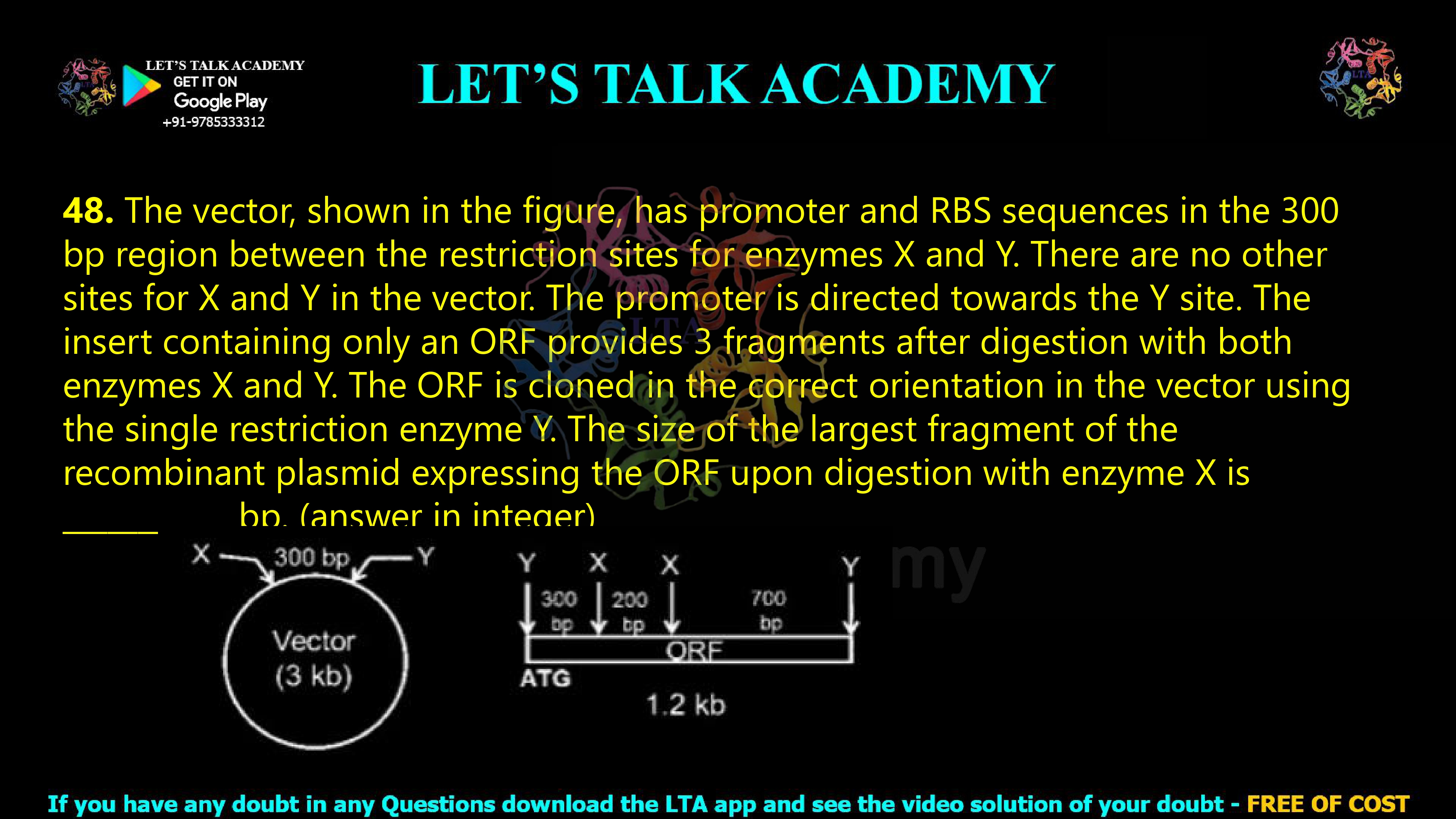
47. The vector, shown in the figure, has promoter and RBS sequences in the 300 bp region between the restriction sites for enzymes X and Y. There are no other sites for X and Y in the vector. The promoter is directed towards the Y site. The insert containing only an ORF provides 3 fragments after digestion with both enzymes X and Y. The ORF is cloned in the correct orientation in the vector using the single restriction enzyme Y. The size of the largest fragment of the recombinant plasmid expressing the ORF upon digestion with enzyme X is ___________ bp. (answer in integer)
How to Calculate the Largest Fragment of a Recombinant Plasmid After Restriction Enzyme X Digestion
Detailed Explanation
This question combines several important concepts of molecular cloning, including restriction mapping, circular plasmid DNA, insert orientation, promoter direction, open reading frame cloning, and calculation of restriction fragment sizes. The calculation becomes straightforward once the vector and insert are converted into a single recombinant plasmid map.
The original vector is 3 kb, which is equal to 3000 bp. The vector contains one restriction site for enzyme X and one restriction site for enzyme Y. The distance between X and Y through the promoter and RBS region is 300 bp.
The insert is 1.2 kb, or 1200 bp, and contains two internal X sites. The insert map shown in the figure can be written as:
Y — 300 bp — X — 200 bp — X — 700 bp — Y
The ORF is cloned at the Y site in the correct orientation for expression. After cloning, the recombinant plasmid therefore contains three X restriction sites: one X site from the vector and two X sites from the insert.
Complete digestion of a circular DNA molecule containing three X sites produces three DNA fragments. The sizes of these fragments are calculated by measuring the distances between consecutive X sites around the complete recombinant plasmid.
The three fragments are 600 bp, 200 bp, and 3400 bp. Therefore, the largest fragment is 3400 bp.
Understanding the Restriction Map of the Original Vector
The Vector Is 3000 bp Long
The original circular vector has a total size of:
3 kb = 3000 bp
The figure shows that the distance from the vector X site to the vector Y site through the promoter and RBS region is:
X → 300 bp → Y
Because the plasmid is circular, there are two possible paths between X and Y. One path is the short 300 bp promoter-containing region. The remaining path represents the rest of the vector.
Therefore:
Remaining vector backbone = 3000 − 300
Remaining vector backbone = 2700 bp
Thus, the vector can be represented as:
X — 300 bp — Y — 2700 bp — back to X
This 2700 bp vector backbone segment becomes very important when calculating the largest fragment after digestion of the recombinant plasmid.
Understanding the Restriction Map of the 1.2 kb Insert
The Insert Contains Two Internal X Sites
The insert has a total length of:
1.2 kb = 1200 bp
According to the figure, its restriction map is:
Y — 300 bp — X — 200 bp — X — 700 bp — Y
Checking the total insert size:
300 + 200 + 700 = 1200 bp
Therefore, the restriction map is internally consistent.
The first X site is located 300 bp from the left Y end. The second X site is another 200 bp downstream. From the second X site to the right Y end, the distance is 700 bp.
The insert therefore contributes two X sites to the recombinant plasmid.
Why Does the Orientation of the Insert Matter?
The ORF Must Be Placed Downstream of the Promoter
The vector contains a promoter and ribosome-binding site in the 300 bp region between X and Y. The promoter is directed toward the Y site. Therefore, for expression of the ORF, the coding sequence must be inserted in the orientation in which transcription proceeds from the vector promoter into the ORF.
The figure shows the ATG start codon near the left Y end of the insert. Therefore, in the correctly expressing recombinant plasmid, this left Y end of the insert must be positioned immediately downstream of the promoter-containing vector Y site.
The relevant linear order from the vector X site through the promoter and into the insert is therefore:
Vector X — 300 bp vector region — Y — 300 bp insert region — Insert X — 200 bp — Insert X — 700 bp — Y
The remaining 2700 bp of vector backbone then completes the circular recombinant plasmid and returns to the original vector X site.
This orientation is essential because reversing the insert would change the distances between the vector X site and the internal X sites of the insert.
What Is the Total Size of the Recombinant Plasmid?
The recombinant plasmid contains the complete 3000 bp vector plus the 1200 bp insert.
Therefore:
Recombinant plasmid size = Vector size + Insert size
Recombinant plasmid size = 3000 + 1200
Recombinant plasmid size = 4200 bp
Thus, the recombinant plasmid is 4.2 kb or 4200 bp long.
This value also provides an important final check because the sizes of all fragments generated by complete digestion must add up to 4200 bp.
How Many X Sites Are Present in the Recombinant Plasmid?
The original vector contains:
1 X site
The insert contains:
2 X sites
Therefore:
Total number of X sites = 1 + 2 = 3
A complete digestion of a circular plasmid with three sites for the same restriction enzyme generates:
3 DNA fragments
We now need to calculate the distance between each pair of consecutive X sites around the recombinant circular plasmid.
Calculation of the First X Fragment
From the Vector X Site to the First Insert X Site
Starting from the vector X site, we move toward the Y cloning site through the promoter and RBS region.
The distance from the vector X site to the vector Y site is:
300 bp
After entering the insert at the Y site, the distance from the left Y end to the first internal X site is:
300 bp
Therefore:
First fragment = 300 + 300
First fragment = 600 bp
Thus, the first X digestion fragment is 600 bp.
Calculation of the Second X Fragment
Between the Two Internal X Sites of the Insert
The figure directly shows that the distance between the two internal X sites is:
200 bp
Therefore:
Second fragment = 200 bp
Thus, the second X digestion fragment is 200 bp.
Calculation of the Third and Largest X Fragment
From the Second Insert X Site Back to the Vector X Site
After the second internal X site, there are 700 bp remaining before reaching the right Y end of the insert.
Therefore:
Second insert X → 700 bp → Y
From this Y junction, the circular DNA continues through the remaining vector backbone until it reaches the vector X site.
The remaining vector backbone is:
2700 bp
Therefore, the third fragment is:
Third fragment = 700 + 2700
Third fragment = 3400 bp
Thus, the largest DNA fragment produced after digestion with enzyme X is:
3400 bp
Verification Using the Total Recombinant Plasmid Size
A reliable way to confirm a restriction mapping calculation is to add all the digestion fragments.
The three X fragments are:
600 bp + 200 bp + 3400 bp
Adding them:
600 + 200 + 3400 = 4200 bp
The total size of the recombinant plasmid was independently calculated as:
3000 bp vector + 1200 bp insert = 4200 bp
Since both values are equal, the restriction fragment calculation is correct.
Complete Recombinant Plasmid Map
Arrangement of Restriction Sites in the Expressing Clone
The recombinant plasmid can be followed around the circle as:
Vector X → 300 bp → Y → 300 bp → Insert X → 200 bp → Insert X → 700 bp → Y → 2700 bp vector backbone → back to Vector X
When enzyme X cuts this circular molecule, the fragments are:
Vector X to First Insert X = 300 + 300 = 600 bp
First Insert X to Second Insert X = 200 bp
Second Insert X to Vector X = 700 + 2700 = 3400 bp
Therefore, the three fragments generated are:
600 bp, 200 bp, and 3400 bp
The largest fragment is clearly 3400 bp.
Why the 300 bp Vector Region Must Be Included in the Calculation
The 300 bp region between X and Y in the vector contains the promoter and RBS sequences. When the insert is cloned at the Y site, this 300 bp segment remains part of the recombinant plasmid.
Therefore, the distance from the vector X site to the first X site inside the insert is not simply 300 bp. It contains two separate 300 bp segments: the 300 bp vector promoter/RBS region and the 300 bp segment from the insert Y end to its first X site.
Thus:
300 bp + 300 bp = 600 bp
This is why the first restriction fragment is 600 bp.
Why the Remaining Vector Backbone Is 2700 bp
The total vector is 3000 bp long, but 300 bp of the vector lies between the X and Y sites through the promoter-containing region.
Therefore, the other path around the circular vector must be:
3000 − 300 = 2700 bp
This 2700 bp backbone segment joins the right Y end of the correctly oriented insert back to the vector X site.
When calculating the largest fragment, this backbone must be combined with the 700 bp segment between the second insert X site and the right Y end.
Therefore:
700 + 2700 = 3400 bp
This produces the largest fragment.
Why Circular DNA Is Important in This Question
Restriction fragment calculations for circular DNA differ from those for linear DNA. In a circular plasmid, every restriction site is connected to another restriction site in both directions around the circle.
A circular DNA molecule cut at three positions produces three fragments. There are no free terminal ends before digestion.
In this recombinant plasmid, the three X sites divide the 4200 bp circular DNA molecule into three continuous regions measuring 600 bp, 200 bp, and 3400 bp.
Understanding the circular nature of the plasmid is essential because the 700 bp insert segment and the 2700 bp vector backbone belong to the same continuous restriction fragment.
Final Calculation
Vector size = 3000 bp
Insert size = 1200 bp
Total recombinant plasmid size = 4200 bp
Remaining vector backbone = 3000 − 300 = 2700 bp
The three fragments after digestion with X are:
Fragment 1 = 300 + 300 = 600 bp
Fragment 2 = 200 bp
Fragment 3 = 700 + 2700 = 3400 bp
Verification:
600 + 200 + 3400 = 4200 bp
Final Answer
The size of the largest fragment of the recombinant plasmid after digestion with restriction enzyme X is:
Correct Answer: 3400 bp
The correctly oriented recombinant plasmid contains one X site in the vector and two X sites in the 1.2 kb insert. Complete digestion with enzyme X produces fragments of 600 bp, 200 bp, and 3400 bp. Therefore, the largest restriction fragment is 3400 bp.


