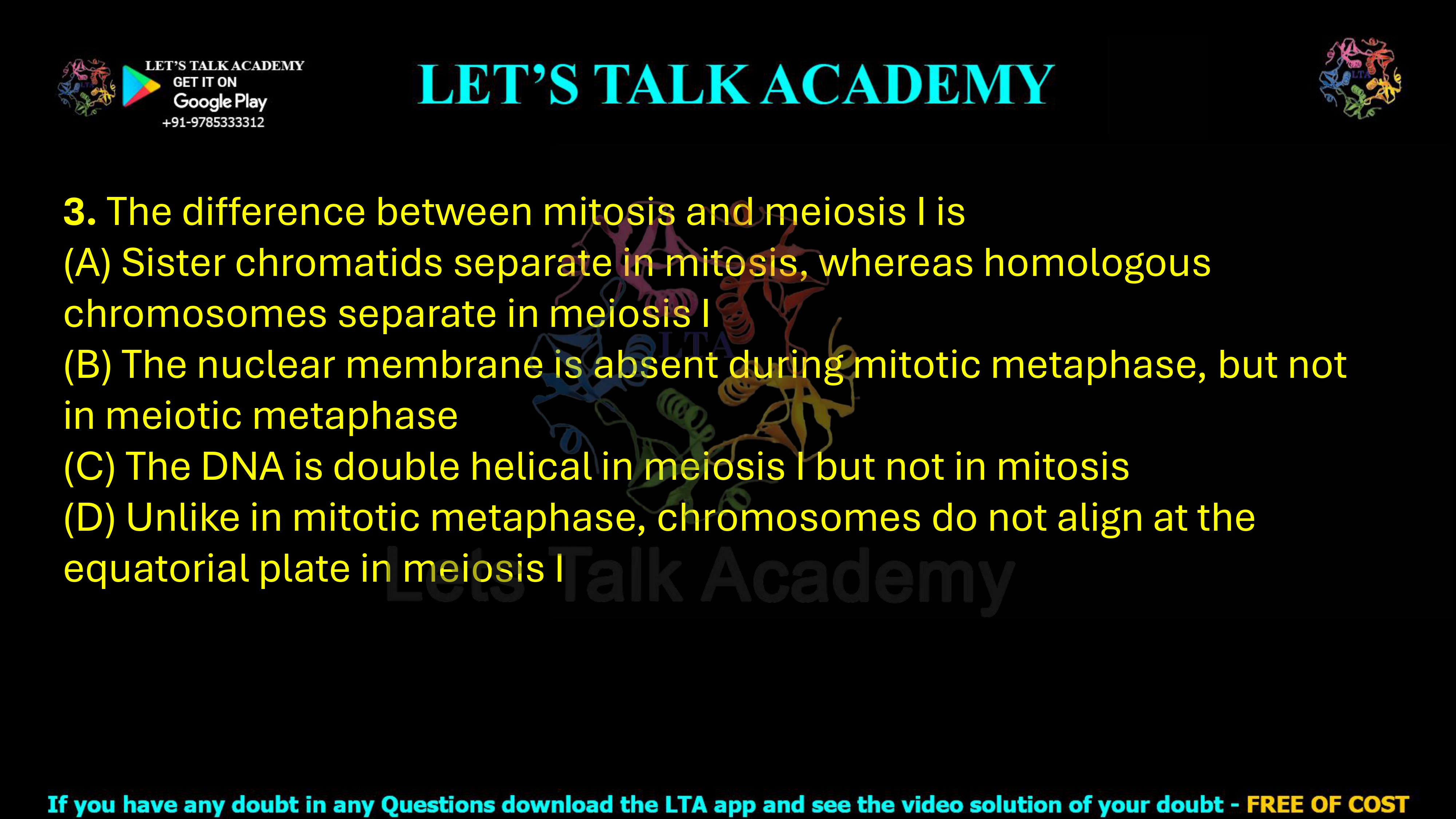
3. The difference between mitosis and meiosis I is
(A) Sister chromatids separate in mitosis, whereas homologous chromosomes separate in meiosis I
(B) The nuclear membrane is absent during mitotic metaphase, but not in meiotic metaphase
(C) The DNA is double helical in meiosis I but not in mitosis
(D) Unlike in mitotic metaphase, chromosomes do not align at the equatorial plate in meiosis I
Mitosis vs Meiosis I: Key Differences, Chromosome Separation, and Cell Division Explained
Introduction
Cell division is one of the most fundamental biological processes responsible for growth, development, tissue repair, and reproduction in living organisms. Eukaryotic cells divide primarily through two mechanisms: mitosis and meiosis. Although both involve DNA replication followed by chromosome segregation, they serve entirely different biological purposes. Mitosis produces genetically identical daughter cells that maintain the chromosome number of the parent cell, whereas meiosis generates genetically diverse haploid gametes required for sexual reproduction.
The most significant distinction between mitosis and meiosis occurs during chromosome segregation. In mitosis, sister chromatids separate and move to opposite poles, ensuring that each daughter cell receives an identical set of chromosomes. In contrast, during meiosis I, homologous chromosome pairs separate while sister chromatids remain attached at their centromeres. This reductional division decreases the chromosome number from diploid to haploid and contributes to genetic variation through independent assortment and crossing over.
Correct Answer
Correct Option: (A)
Detailed Explanation
Mitosis and meiosis share several stages, including prophase, metaphase, anaphase, and telophase, but they differ fundamentally in the behavior of chromosomes during anaphase. During mitosis, spindle fibers attach to sister chromatids from opposite poles. At anaphase, the centromeres divide, allowing sister chromatids to separate and migrate independently to opposite poles. As a result, each daughter cell receives an identical diploid chromosome complement.
During meiosis I, homologous chromosomes pair during prophase I through a process called synapsis and may exchange genetic material by crossing over. At metaphase I, homologous chromosome pairs align together at the equatorial plate. During anaphase I, homologous chromosomes separate and migrate to opposite poles, while sister chromatids remain joined because their centromeres do not divide. This process reduces the chromosome number by half, making meiosis I a reductional division.
Therefore, the defining difference between these two divisions is that mitosis separates sister chromatids, whereas meiosis I separates homologous chromosomes.
Explanation of Each Option
Option (A): Sister Chromatids Separate in Mitosis, Whereas Homologous Chromosomes Separate in Meiosis I
This option is correct. During mitotic anaphase, sister chromatids separate following centromere division. During meiotic anaphase I, homologous chromosomes separate, while sister chromatids remain attached until meiosis II.
Option (B): The Nuclear Membrane is Absent During Mitotic Metaphase, but Not in Meiotic Metaphase
This option is incorrect. In both mitotic metaphase and meiotic metaphase I, the nuclear envelope has already broken down during prophase, allowing spindle fibers to interact with chromosomes.
Option (C): The DNA is Double Helical in Meiosis I but Not in Mitosis
This option is incorrect. DNA retains its double-helical structure throughout both mitosis and meiosis. Chromosomes become condensed during cell division, but the DNA molecule itself remains double stranded.
Option (D): Unlike in Mitotic Metaphase, Chromosomes do not Align at the Equatorial Plate in Meiosis I
This option is incorrect. Chromosomes align at the equatorial plate during both mitosis and meiosis I. The difference is that individual chromosomes align during mitosis, whereas homologous chromosome pairs (bivalents) align during metaphase I.
Why Option (A) is Correct
The hallmark of mitosis is the separation of sister chromatids, whereas the defining feature of meiosis I is the separation of homologous chromosome pairs. This distinction allows meiosis I to reduce chromosome number and generate genetically diverse gametes, while mitosis preserves chromosome number for growth and tissue maintenance.
Comparison of All Options
| Option | Statement | Status |
|---|---|---|
| A | Sister chromatids separate in mitosis; homologous chromosomes separate in meiosis I | Correct |
| B | Nuclear membrane absent only in mitosis | Incorrect |
| C | DNA is double helical only in meiosis I | Incorrect |
| D | Chromosomes do not align at metaphase I | Incorrect |
Comparison Between Mitosis and Meiosis I
| Feature | Mitosis | Meiosis I |
|---|---|---|
| Purpose | Growth and tissue repair | Gamete formation |
| Type of Division | Equational | Reductional |
| Chromosome Pairing | Absent | Present (Synapsis) |
| Crossing Over | Absent | Occurs during Prophase I |
| Metaphase Alignment | Individual chromosomes | Homologous chromosome pairs (Bivalents) |
| Anaphase Event | Sister chromatids separate | Homologous chromosomes separate |
| Chromosome Number | Maintained | Reduced by half |
| Genetic Outcome | Genetically identical cells | Genetically diverse cells |
Major Events During Meiosis I
| Stage | Major Event |
|---|---|
| Prophase I | Synapsis and crossing over occur |
| Metaphase I | Homologous chromosome pairs align at the equator |
| Anaphase I | Homologous chromosomes separate |
| Telophase I | Two haploid daughter cells are produced |
Biological Significance
Mitosis ensures genetic stability by producing daughter cells that are genetically identical to the parent cell, making it essential for growth, tissue repair, and asexual reproduction. Meiosis I, in contrast, introduces genetic variation through crossing over and independent assortment while reducing the chromosome number by half. These processes are fundamental for sexual reproduction, maintaining chromosome number across generations, and promoting evolutionary diversity.
Final Answer
During mitosis, sister chromatids separate to produce genetically identical daughter cells. During meiosis I, homologous chromosomes separate while sister chromatids remain attached, reducing the chromosome number by half.
Correct Option: (A) Sister chromatids separate in mitosis, whereas homologous chromosomes separate in meiosis I.


