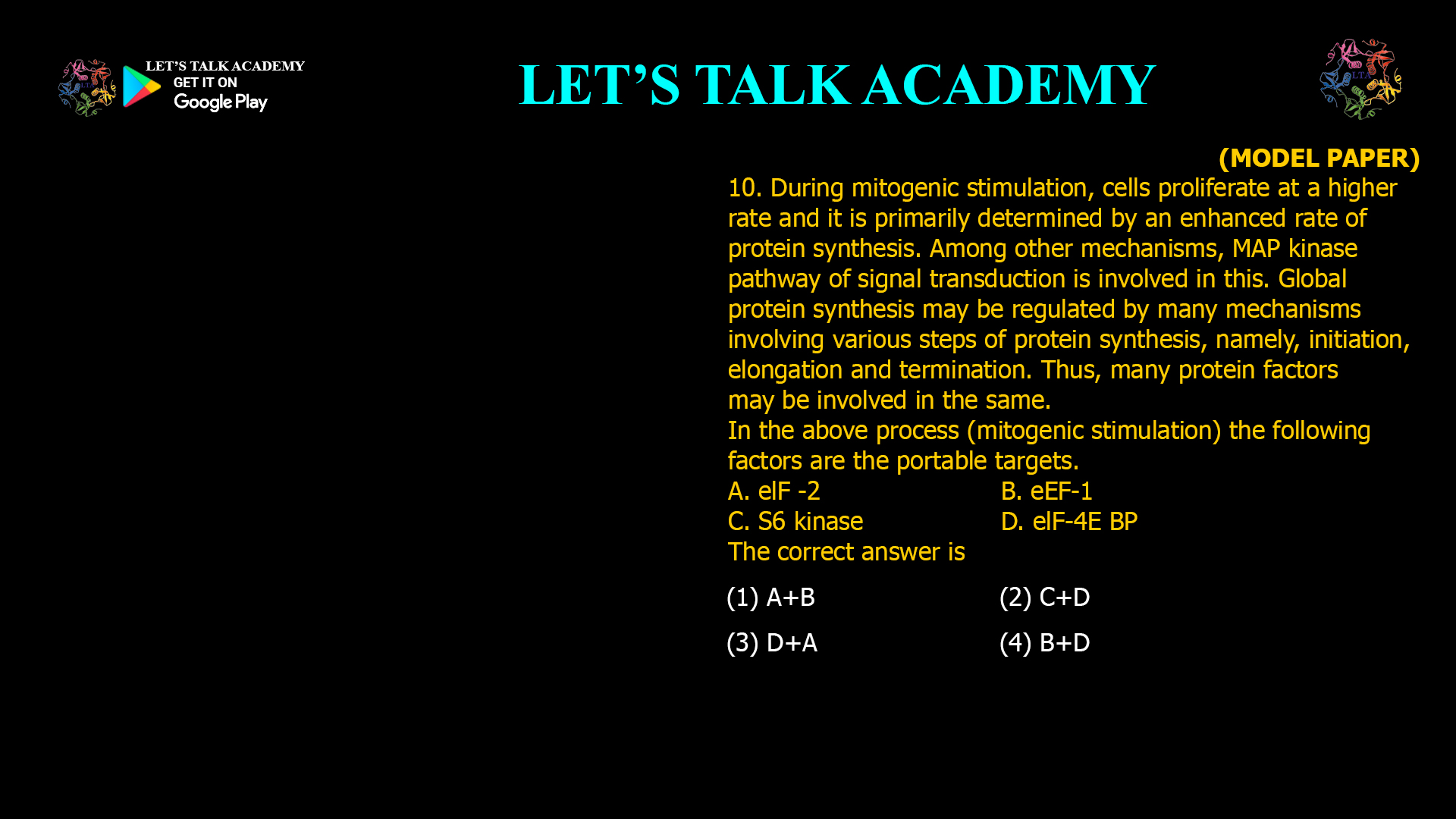
10. During mitogenic stimulation, cells proliferate at a higher rate and it is primarily determined by an enhanced rate of protein synthesis. Among other mechanisms, MAP kinase pathway of signal transduction is involved in this. Global protein synthesis may be regulated by many mechanisms involving various steps of protein synthesis, namely, initiation, elongation and termination. Thus, many protein factors may be involved in the same.
In the above process (mitogenic stimulation) the following factors are the portable targets.
A. elF -2 B. eEF-1
C. S6 kinase D. elF-4E BP
The correct answer is
(1) A+B (2) C+D
(3) D+A (4) B+D
Introduction
Cell proliferation induced by mitogenic stimulation requires a significant increase in protein synthesis. The MAP kinase pathway, among other signaling cascades, plays a pivotal role in modulating translation machinery to meet this demand. Understanding which translation factors are targeted during this process is essential for insights into cell growth regulation and potential therapeutic interventions.
Translation Regulation in Mitogenic Stimulation
Protein synthesis involves several stages: initiation, elongation, and termination. Mitogenic signals primarily enhance translation initiation, the rate-limiting step, by modulating specific translation factors.
S6 Kinase (S6K)
S6 kinase is a downstream effector of mTOR and MAP kinase pathways. Upon activation, S6K phosphorylates ribosomal protein S6 and other components, promoting the translation of mRNAs, particularly those with 5′ terminal oligopyrimidine tracts (5′ TOP), which encode components of the translational apparatus. This action increases the cell’s capacity for protein synthesis, supporting rapid cell growth.
eIF4E-Binding Protein (eIF4E-BP)
eIF4E-BP binds to eIF4E, preventing its association with eIF4G and thus inhibiting cap-dependent translation initiation. Mitogenic stimulation leads to phosphorylation of eIF4E-BP by mTOR, causing its dissociation from eIF4E. Freed eIF4E can then participate in forming the eIF4F complex, facilitating the recruitment of ribosomes to mRNA and enhancing translation initiation.
Other Translation Factors
-
eIF-2: Involved in delivering initiator tRNA to the ribosome; its activity is regulated but not the primary target of mitogenic pathways for global translation control.
-
eEF-1: Responsible for delivering aminoacyl-tRNAs during elongation; generally not a direct target of mitogenic signaling for translation regulation.
Conclusion
During mitogenic stimulation, the MAP kinase and mTOR pathways target key translation regulators to boost global protein synthesis. S6 kinase and eIF4E-BP are the primary factors modified to enhance translation initiation and capacity.
Correct answer: (2) C and D
This explanation aligns with current understanding of translation regulation during cell proliferation and mitogenic signaling.


