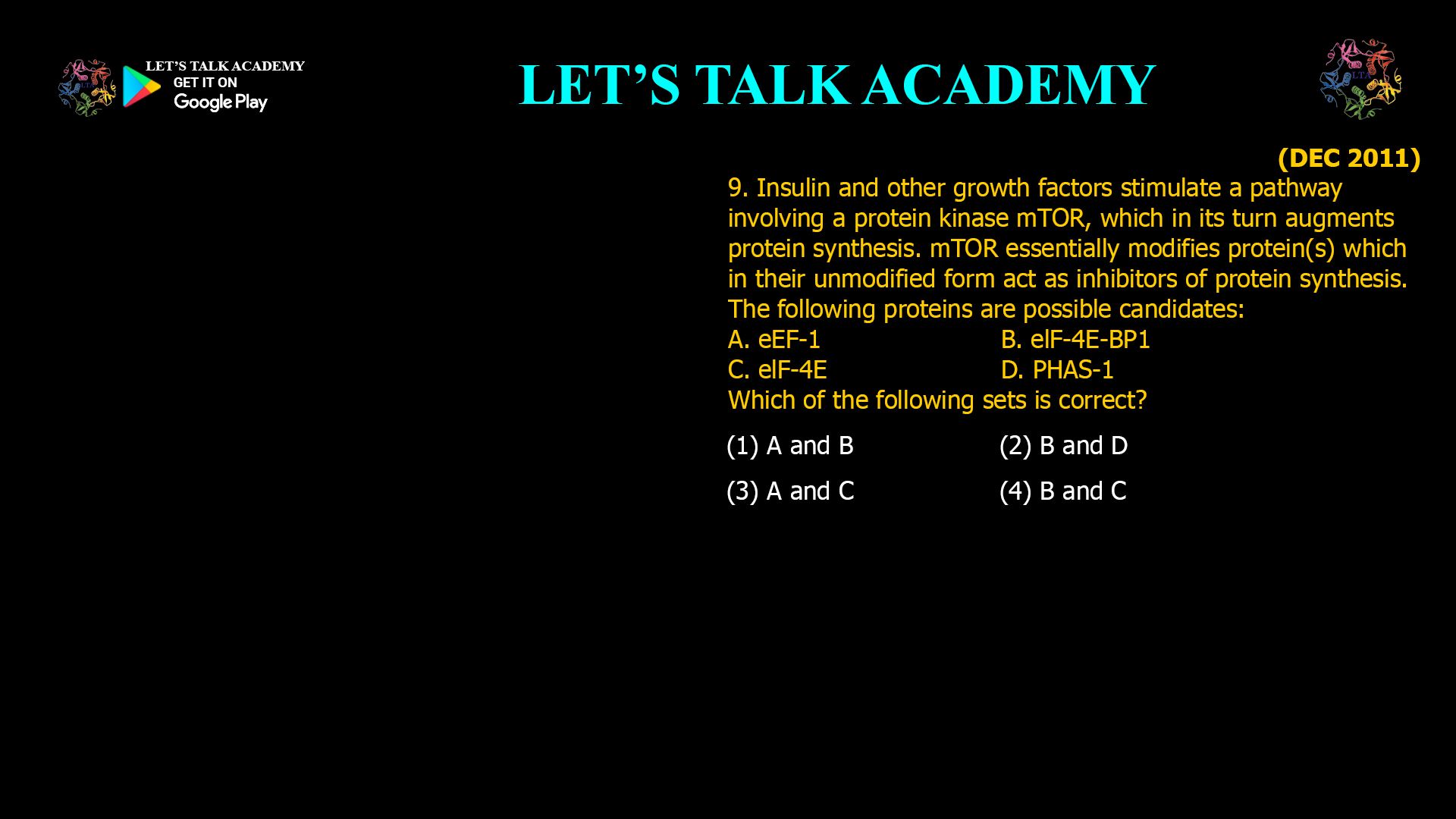
9. Insulin and other growth factors stimulate a pathway involving a protein kinase mTOR, which in its turn augments protein synthesis. mTOR essentially modifies protein( s) which in their unmodified form act as inhibitors of protein synthesis. The following proteins are possible candidates:
A. eEF-1 B. elF-4E-BP1
C. elF-4E D. PHAS-I
Which of the following sets is correct?
(1) A and B (2) Band D
(3) A and C (4) B and C
Introduction
The mammalian target of rapamycin (mTOR) is a central kinase that integrates signals from nutrients, growth factors, and energy status to regulate cell growth and protein synthesis. One of its key functions is to promote translation initiation by modifying proteins that otherwise inhibit this process. Among these, eIF4E-binding proteins (4E-BPs), particularly eIF4E-BP1 (also known as PHAS-I), play a crucial role. This article explains how mTOR regulates protein synthesis through phosphorylation of these inhibitory proteins and the consequences for cellular function.
The mTOR Pathway and Protein Synthesis
mTOR exists in two complexes, mTORC1 and mTORC2, with mTORC1 primarily responsible for regulating protein synthesis. Activation of mTORC1 by insulin, growth factors, and amino acids leads to phosphorylation of downstream targets that control translation.
Two critical substrates of mTORC1 in this context are:
-
eIF4E-binding protein 1 (eIF4E-BP1 or PHAS-I)
-
S6 kinase 1 (S6K1)
Phosphorylation of these proteins by mTORC1 promotes translation initiation and elongation, enhancing protein synthesis.
eIF4E-BP1 and PHAS-I: Translational Repressors
eIF4E-BP1 is a small protein that binds to eukaryotic initiation factor 4E (eIF4E), preventing its interaction with eIF4G and formation of the eIF4F complex necessary for cap-dependent translation initiation.
-
In its unphosphorylated state, eIF4E-BP1 tightly binds eIF4E, inhibiting translation.
-
Upon phosphorylation by mTOR, eIF4E-BP1 undergoes conformational changes and dissociates from eIF4E.
-
This release allows eIF4E to bind eIF4G, forming the active eIF4F complex and initiating translation.
PHAS-I is another name for eIF4E-BP1, highlighting the same protein’s role as a phosphorylation-dependent inhibitor of translation.
Other Proteins: eIF4E and eEF-1
-
eIF4E is the cap-binding protein essential for recruiting ribosomes to mRNA. It is not an inhibitor but a key factor in translation initiation.
-
eEF-1 (elongation factor 1) is involved in the elongation phase of translation, delivering aminoacyl-tRNAs to the ribosome. It is generally not directly regulated by mTOR as an inhibitor.
Summary of Protein Roles in mTOR-Mediated Translation Regulation
| Protein | Role in Translation Regulation | Regulated by mTOR? |
|---|---|---|
| eIF4E-BP1 | Translation inhibitor that binds eIF4E | Yes, phosphorylated by mTOR |
| PHAS-I | Another name for eIF4E-BP1 | Yes |
| eIF4E | Cap-binding translation initiation factor | Indirectly regulated (released from eIF4E-BP1 inhibition) |
| eEF-1 | Translation elongation factor | Not a direct mTOR target |
Conclusion
mTOR promotes protein synthesis largely by phosphorylating and inactivating translational repressors such as eIF4E-BP1 (PHAS-I). This phosphorylation frees eIF4E to participate in the formation of the translation initiation complex, thereby enhancing protein synthesis in response to growth signals.
The correct answer to the question is:
(2) B and D
(eIF4E-BP1 and PHAS-I)
This explanation clarifies the molecular players regulated by mTOR in controlling protein synthesis and highlights why eIF4E-BP1 and PHAS-I are the key inhibitory proteins modified by mTOR.


