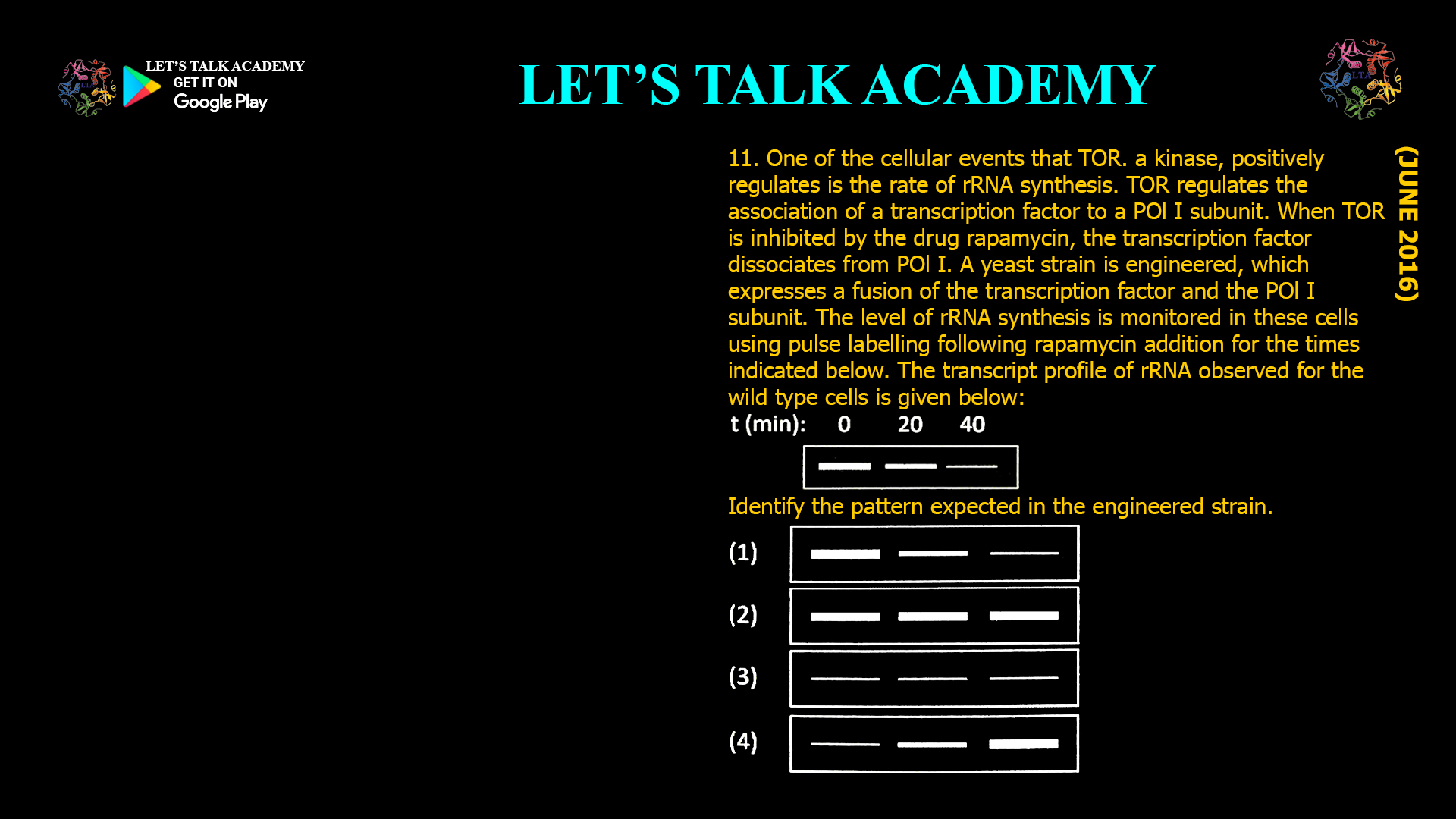
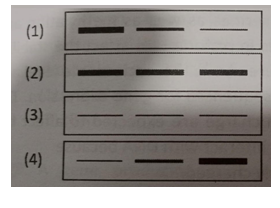
11. one of the cellular events that TOR. a kinase, positively regulates is the rate of rRNA synthesis. TOR regulates the association of a transcription factor to a POI I subunit. When TOR is inhibited by the drug rapamycin, the transcription factor dissociates from POI I. A yeast strain is engineered, which expresses a fusion of the transcription factor and the POI I subunit. The level of rRNA synthesis is monitored in these cells using pulse labelling following rapamycin addition for the times indicated below. The transcript profile of rRNAobserved for the wild type cells is given below:Identify the pattern expected in the engineered strain
.
Introduction
The Target of Rapamycin (TOR) kinase is a master regulator of cell growth and metabolism, controlling processes such as protein synthesis, ribosome biogenesis, and nutrient sensing. One critical function of TOR is the positive regulation of ribosomal RNA (rRNA) synthesis, which is essential for ribosome production and cell proliferation. TOR achieves this, in part, by regulating the association of a specific transcription factor with RNA Polymerase I (Pol I), the enzyme responsible for transcribing rRNA genes.
Inhibition of TOR by the drug rapamycin leads to dissociation of this transcription factor from Pol I, resulting in decreased rRNA synthesis. A genetically engineered yeast strain expressing a fusion protein that permanently links the transcription factor to the Pol I subunit offers a unique tool to study the functional consequences of this interaction under TOR inhibition.
This article discusses the expected pattern of rRNA synthesis in such an engineered strain compared to wild-type cells upon rapamycin treatment.
TOR and rRNA Synthesis Regulation
TOR signaling promotes rRNA synthesis by facilitating the recruitment or stable association of a transcription factor with Pol I. This interaction is crucial for efficient transcription initiation of rRNA genes.
-
Under normal conditions: TOR activity maintains the transcription factor bound to Pol I, supporting high rRNA transcription.
-
Upon rapamycin treatment: TOR is inhibited, causing the transcription factor to dissociate from Pol I, leading to rapid downregulation of rRNA synthesis.
This regulation is part of a broader cellular response to nutrient availability and stress, coordinating ribosome production with growth conditions.
Fusion Protein Experiment: Fixing the Transcription Factor-Pol I Association
In the engineered yeast strain, the transcription factor is fused directly to the Pol I subunit, physically linking them regardless of TOR activity. This design tests whether forced association can bypass TOR-dependent regulation.
Expected Outcomes
-
Wild-type cells:
-
Rapamycin treatment causes dissociation of the transcription factor from Pol I, leading to a rapid decrease in rRNA synthesis, as shown by pulse labeling experiments.
-
-
Engineered fusion strain:
-
Because the transcription factor is permanently tethered to Pol I, rapamycin-induced dissociation cannot occur.
-
Therefore, rRNA synthesis is expected to be maintained or show a significantly reduced decrease upon rapamycin treatment compared to wild-type.
-
The fusion protein effectively uncouples rRNA transcription from TOR regulation at this interaction step.
-
Supporting Evidence from Literature
Studies have demonstrated that:
-
TOR inhibition leads to rapid repression of rRNA synthesis via dissociation of essential transcription factors from Pol I.
-
Chromatin modifications and nucleolar structural changes accompany this repression.
-
Fusion of the transcription factor to Pol I subunits prevents dissociation, maintaining rRNA transcription despite TOR inhibition.
These findings confirm the central role of transcription factor-Pol I association in TOR-mediated control of rRNA synthesis.
Summary
| Condition | Wild-Type Cells | Fusion Protein Cells |
|---|---|---|
| No rapamycin (TOR active) | High rRNA synthesis | High rRNA synthesis |
| Rapamycin treatment (TOR inhibited) | Rapid decrease in rRNA synthesis | Sustained or less reduced rRNA synthesis |
Conclusion
The TOR kinase regulates rRNA synthesis by controlling the association of a transcription factor with RNA Polymerase I. Rapamycin-mediated TOR inhibition causes dissociation of this factor, reducing rRNA transcription. However, in a yeast strain engineered to express a fusion of the transcription factor and Pol I subunit, this dissociation is prevented, and rRNA synthesis remains largely unaffected by rapamycin.
This experimental design elegantly demonstrates the mechanistic role of TOR in ribosome biogenesis and highlights how protein-protein interactions can be critical regulatory nodes in cellular signaling pathways.
Key Takeaway:
In yeast cells expressing a transcription factor–Pol I fusion, rapamycin inhibition of TOR cannot disrupt their association, resulting in sustained rRNA synthesis despite TOR pathway inhibition.
This explanation integrates current understanding of TOR signaling, rRNA transcription regulation, and experimental approaches to dissect molecular mechanisms governing cell growth.


