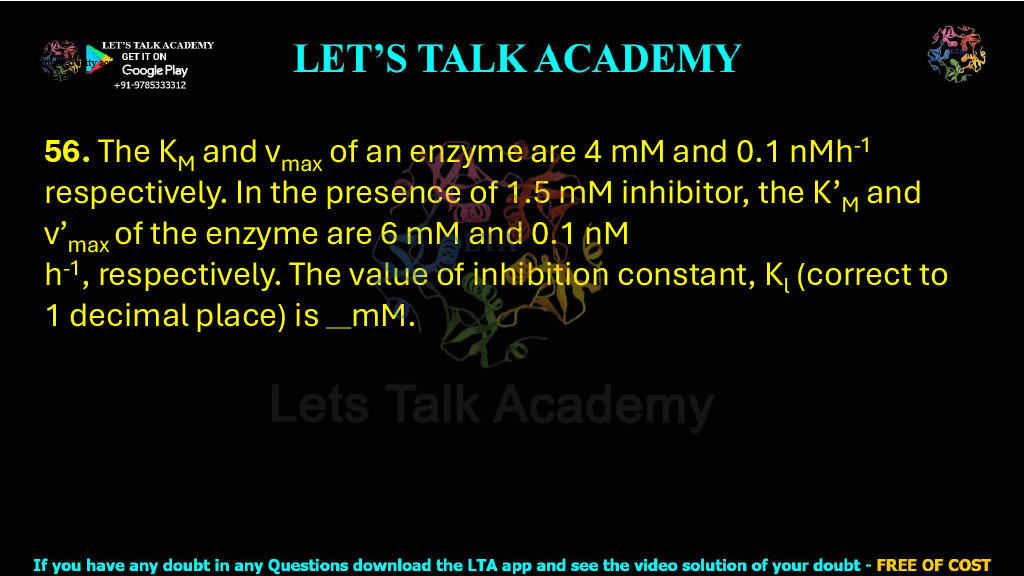
56. The KM and vmax of an enzyme are 4 mM and 0.1 nMh-1 respectively. In the presence of 1.5 mM inhibitor, the K’M and v’max of the enzyme are 6 mM and 0.1 nM
h-1, respectively. The value of inhibition constant, Kl (correct to 1 decimal place) is mM.
How to Calculate the Inhibition Constant (Ki) from Michaelis–Menten Parameters?
Correct Answer
3.0 mM
Introduction
Enzyme inhibitors regulate biochemical reactions by decreasing the catalytic activity of enzymes. Among the different types of reversible inhibition, competitive inhibition is one of the most frequently encountered mechanisms in enzyme kinetics. In competitive inhibition, the inhibitor resembles the substrate and competes for binding at the enzyme’s active site. As a result, a higher substrate concentration is required to achieve the same reaction velocity, causing the apparent Michaelis constant (Km) to increase while the maximum reaction velocity (Vmax) remains unchanged.
The strength of a competitive inhibitor is expressed by its inhibition constant (Ki). A smaller Ki indicates tighter binding of the inhibitor to the enzyme, whereas a larger Ki indicates weaker inhibition.
Understanding the Concept Behind the Question
The given kinetic parameters are:
Km = 4 mM
Vmax = 0.1 nM h⁻¹
In the presence of inhibitor:
K′m = 6 mM
V′max = 0.1 nM h⁻¹
Since Vmax remains unchanged while Km increases, the inhibitor is clearly competitive.
For competitive inhibition:
K′m = Km × (1 + [I]/Ki)
where,
- K′m = Apparent Michaelis constant
- Km = Original Michaelis constant
- [I] = Inhibitor concentration
- Ki = Inhibition constant
The inhibitor concentration is:
[I] = 1.5 mM
Step 1. Write the Competitive Inhibition Equation
K′m = Km × (1 + [I]/Ki)
Step 2. Substitute the Given Values
6 = 4 × (1 + 1.5/Ki)
Step 3. Divide Both Sides by 4
6/4 = 1 + 1.5/Ki
1.5 = 1 + 1.5/Ki
Step 4. Rearrange the Equation
Subtract 1 from both sides:
0.5 = 1.5/Ki
Now solve for Ki:
Ki = 1.5/0.5
Ki = 3.0 mM
Final Calculation
Ki = 3.0 mM
Why Is This Competitive Inhibition?
One of the defining characteristics of competitive inhibition is that the inhibitor competes directly with the substrate for the enzyme’s active site.
Because sufficiently high substrate concentrations can outcompete the inhibitor, the enzyme can still achieve its original maximum velocity.
Therefore:
- Vmax remains unchanged
- Km increases
The given data show exactly this behavior:
- Km increases from 4 to 6 mM
- Vmax remains 0.1 nM h⁻¹
Hence, the inhibitor is competitive.
Formula Used
Competitive Inhibition
K′m = Km × (1 + [I]/Ki)
Rearranging,
Ki = [I] / [(K′m/Km) − 1]
This simplified equation is particularly useful for solving numerical problems quickly.
Biological Importance
Competitive inhibition is one of the most common mechanisms by which drugs regulate enzyme activity. Many therapeutic agents function as competitive inhibitors because they resemble the natural substrate and occupy the enzyme’s active site without undergoing catalysis. Examples include methotrexate, statins, and sulfonamides. Determining the inhibition constant (Ki) helps researchers evaluate inhibitor potency and optimize drug design in pharmaceutical research.
High-Yield Points
- Competitive inhibition increases Km.
- Vmax remains unchanged in competitive inhibition.
- Lower Ki indicates stronger inhibitor binding.
- Formula:
K′m = Km (1 + [I]/Ki)
- Rearranged formula:
Ki = [I] / [(K′m/Km) − 1]
- Active-site binding is characteristic of competitive inhibitors.
Frequently Asked Questions
Why does Km increase during competitive inhibition?
The inhibitor competes with the substrate for binding to the active site. As a result, a higher substrate concentration is required to achieve half of Vmax, increasing the apparent Km.
Why does Vmax remain unchanged?
At sufficiently high substrate concentrations, the substrate outcompetes the inhibitor for binding to the enzyme. Therefore, the enzyme can still reach its original maximum velocity.
What does Ki represent?
The inhibition constant (Ki) measures the affinity of an inhibitor for the enzyme. Smaller Ki values indicate stronger inhibitor binding and more effective inhibition.
Key Takeaways
The unchanged Vmax together with an increased Km clearly indicates competitive inhibition. Applying the competitive inhibition equation:
K′m = Km (1 + [I]/Ki)
and substituting the given values:
6 = 4 (1 + 1.5/Ki)
gives:
Ki = 3.0 mM
This numerical problem demonstrates how changes in Michaelis–Menten parameters can be used to identify the type of inhibition and calculate the inhibitor’s binding affinity.
Final Answer
Ki = 3.0 mM
Explanation
Since Vmax remains unchanged (0.1 nM h⁻¹) while Km increases from 4 mM to 6 mM, the inhibitor is competitive. Using the competitive inhibition equation:
K′m = Km (1 + [I]/Ki)
Substituting the given values:
6 = 4 (1 + 1.5/Ki)
1.5 = 1 + 1.5/Ki
0.5 = 1.5/Ki
Ki = 1.5 ÷ 0.5 = 3.0 mM
Therefore, the inhibition constant (Ki) is 3.0 mM.


