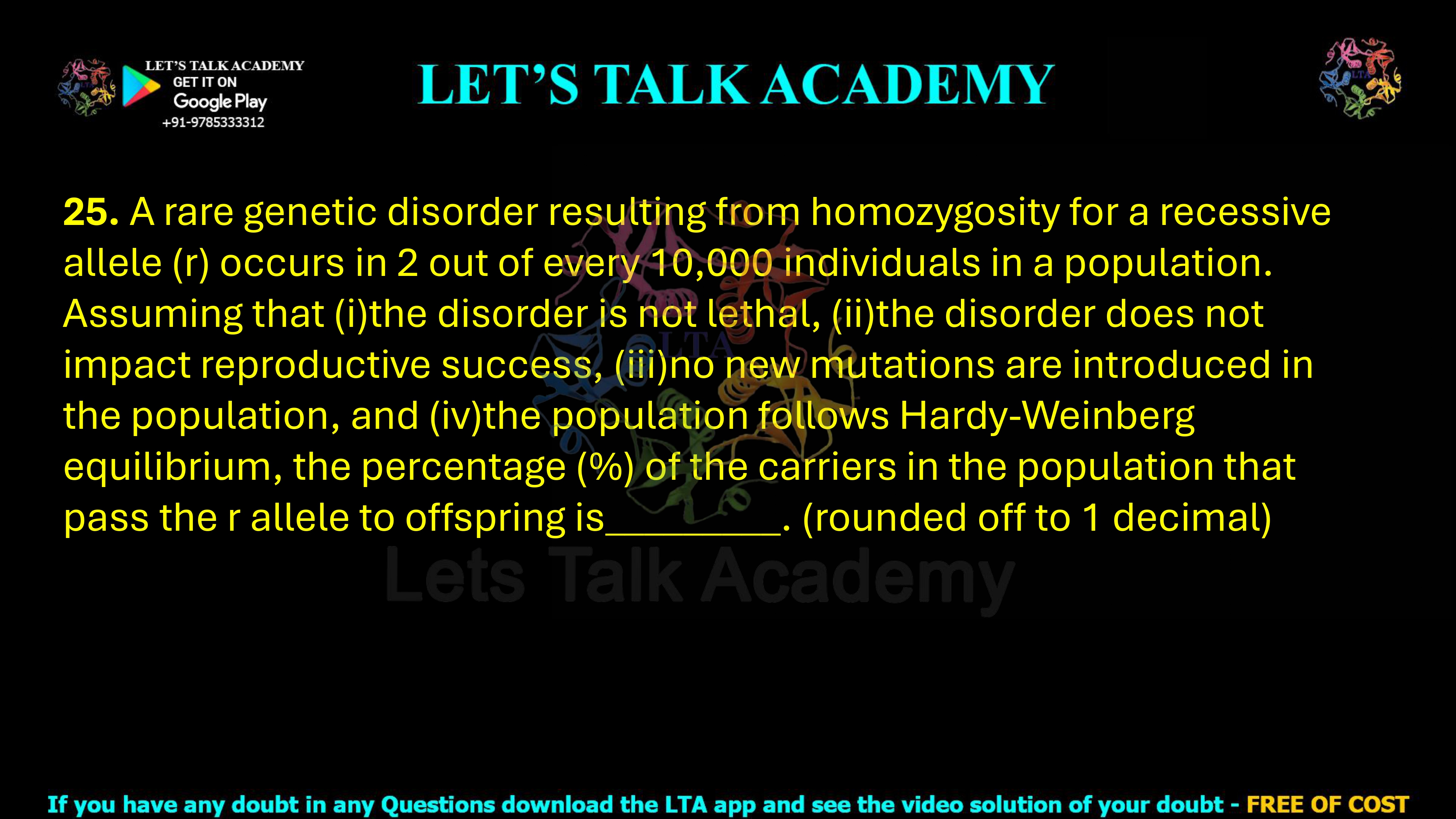
25. A rare genetic disorder resulting from homozygosity for a recessive allele (r) occurs in 2 out of every 10,000 individuals in a population. Assuming that (i)the disorder is not lethal, (ii)the disorder does not impact reproductive success, (iii)no new mutations are introduced in the population, and (iv)the population follows Hardy-Weinberg equilibrium, the percentage (%) of the carriers in the population that pass the r allele to offspring is_________. (rounded off to 1 decimal)
Hardy-Weinberg Equilibrium: Calculating the Percentage of Carriers That Pass the Recessive Allele
Introduction
Hardy-Weinberg equilibrium is one of the most important mathematical models in population genetics. It predicts how allele frequencies and genotype frequencies remain constant across generations when evolutionary forces such as mutation, migration, natural selection, genetic drift, and non-random mating are absent. This principle provides the foundation for estimating disease prevalence, carrier frequency, and inheritance patterns in human populations.
For autosomal recessive disorders, affected individuals possess the genotype rr, whereas heterozygous individuals (Rr) are known as carriers. Although carriers do not usually exhibit disease symptoms, they possess one copy of the recessive allele and can transmit it to their offspring. Consequently, calculating carrier frequency and the probability of allele transmission is essential in medical genetics, genetic counseling, and disease prediction.
Correct Answer
Correct Answer: 50.0%
Detailed Explanation
The prevalence of the disorder represents the frequency of the homozygous recessive genotype (rr), which is denoted by q² in the Hardy-Weinberg equation.
Given:
q² = 2 / 10,000 = 0.0002
Therefore,
q = √0.0002 ≈ 0.0141
Since:
p + q = 1
p = 1 − 0.0141 = 0.9859
The carrier frequency is:
2pq = 2 × 0.9859 × 0.0141 ≈ 0.0278
However, the question does not ask for the percentage of carriers in the population. Instead, it asks:
“What percentage of carriers pass the recessive allele (r) to their offspring?”
A carrier has the genotype:
Rr
During meiosis, each gamete receives only one allele.
Therefore, every carrier produces:
- 50% R gametes
- 50% r gametes
Thus, irrespective of the allele frequency in the population, every heterozygous carrier transmits the recessive allele to half of its gametes.
Therefore, the percentage of carriers that pass the r allele to their offspring is:
50.0%
Step-by-Step Calculation
Step 1: Calculate the Frequency of Homozygous Recessive Individuals
q² = 2 / 10,000 = 0.0002
Step 2: Calculate the Recessive Allele Frequency
q = √0.0002 ≈ 0.0141
Step 3: Calculate the Carrier Frequency
2pq = 2 × 0.9859 × 0.0141 ≈ 0.0278
This means approximately 2.78% of the population are carriers.
Step 4: Determine the Allele Transmission by Carriers
Each carrier has genotype:
Rr
Gametes produced:
- 50% R
- 50% r
Hence, each carrier passes the recessive allele with a probability of:
50%
Calculation Summary
| Parameter | Value |
|---|---|
| Disease Frequency (q²) | 0.0002 |
| Allele Frequency (q) | 0.0141 |
| Dominant Allele Frequency (p) | 0.9859 |
| Carrier Frequency (2pq) | 0.0278 (2.78%) |
| Probability That a Carrier Passes r | 50% |
Understanding Why the Answer Is 50%
A common mistake is to calculate only the carrier frequency using Hardy-Weinberg equilibrium and assume that is the final answer. However, this question specifically asks about the probability that carriers transmit the recessive allele.
Since every carrier is heterozygous (Rr), meiosis produces two equally likely gametes:
| Carrier Genotype | Gametes Produced | Frequency |
|---|---|---|
| Rr | R | 50% |
| Rr | r | 50% |
Therefore, regardless of how rare or common the disease is, every carrier transmits the recessive allele to half of its offspring on average.
Hardy-Weinberg Equations
| Expression | Meaning |
|---|---|
| p + q = 1 | Allele frequencies |
| p² | Homozygous dominant |
| 2pq | Heterozygous carriers |
| q² | Homozygous recessive |
| p² + 2pq + q² = 1 | Total genotype frequencies |
Biological Significance
Carrier individuals play a major role in the persistence of recessive genetic disorders within populations. Although they usually remain healthy, they silently transmit disease-causing alleles to future generations. Estimating carrier frequencies and understanding allele transmission are therefore fundamental aspects of medical genetics, prenatal diagnosis, population screening, and genetic counseling. Hardy-Weinberg equilibrium provides the mathematical framework for these calculations.
Final Answer
The disease frequency is:
q² = 2/10,000 = 0.0002
The carrier genotype is:
Rr
Each carrier produces:
50% R gametes and 50% r gametes
Therefore, the percentage of carriers that pass the recessive allele to their offspring is:
50.0%
Correct Answer: 50.0%


