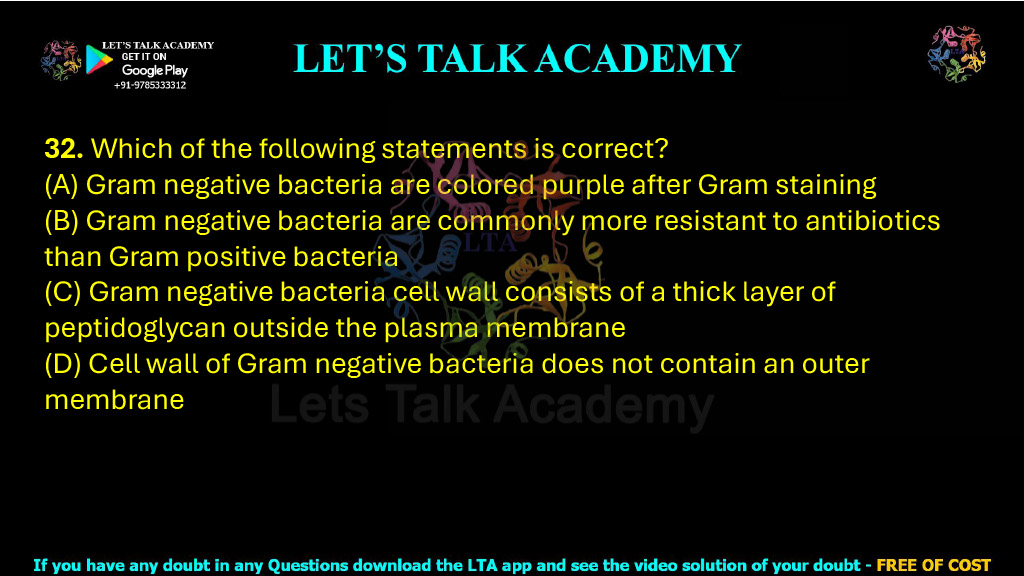
32. Which of the following statements is correct?
(A) Gram negative bacteria are colored purple after Gram staining
(B) Gram negative bacteria are commonly more resistant to antibiotics than Gram positive bacteria
(C) Gram negative bacteria cell wall consists of a thick layer of peptidoglycan outside the plasma membrane
(D) Cell wall of Gram negative bacteria does not contain an outer membrane
Gram-Negative Bacteria: Cell Wall Structure, Gram Staining, and Antibiotic Resistance Explained
Introduction
Gram staining is one of the most fundamental laboratory techniques in microbiology and serves as the basis for classifying bacteria into Gram-positive and Gram-negative groups. Developed by Hans Christian Gram in 1884, this differential staining technique distinguishes bacteria according to the structural organization of their cell walls. The difference in staining behavior reflects major variations in peptidoglycan thickness, membrane organization, and cell envelope composition, all of which influence bacterial physiology, pathogenicity, and susceptibility to antibiotics.
Gram-negative bacteria possess a unique cell envelope consisting of an inner plasma membrane, a thin peptidoglycan layer located within the periplasmic space, and an outer membrane containing lipopolysaccharide (LPS). This outer membrane acts as an effective permeability barrier against many antimicrobial agents, detergents, and toxic compounds. Consequently, Gram-negative bacteria are generally more resistant to antibiotics than Gram-positive bacteria. Understanding these structural differences is essential for microbiology, infectious diseases, biotechnology, and medical sciences.
Correct Answer
Correct Option: (B) Gram-negative bacteria are commonly more resistant to antibiotics than Gram-positive bacteria.
Detailed Explanation
Gram-negative bacteria possess a highly specialized cell envelope composed of an inner plasma membrane, a thin peptidoglycan layer, and an outer membrane containing lipopolysaccharide (LPS). This additional outer membrane serves as a protective permeability barrier that restricts the entry of numerous antibiotics, detergents, bile salts, and toxic molecules. Moreover, porin proteins selectively regulate the movement of substances across the outer membrane, while the periplasmic space often contains enzymes such as β-lactamases that can inactivate antibiotics before they reach their targets.
Because of these structural characteristics, Gram-negative bacteria are generally more resistant to antibiotics than Gram-positive bacteria. Although some antibiotics remain effective against Gram-negative organisms, treatment is often more challenging due to the presence of the outer membrane, multidrug efflux pumps, and antibiotic-degrading enzymes.
In contrast, Gram-positive bacteria possess a thick peptidoglycan layer but lack an outer membrane. During Gram staining, the thick peptidoglycan retains the crystal violet-iodine complex, causing Gram-positive cells to appear purple. Gram-negative bacteria lose the primary stain during alcohol decolorization and subsequently take up the counterstain safranin, appearing pink or red.
Explanation of Each Option
Option (A): Gram-Negative Bacteria are Colored Purple After Gram Staining
This statement is incorrect. Gram-negative bacteria do not retain the crystal violet stain because of their thin peptidoglycan layer. After decolorization, they absorb the safranin counterstain and appear pink or red.
Option (B): Gram-Negative Bacteria are Commonly More Resistant to Antibiotics than Gram-Positive Bacteria
This statement is correct. The presence of the outer membrane, lipopolysaccharide, porins, periplasmic enzymes, and efflux pumps makes Gram-negative bacteria generally more resistant to many antibiotics.
Option (C): Gram-Negative Bacteria Cell Wall Consists of a Thick Layer of Peptidoglycan Outside the Plasma Membrane
This statement is incorrect. Gram-negative bacteria possess only a thin peptidoglycan layer located within the periplasmic space. A thick peptidoglycan layer is characteristic of Gram-positive bacteria.
Option (D): Cell Wall of Gram-Negative Bacteria Does Not Contain an Outer Membrane
This statement is incorrect. The outer membrane is one of the defining structural features of Gram-negative bacteria and contains lipopolysaccharide (LPS), phospholipids, lipoproteins, and porins.
Why Option (B) is Correct
Gram-negative bacteria possess an additional outer membrane that restricts antibiotic entry and frequently contain β-lactamases and multidrug efflux systems. These features collectively make them more resistant to antibiotics than most Gram-positive bacteria.
Why the Other Options are Incorrect
Why Option (A) is Incorrect
Only Gram-positive bacteria retain crystal violet and appear purple after Gram staining. Gram-negative bacteria appear pink because they take up the safranin counterstain.
Why Option (C) is Incorrect
The thick peptidoglycan layer described in this option is a characteristic of Gram-positive bacteria, not Gram-negative bacteria.
Why Option (D) is Incorrect
The outer membrane is the most distinguishing feature of Gram-negative bacteria and is responsible for many of their biological properties, including increased antibiotic resistance.
Comparison of All Options
| Option | Statement | Status |
|---|---|---|
| A | Gram-negative bacteria stain purple | Incorrect |
| B | Gram-negative bacteria are commonly more resistant to antibiotics | Correct |
| C | Thick peptidoglycan layer | Incorrect |
| D | No outer membrane | Incorrect |
Gram-Positive vs Gram-Negative Bacteria
| Feature | Gram-Positive | Gram-Negative |
|---|---|---|
| Gram Stain Color | Purple | Pink/Red |
| Peptidoglycan Layer | Thick | Thin |
| Outer Membrane | Absent | Present |
| Lipopolysaccharide (LPS) | Absent | Present |
| Teichoic Acids | Present | Absent |
| Periplasmic Space | Minimal | Well developed |
| Antibiotic Resistance | Generally lower | Generally higher |
Steps of Gram Staining
| Step | Reagent | Purpose |
|---|---|---|
| 1 | Crystal Violet | Primary stain |
| 2 | Gram’s Iodine | Mordant |
| 3 | Alcohol/Acetone | Decolorization |
| 4 | Safranin | Counterstain |
Importance of the Outer Membrane
| Component | Function |
|---|---|
| Lipopolysaccharide (LPS) | Endotoxin and structural stability |
| Porins | Selective transport of small molecules |
| Lipoproteins | Connect outer membrane to peptidoglycan |
| Periplasmic Enzymes | Antibiotic degradation and nutrient processing |
Biological Significance
The unique cell envelope of Gram-negative bacteria contributes significantly to their pathogenicity and environmental adaptability. The outer membrane protects bacteria from harmful chemicals, while lipopolysaccharide acts as an endotoxin capable of triggering fever, inflammation, septic shock, and disseminated intravascular coagulation. Understanding these structural features is essential for developing new antimicrobial drugs capable of overcoming the protective barrier of Gram-negative pathogens.
Final Answer
Correct Option: (B)
Gram-negative bacteria are commonly more resistant to antibiotics than Gram-positive bacteria because their outer membrane, lipopolysaccharide layer, porins, and periplasmic enzymes provide an additional barrier against many antimicrobial agents.


