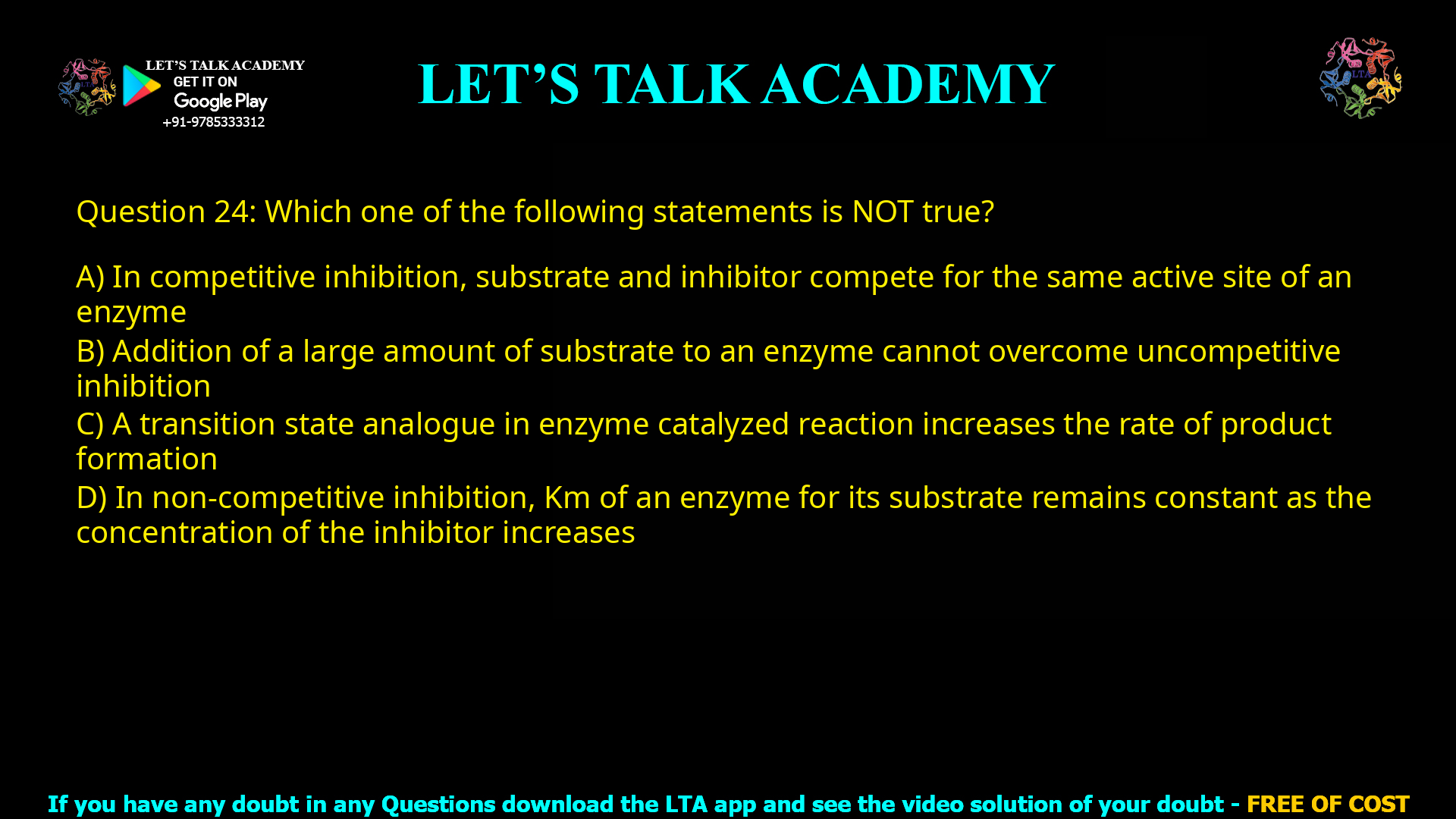
Q.24 Which one of the following statements is NOT true?
(A) In competitive inhibition, substrate and inhibitor compete for the same active site of an enzyme
(B) Addition of a large amount of substrate to an enzyme cannot overcome uncompetitive inhibition
(C) A transition state analogue in enzyme catalyzed reaction increases the rate of product formation
(D) In non-competitive inhibition, Km of an enzyme for its substrate remains constant as the
concentration of the inhibitor increases
Option C is not true. Transition state analogues stabilize the transition state, acting as inhibitors that decrease the reaction rate rather than increasing product formation.
Option Analysis
Competitive Inhibition (A): True. The inhibitor binds reversibly to the enzyme’s active site, directly competing with the substrate and preventing its binding. High substrate concentrations can overcome this by outcompeting the inhibitor.
Uncompetitive Inhibition (B): True. The inhibitor binds only to the enzyme-substrate complex at a site distinct from the active site, so excess substrate cannot displace it and inhibition persists.
Transition State Analogue (C): False. These stable mimics of the high-energy transition state bind tightly to the enzyme, inhibiting catalysis by stabilizing the transition state mimic over the true transition state, thus slowing product formation.
Non-Competitive Inhibition (D): True. The inhibitor binds an allosteric site, reducing Vmax while Km stays constant since substrate affinity at the active site remains unchanged.
Understanding Enzyme Inhibition
Enzymes accelerate reactions by stabilizing transition states, but inhibitors disrupt this. Competitive inhibition involves substrate and inhibitor battling for the active site, while uncompetitive and non-competitive types bind differently. This regulation maintains metabolic balance.
Competitive Inhibition Mechanics
Inhibitors mimic substrates, occupying the active site reversibly. Km rises (apparent lower affinity), but Vmax holds as excess substrate displaces the inhibitor.
Uncompetitive and Non-Competitive Differences
Uncompetitive inhibitors target the ES complex exclusively; substrate addition worsens inhibition by forming more ES. Non-competitive inhibitors hit allosteric sites, dropping Vmax while Km remains fixed.
Transition State Analogues Role
These inhibitors resemble the fleeting transition state, binding with extreme affinity (often Ki in nanomolar range). No rate increase occurs—they block progression to products.
| Inhibition Type | Binding Site | Effect on Km | Effect on Vmax | Overcome by Substrate? |
|---|---|---|---|---|
| Competitive | Active site | Increases | Unchanged | Yes |
| Uncompetitive | ES complex | Decreases | Decreases | No |
| Non-competitive | Allosteric | Unchanged | Decreases | No |


