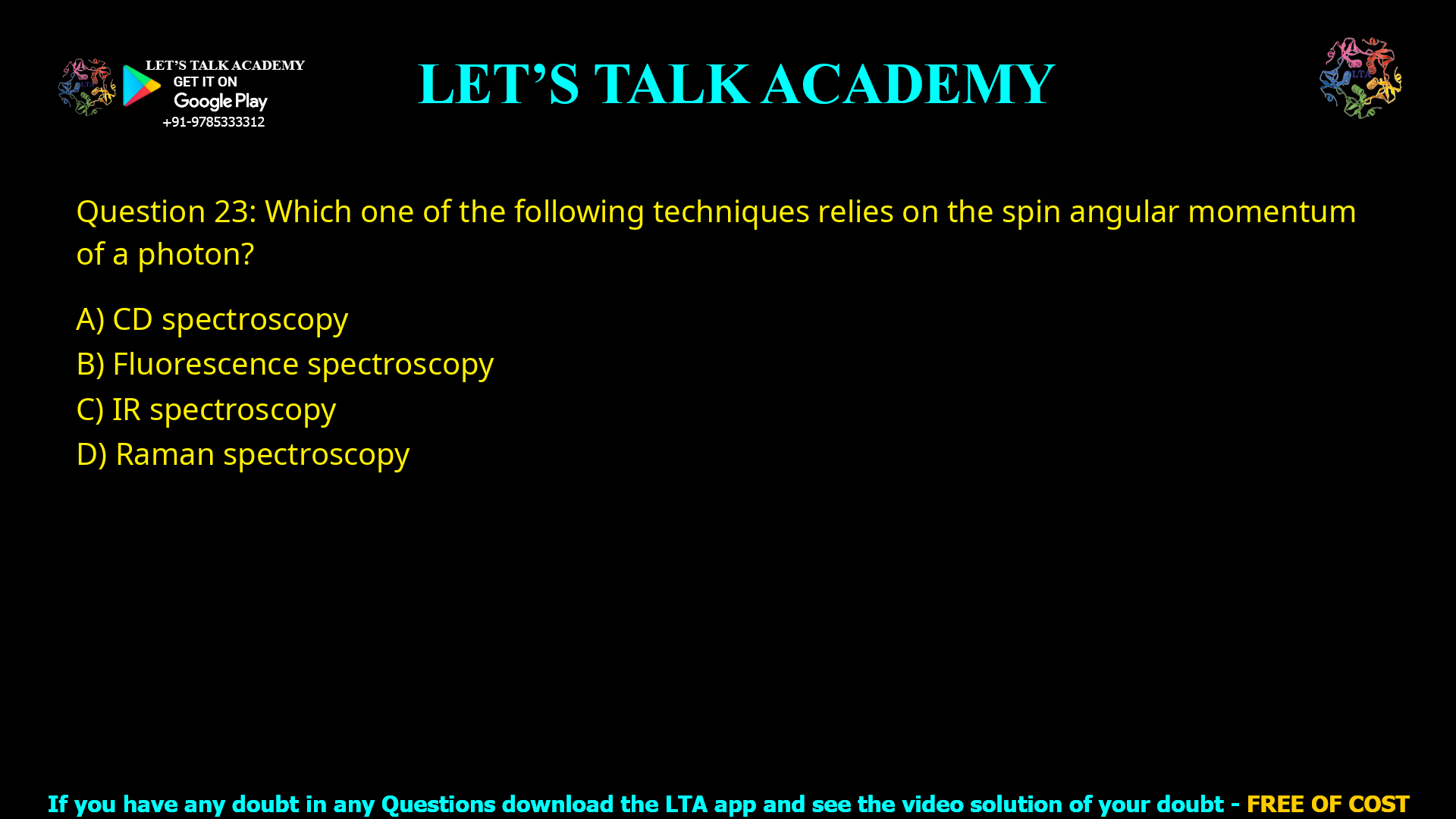
Q.23 Which one of the following techniques relies on the spin angular momentum of a photon?
(A) CD spectroscopy (B) Fluorescence spectroscopy
(C) IR spectroscopy (D) Raman spectroscopy
CD spectroscopy is the technique that relies on the spin angular momentum of a photon, as it measures differential absorption between left- and right-circularly polarized light, where circular polarization corresponds to the photon’s spin states of ±1. This distinguishes it from the other options, which do not depend on photon spin. Below is a detailed explanation of each option, followed by key insights.
Option Analysis
Circular Dichroism (CD) Spectroscopy (Correct Answer)
CD spectroscopy probes chiral molecules by using circularly polarized light, where left-hand circular (LHC) and right-hand circular (RHC) polarizations represent the two spin angular momentum states (±ħ) of photons. Chiral samples absorb one polarization more than the other due to their handedness, yielding a CD signal that reports on secondary structures like alpha-helices in proteins. Photons’ spin directly enables this differential absorption, making CD unique among the options.
Fluorescence Spectroscopy
Fluorescence involves exciting molecules with linearly polarized light, followed by emission detection, focusing on electronic transitions and lifetimes rather than photon spin. It measures intensity decay or anisotropy from rotational motion, with no reliance on circular polarization or spin angular momentum. This technique suits fluorophore studies but ignores photon’s intrinsic spin properties.
IR Spectroscopy
Infrared spectroscopy detects molecular vibrations via absorption of IR photons, using linear polarization or unpolarized light to match bond dipole changes. It provides functional group fingerprints without considering photon spin, as the interaction is electric dipole-based. Spin angular momentum plays no role here.
Raman Spectroscopy
Raman relies on inelastic scattering of monochromatic laser photons (typically linear), where energy shifts reveal vibrational modes through polarizability changes. No circular polarization or spin dependence occurs in standard Raman; it’s about photon-molecule scattering, not spin states. Variants like surface-enhanced Raman also ignore spin.
Key Differences Table
| Technique | Photon Interaction | Relies on Spin Angular Momentum? | Primary Application |
|---|---|---|---|
| CD Spectroscopy | Differential absorption | Yes | Chiral structure analysis |
| Fluorescence | Excitation-emission | No | Electronic states, dynamics |
| IR Spectroscopy | Vibrational absorption | No | Functional groups |
| Raman Spectroscopy | Inelastic scattering | No | Vibrational fingerprints |
Applications in Molecular Biology
Given expertise in molecular biology and biotechnology, CD spectroscopy excels for protein folding and enantiomer detection, complementing fluorescence for dynamics or Raman for vibrations. It uses UV-Vis range light, aligning with lab techniques like PCR or ELISA in chiral biomolecule studies.


