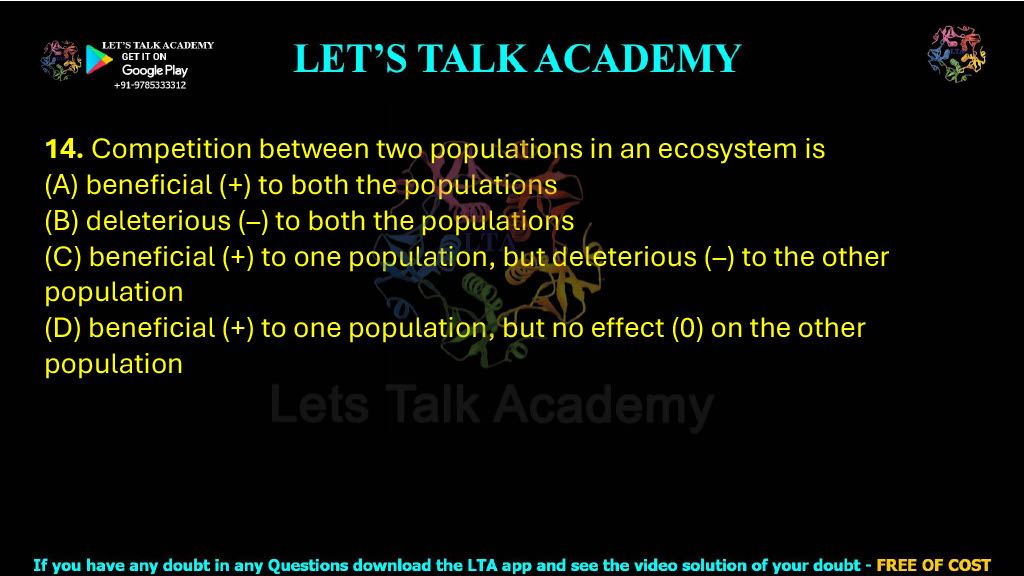
14. Competition between two populations in an ecosystem is
(A) beneficial (+) to both the populations
(B) deleterious (–) to both the populations
(C) beneficial (+) to one population, but deleterious (–) to the other population
(D) beneficial (+) to one population, but no effect (0) on the other population
Competition Between Two Populations in an Ecosystem: Why the Interaction Is Negative for Both
Explanation of the Correct Answer
The correct answer is (B) deleterious (–) to both the populations because competition is classified as a negative-negative (–/–) ecological interaction. Competition occurs when two populations require the same limited resource, such as food, water, nutrients, light, space, shelter, or breeding sites. Because the resource is insufficient to satisfy the requirements of both populations completely, the presence of each population reduces the availability of that resource to the other.
In ecological interaction notation, a positive sign (+) indicates that a population receives a benefit, a negative sign (–) indicates that a population is adversely affected, and zero (0) indicates that a population is neither significantly benefited nor harmed. Since both competing populations experience a reduction in access to a limited resource, competition is represented as (–/–).
The word deleterious means harmful or disadvantageous. This does not necessarily mean that both populations are immediately eliminated from the ecosystem. Instead, competition can reduce population growth rate, survival, reproduction, resource acquisition, or overall fitness compared with the situation in which the competitor is absent.
For example, imagine that two fish populations living in the same lake depend on the same limited food source. When the first population consumes part of the available food, less food remains for the second population. At the same time, consumption by the second population reduces the amount of food available to the first. Therefore, each population negatively affects the other, making the interaction deleterious to both populations.
What Is Competition in Ecology?
Competition is a biological interaction in which organisms or populations require the same resource and the availability of that resource is limited. The essential condition for competition is not simply that two populations use the same resource. The resource must be sufficiently limited so that its use by one population reduces its availability to the other.
Competition is one of the most important ecological interactions because it can influence population size, species distribution, resource use, community structure, ecological niches, and evolutionary adaptation. It can determine which species survive in a habitat, whether competing species coexist, and how species divide available resources.
When two populations compete, each population would generally perform better if the competing population were absent. This is the fundamental reason competition receives a negative sign for both participants.
Why Is Competition Represented as a Negative-Negative Interaction?
Competition is represented by the symbol (–/–) because both participants experience a negative effect. Each population reduces the availability of a resource required by the other population.
Suppose two plant populations grow in the same habitat and both require sunlight, water, mineral nutrients, and space. If one population absorbs water and nutrients from the soil, fewer resources remain available to the other population. Similarly, the second population also consumes resources that could otherwise have been used by the first.
Therefore, neither population benefits from the presence of its competitor. Both populations experience some ecological cost, which may appear as slower growth, reduced reproductive output, lower survival, decreased population density, or restricted access to suitable habitat.
This reciprocal negative effect distinguishes competition from other ecological interactions such as mutualism, predation, parasitism, commensalism, and amensalism.
How Competition Develops Between Two Populations
Competition begins when the ecological requirements of two populations overlap and the shared resource becomes limiting. If a resource is present in unlimited quantities, the use of that resource by one population may not significantly affect the other population. Under such conditions, strong competition does not occur.
However, when the demand for a resource exceeds its availability, individuals must compete to obtain enough of that resource for survival, growth, and reproduction. As the overlap in resource requirements increases, the potential intensity of competition may also increase.
Step 1: Two Populations Share the Same Habitat
Two populations occur in the same ecosystem or use overlapping areas of the environment. Their presence in the same habitat creates the possibility of interaction, although simply living together is not sufficient to establish competition.
Step 2: Both Populations Require the Same Resource
The populations depend on a common ecological resource. This shared resource may include food, water, mineral nutrients, sunlight, space, nesting sites, shelter, or another factor required for survival and reproduction.
Step 3: The Shared Resource Becomes Limited
Competition becomes ecologically important when the shared resource is not available in sufficient quantity to meet the requirements of both populations. The use of the resource by one population then reduces the amount available to the other.
Step 4: Both Populations Experience Negative Effects
As competition continues, both populations experience a cost. Their growth rates may decline, fewer individuals may survive, reproductive success may decrease, or population densities may remain below the levels that could be achieved in the absence of competition.
The process can be summarized as:
Two populations → Shared resource requirement → Resource limitation → Reduced resource availability → Negative effect on both populations → Competition (–/–)
Intraspecific and Interspecific Competition
Competition can occur between individuals of the same species or between individuals belonging to different species. These two forms are known as intraspecific competition and interspecific competition.
Intraspecific Competition
Intraspecific competition occurs among individuals belonging to the same species. Because members of the same species generally have very similar ecological requirements, they often compete strongly for food, space, mates, nesting sites, and other resources.
For example, plants of the same species growing close together may compete for sunlight, water, and soil nutrients. Similarly, individuals within an animal population may compete for territories, food, or mating opportunities.
Intraspecific competition plays an important role in density-dependent population regulation. As population density increases, resources become more limited, and competition among individuals may reduce survival and reproduction.
Interspecific Competition
Interspecific competition occurs between individuals or populations belonging to different species. This type of competition develops when the ecological niches of two species overlap and both depend on the same limited resource.
For example, two bird species may compete for the same nesting sites, two plant species may compete for sunlight and nutrients, or two predator species may depend on the same prey population.
The question specifically refers to competition between two populations in an ecosystem. Regardless of whether the focus is on population-level competition generally or on interspecific competition between different species, the interaction is represented as (–/–) because both competing populations are negatively affected.
Detailed Explanation of Every Option
Option (A): Beneficial (+) to Both Populations — Incorrect
An interaction that benefits both participating populations is represented as (+/+). This type of relationship is generally associated with mutualism rather than competition.
In mutualism, both populations obtain a benefit from the interaction. For example, a flowering plant may provide nectar to a pollinator, while the pollinator helps the plant transfer pollen and reproduce. Both participants receive a positive effect.
Competition works in the opposite direction. When two populations compete for the same limited resource, the use of that resource by one population decreases its availability to the other. Both populations therefore experience a cost rather than a benefit.
If one competitor were removed, the remaining population would generally gain greater access to the limited resource and could potentially show increased growth, survival, or reproduction. This demonstrates that the presence of the competitor has a negative effect.
Therefore, option (A) is incorrect because a beneficial effect on both populations represents a positive-positive interaction, not competition.
Option (B): Deleterious (–) to Both Populations — Correct
This is the correct answer because competition is a negative-negative (–/–) interaction. Both populations require a common limited resource, and each population reduces the amount of that resource available to the other.
The negative effect may be expressed through reduced growth, lower reproductive success, decreased survival, restricted distribution, reduced population density, or decreased access to essential resources.
Even if one population is a stronger competitor and eventually excludes the other, competition still imposes a cost on both populations during their interaction. The stronger competitor must still invest energy and resources in obtaining, defending, or exploiting the shared resource.
Therefore, option (B) is correct.
Option (C): Beneficial (+) to One Population but Deleterious (–) to the Other — Incorrect
An interaction in which one population benefits while the other is harmed is represented as (+/–). This pattern is associated with ecological interactions such as predation, parasitism, and herbivory.
In predation, the predator benefits by obtaining food, while the prey is harmed. In parasitism, the parasite benefits by obtaining resources from the host, while the host experiences a negative effect.
Competition is fundamentally different because neither population benefits from the presence of its competitor. Each population would generally have access to more resources if the competitor were absent.
Therefore, option (C) is incorrect because a positive-negative interaction does not represent competition.
Option (D): Beneficial (+) to One Population but No Effect (0) on the Other — Incorrect
An interaction in which one population benefits while the other is neither significantly helped nor harmed is represented as (+/0). This type of ecological interaction is known as commensalism.
In commensalism, one participant gains a benefit such as food, shelter, transport, or physical support, while the other participant experiences no significant effect.
Competition cannot be represented as (+/0) because the defining feature of competition is that the activities of each competitor negatively influence the other through the use of a limited resource.
Therefore, option (D) is incorrect.
Comparison of Major Ecological Interactions
Ecological interactions are commonly classified according to their effects on the participating populations. A positive sign indicates benefit, a negative sign indicates harm, and zero indicates no significant effect.
Mutualism (+/+): Both populations benefit from the interaction.
Competition (–/–): Both populations are negatively affected because they depend on the same limited resource.
Predation (+/–): The predator benefits while the prey is harmed.
Parasitism (+/–): The parasite benefits while the host is harmed.
Commensalism (+/0): One population benefits while the other experiences no significant effect.
Amensalism (–/0): One population is harmed while the other experiences no significant effect.
Among these interactions, competition is uniquely identified in this question by the negative-negative (–/–) relationship.
Role of Limited Resources in Competition
Resource limitation is central to understanding ecological competition. Populations may have similar requirements, but strong competition occurs only when a shared resource is sufficiently limited.
For example, two plant populations may both require sunlight. If both populations grow in an open environment where sunlight is abundant, competition for light may be weak. However, in a dense forest where sunlight reaching the lower vegetation is limited, plants may compete intensely for access to light.
The same principle applies to food, water, nutrients, nesting sites, and space. When the supply of a resource becomes lower than the combined demand of the populations, the use of the resource by one competitor reduces the opportunity for the other competitor to obtain it.
This explains why competition has a negative effect on both populations.
Exploitative and Interference Competition
Competition can occur through different mechanisms. Two important forms are exploitative competition and interference competition.
Exploitative Competition
Exploitative competition, also called resource competition, occurs when populations indirectly compete by consuming the same limited resource. The competitors do not necessarily need to come into direct physical contact.
For example, two animal populations may feed on the same limited food source. When one population consumes more food, less remains available to the other. Similarly, plant populations can compete indirectly by absorbing the same water and mineral nutrients from the soil.
Interference Competition
Interference competition occurs when one organism or population directly prevents another from accessing a resource. This may involve territorial behaviour, aggression, chemical inhibition, or physical exclusion.
For example, animals may defend territories against competitors, while some organisms may produce chemicals that inhibit the growth of nearby competitors.
Although the mechanisms differ, both exploitative and interference competition produce negative effects on the competing populations.
Competition and the Competitive Exclusion Principle
Strong competition can influence whether two species are able to coexist. According to the competitive exclusion principle, two species with completely identical ecological requirements cannot coexist indefinitely in a stable environment when they depend on the same limiting resource.
If one species consistently uses the limiting resource more efficiently, it may gradually reduce the population size of the weaker competitor. Over time, the weaker competitor may be locally excluded from the habitat.
However, competing species may coexist if they reduce the intensity of competition by using resources differently. This may occur through differences in food choice, feeding time, habitat use, rooting depth, or other ecological characteristics.
Therefore, competition can influence not only population growth but also species coexistence and the structure of ecological communities.
Competition and Resource Partitioning
Resource partitioning occurs when competing species use shared resources in different ways, thereby reducing the intensity of competition. Instead of using exactly the same part of a resource, species may divide the resource according to space, time, or type.
For example, two bird species may feed on different parts of the same tree. One species may search for food near the top of the tree, while the other feeds on lower branches. Similarly, two predators may hunt at different times of the day.
Resource partitioning can promote coexistence because it reduces niche overlap. However, the ecological interaction that drives the need for such differentiation remains competition, which is fundamentally a negative-negative interaction.
Competition in the Lotka-Volterra Model
The Lotka-Volterra competition model provides a mathematical framework for understanding competition between two populations. The model modifies logistic population growth by including the negative effect of one competing population on the growth of the other.
Each population has its own carrying capacity, but the effective growth of each population is reduced by the presence of its competitor. The strength of this effect is represented by competition coefficients.
Depending on the relative carrying capacities and competition coefficients, the model predicts different possible outcomes. One species may exclude the other, either species may win depending on initial conditions, or both species may coexist at a stable equilibrium.
Despite these different outcomes, the underlying interaction remains negative for both populations because each competitor reduces the potential growth of the other.
Final Answer
Competition occurs when two populations depend on the same limited ecological resource. The use of that resource by one population reduces its availability to the other, and the same effect operates in the opposite direction.
As a result, both populations experience a negative effect. Their growth, survival, reproduction, population density, or access to resources may be reduced compared with conditions in which the competitor is absent.
Therefore, competition is classified as a negative-negative (–/–) ecological interaction.
Therefore, the correct answer is (B) Deleterious (–) to both the populations.


