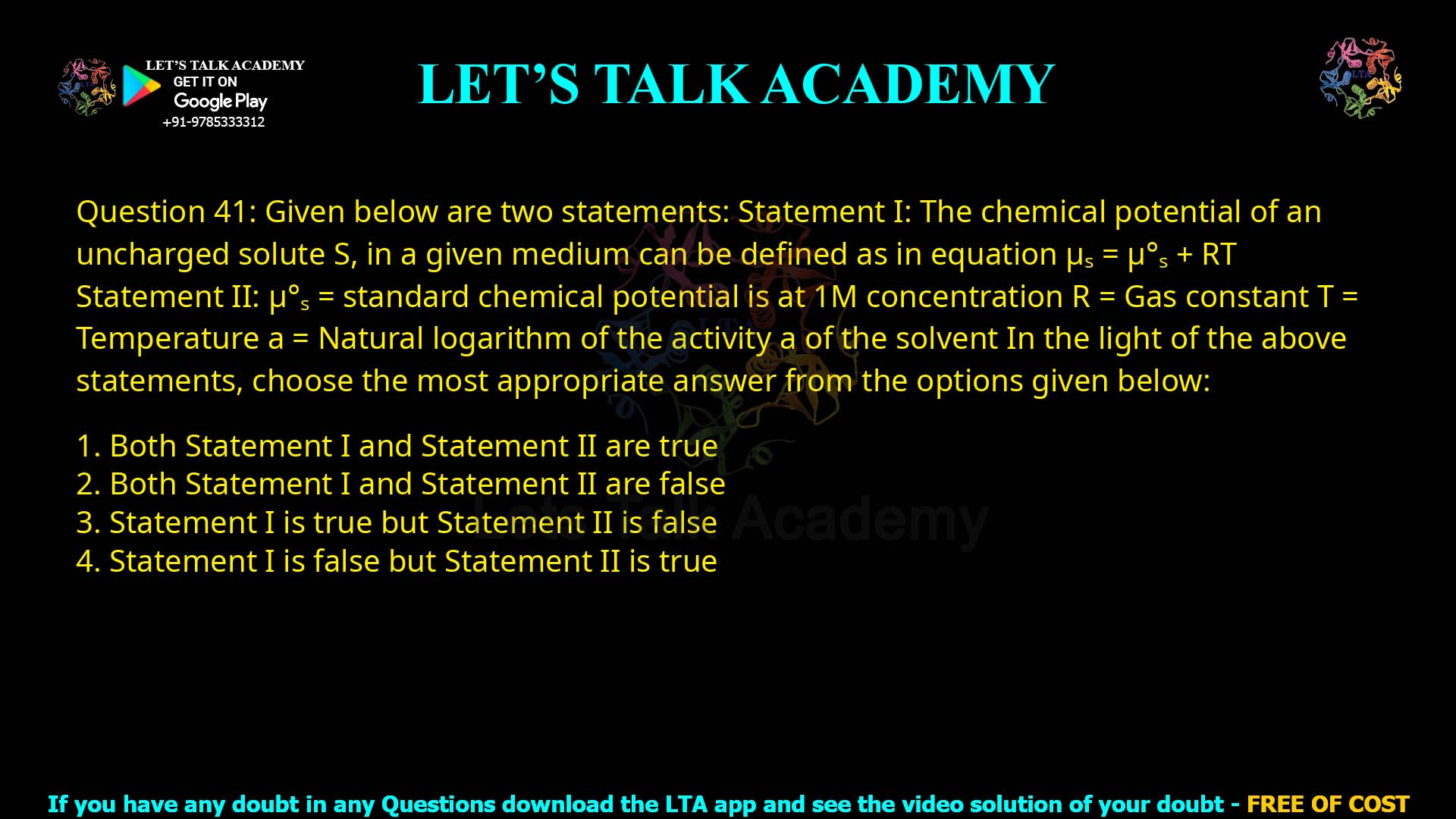
Statement I is true, but Statement II is false.
Detailed Explanation
Statement I: The equation μ_s = μ°_s + RT ln a correctly defines the chemical potential of an uncharged solute S. Here, μ°_s is the standard chemical potential, R is the gas constant, T is temperature, and a is the activity of the solute (often approximated by concentration or mole fraction at low concentrations). This is the standard thermodynamic expression for any species, including uncharged solutes.
Statement II: False—μ°_s (standard chemical potential) is defined at unit activity (a = 1), not specifically “at 1 M concentration.” For solutes, unit activity corresponds to a hypothetical ideal 1 M (or 1 molal) state with zero interactions, but the definition hinges on a = 1, not concentration alone. Real 1 M solutions have activity coefficients deviating from 1.
Options Explained
Both true: Incorrect—Statement II misdefines standard state.
Both false: Incorrect—Statement I is standard thermodynamics.
Statement I true, II false: Correct—I matches textbook equation; II confuses activity with concentration.
Statement I false, II true: Incorrect—both parts wrong as explained.
Introduction
The chemical potential of an uncharged solute follows μ_s = μ°_s + RT ln a, where a is solute activity—not solvent as misstated. Standard chemical potential μ°_s occurs at unit activity (a=1), making Statement I true but II false, as it’s not strictly “1 M concentration.”
Chemical Potential Basics
Chemical potential (μ) drives diffusion and equilibrium: equal μ on both sides of a membrane means no net flow. For uncharged solutes, activity a ≈ concentration c (in mol/L) times activity coefficient γ (≈1 for dilute ideal solutions): a = γc/c°, with c° = 1 M.
Corrected Statements
| Statement |
Verdict |
Reason |
| I: μ_s = μ°_s + RT ln a |
True |
Standard form for solutes |
| II: μ°_s at 1 M |
False |
Defined at a=1 (hypothetical ideal state at 1 M reference) |
Applications
Used in osmosis (solute μ gradients draw water), biochemistry (enzyme-substrate binding), and colligative properties. Real solutions adjust via γ to approach ideality.