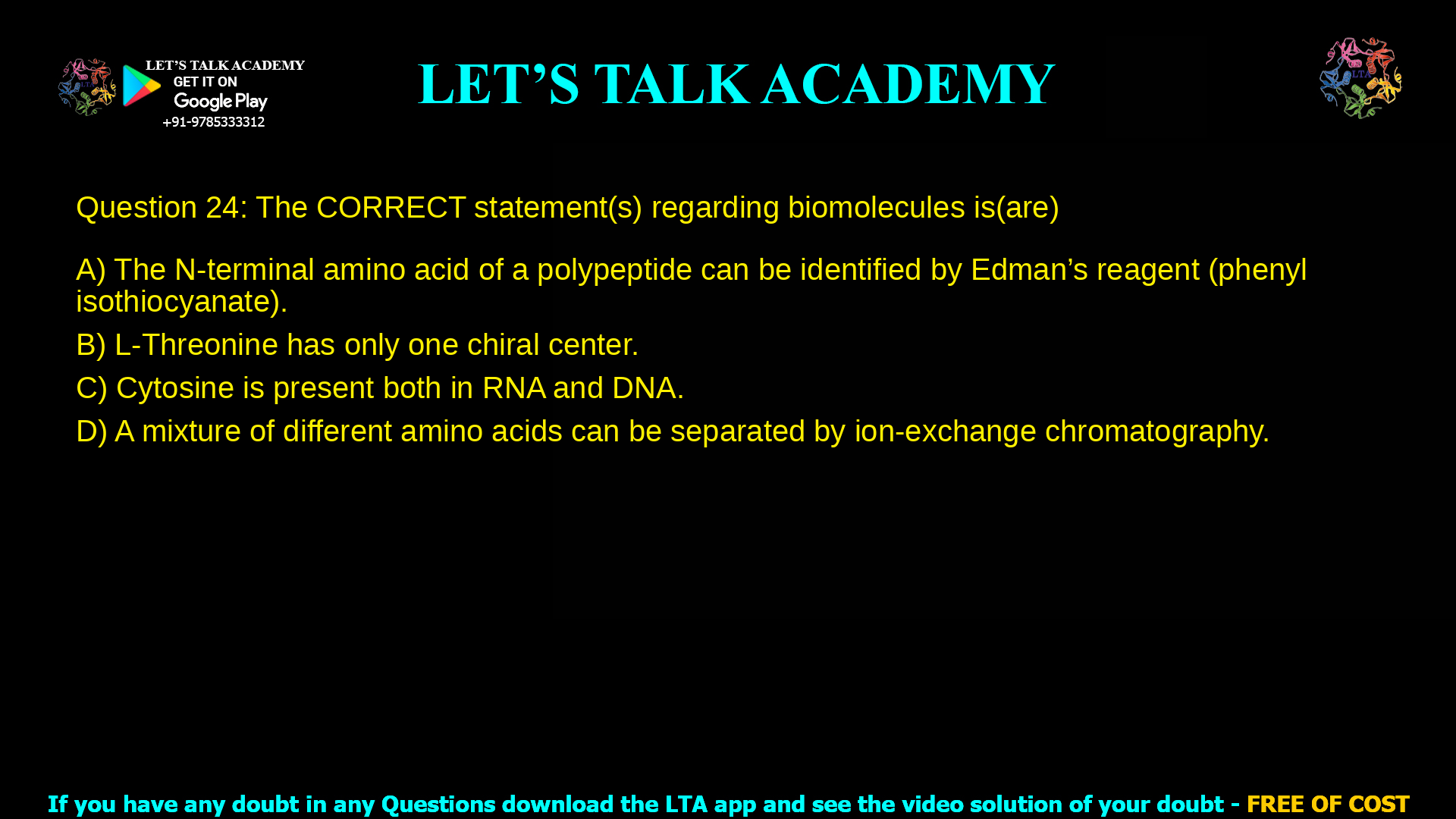
Q. 24 The CORRECT statement(s) regarding biomolecules is(are)
(A) The N–terminal amino acid of a polypeptide can be identified by Edman’s reagent
(phenyl isothiocyanate).
(B) L–Threonine has only one chiral center.
(C) Cytosine is present both in RNA and DNA.
(D) A mixture of different amino acids can be separated by ion–exchange
The correct statements regarding biomolecules are options A, C, and D. Option B is incorrect as L-Threonine has two chiral centers, not one.
Option A: Edman’s Reagent
Edman’s reagent, phenyl isothiocyanate, reacts specifically with the N-terminal amino group of a polypeptide under alkaline conditions to form a phenylthiocarbamyl derivative. Mild acid treatment cleaves this derivative, releasing a stable phenylthiohydantoin (PTH)-amino acid identifiable by HPLC, leaving the rest of the chain intact for sequential analysis. This method confirms option A as correct for N-terminal identification.
Option B: L-Threonine Chiral Centers
L-Threonine (2S,3R-threonine) features two chiral carbons: the α-carbon bonded to NH₂, COOH, H, and the side chain -CH(OH)CH₃, and the β-carbon in the side chain bonded to OH, H, CH₃, and the α-carbon. These four distinct substituents on each make both chiral centers, yielding four stereoisomers, so the statement “only one chiral center” is false.
Option C: Cytosine Presence
Cytosine serves as a pyrimidine base in both DNA (pairing with guanine via three hydrogen bonds) and RNA (as cytidine nucleotides), forming part of the genetic code in nucleic acids. Unlike thymine (DNA-specific) or uracil (RNA-specific), cytosine appears universally, making this statement correct.
Option D: Ion-Exchange Separation
Ion-exchange chromatography separates amino acid mixtures based on net charge, which varies with pH relative to isoelectric point (pI); cation exchangers bind positively charged amino acids, eluted by pH gradients or salt. Negatively charged resins attract cations like lysine first, followed by others like aspartic acid, enabling effective purification as routinely used in amino acid analysis.


1 Comment
Bhanwar
January 20, 2026two chiral carbons not One