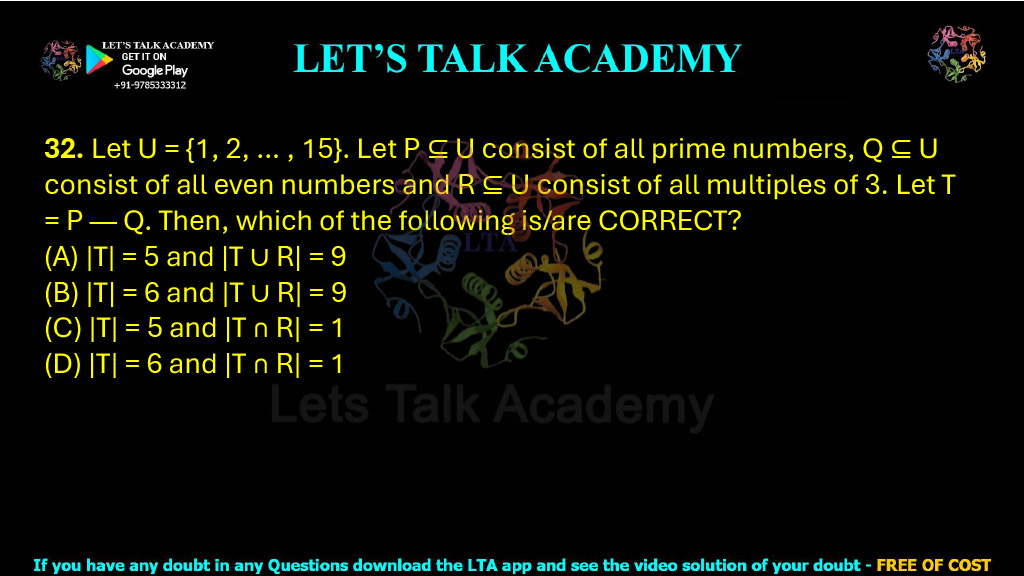
32. Let U = {1, 2, … , 15}. Let P ⊆ U consist of all prime numbers, Q ⊆ U consist of all even numbers and R ⊆ U consist of all multiples of 3. Let T = P — Q. Then, which of the following is/are CORRECT?
(A) |T| = 5 and |T ∪ R| = 9
(B) |T| = 6 and |T ∪ R| = 9
(C) |T| = 5 and |T ∩ R| = 1
(D) |T| = 6 and |T ∩ R| = 1
Find the Correct Options for T = P − Q Using Set Difference, Union and Intersection
Understanding the Given Set Theory Problem
This question tests the concepts of set difference, union, intersection, and cardinality. We are given a universal set U containing the integers from 1 to 15. Three subsets P, Q, and R are defined according to specific mathematical properties, and a fourth set T is formed by taking the set difference P − Q.
The key to solving the question correctly is to construct each set carefully. After finding T, we need to determine three quantities: the number of elements in T, the number of elements in T ∪ R, and the number of elements in T ∩ R. These values will allow us to check every option individually.
The notation |A| represents the cardinality of a set A, which simply means the number of distinct elements present in that set.
Write the Universal Set U
The universal set is given as:
U = {1, 2, 3, 4, 5, 6, 7, 8, 9, 10, 11, 12, 13, 14, 15}
Every element of P, Q, and R must come from this universal set. Therefore, we only need to consider numbers from 1 through 15.
Step-by-Step Solution
Step 1: Construct the Set P of Prime Numbers
The set P contains all prime numbers belonging to U. A prime number is a positive integer greater than 1 that has exactly two positive factors: 1 and the number itself.
The prime numbers from 1 to 15 are:
P = {2, 3, 5, 7, 11, 13}
Notice that 1 is not included because 1 is not a prime number. Thus, P contains six elements.
Therefore:
|P| = 6
Step 2: Construct the Set Q of Even Numbers
The set Q contains all even numbers in U. An even number is an integer divisible by 2.
Therefore:
Q = {2, 4, 6, 8, 10, 12, 14}
The important observation is that 2 belongs to both P and Q. It is the only even prime number.
Step 3: Construct the Set R of Multiples of 3
The set R contains all multiples of 3 that belong to U. These numbers are obtained by multiplying 3 by the positive integers while keeping the result less than or equal to 15.
Therefore:
R = {3, 6, 9, 12, 15}
Hence:
|R| = 5
Step 4: Find the Set Difference T = P − Q
The set difference P − Q contains all elements that belong to P but do not belong to Q. In simple terms, we begin with all elements of P and remove every element that also appears in Q.
We have:
P = {2, 3, 5, 7, 11, 13}
and:
Q = {2, 4, 6, 8, 10, 12, 14}
The only element common to P and Q is 2. Therefore, 2 must be removed from P.
Thus:
T = P − Q = {3, 5, 7, 11, 13}
The set T contains five elements. Therefore:
|T| = 5
This result immediately eliminates Options (B) and (D), because both of those options incorrectly state that |T| = 6.
Finding the Union T ∪ R
Step 5: Combine All Distinct Elements of T and R
The union of two sets contains every element that belongs to the first set, the second set, or both. An element appearing in both sets is written only once because sets do not contain duplicate elements.
We have:
T = {3, 5, 7, 11, 13}
and:
R = {3, 6, 9, 12, 15}
Combining all distinct elements gives:
T ∪ R = {3, 5, 6, 7, 9, 11, 12, 13, 15}
Counting these elements:
|T ∪ R| = 9
Therefore, the two statements:
|T| = 5
and:
|T ∪ R| = 9
are both correct. Hence, Option (A) is correct.
Finding the Intersection T ∩ R
Step 6: Identify the Elements Common to T and R
The intersection of two sets contains only those elements that are present in both sets.
Again:
T = {3, 5, 7, 11, 13}
and:
R = {3, 6, 9, 12, 15}
Comparing the two sets shows that the only common element is 3.
Therefore:
T ∩ R = {3}
Hence:
|T ∩ R| = 1
Since we have already established that |T| = 5, both statements given in Option (C) are correct. Therefore, Option (C) is also correct.
Verification Using the Cardinality Formula for Union
The value of |T ∪ R| can also be verified using the standard formula:
|T ∪ R| = |T| + |R| − |T ∩ R|
We have already found:
|T| = 5
|R| = 5
and:
|T ∩ R| = 1
Substituting these values:
|T ∪ R| = 5 + 5 − 1
Therefore:
|T ∪ R| = 9
This confirms the result obtained by directly listing the elements of the union.
Why the Number 2 Is Removed from P
The set P initially contains six prime numbers:
{2, 3, 5, 7, 11, 13}
However, T is not equal to P. It is defined as P − Q, meaning that every element of P that also belongs to Q must be removed.
The number 2 is both prime and even. Therefore:
2 ∈ P
and:
2 ∈ Q
Hence, 2 cannot remain in P − Q. Removing it leaves:
T = {3, 5, 7, 11, 13}
This is why |T| equals 5 rather than 6.
Detailed Analysis of Each Option
Option (A): |T| = 5 and |T ∪ R| = 9
This option is correct. The set difference is:
T = {3, 5, 7, 11, 13}
Therefore, |T| = 5. Also:
T ∪ R = {3, 5, 6, 7, 9, 11, 12, 13, 15}
which contains nine elements. Hence, both statements in Option (A) are true.
Option (B): |T| = 6 and |T ∪ R| = 9
This option is incorrect. Although the statement |T ∪ R| = 9 is correct, the statement |T| = 6 is false.
The prime set P contains six elements, but T = P − Q requires the even prime number 2 to be removed. Therefore:
|T| = 5
Since both parts of the option must be correct, Option (B) is incorrect.
Option (C): |T| = 5 and |T ∩ R| = 1
This option is correct. We have:
|T| = 5
and the only element common to T and R is 3:
T ∩ R = {3}
Therefore:
|T ∩ R| = 1
Both statements are correct, so Option (C) is correct.
Option (D): |T| = 6 and |T ∩ R| = 1
This option is incorrect. The statement |T ∩ R| = 1 is correct, but |T| = 6 is incorrect.
Since 2 must be removed from the six-element prime set P, the resulting set T contains only five elements. Therefore, Option (D) cannot be correct.
Complete Solution in Compact Form
The required sets are:
P = {2, 3, 5, 7, 11, 13}
Q = {2, 4, 6, 8, 10, 12, 14}
R = {3, 6, 9, 12, 15}
Therefore:
T = P − Q = {3, 5, 7, 11, 13}
Hence:
|T| = 5
Also:
T ∪ R = {3, 5, 6, 7, 9, 11, 12, 13, 15}
Therefore:
|T ∪ R| = 9
Further:
T ∩ R = {3}
Therefore:
|T ∩ R| = 1
Final Answer
The set T = P − Q is {3, 5, 7, 11, 13}. Therefore, |T| = 5, |T ∪ R| = 9, and |T ∩ R| = 1.
Correct Options: (A) and (C)


