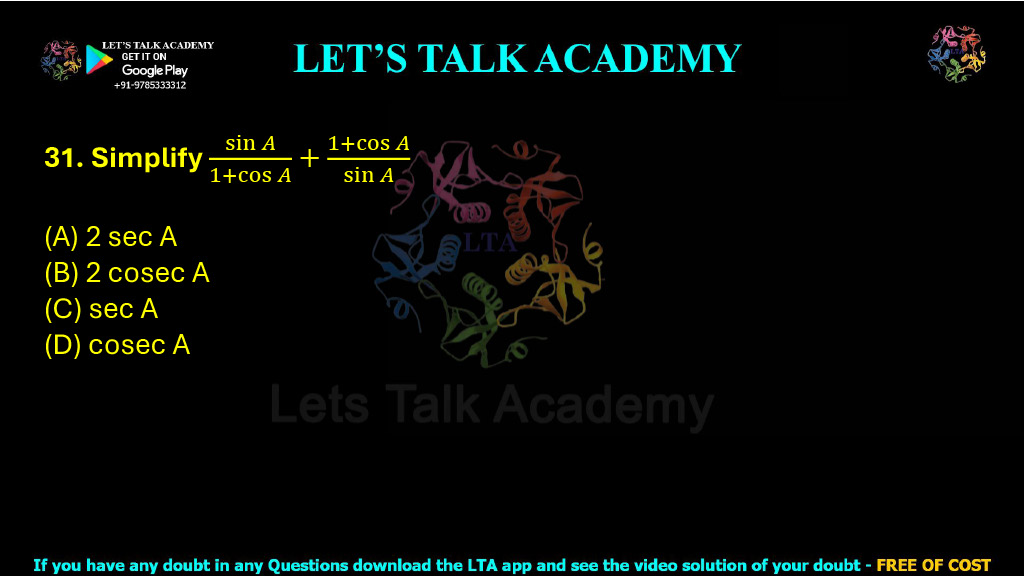
sin A/(1 + cos A) + (1 + cos A)/sin A
(A) 2 sec A
(B) 2 cosec A
(C) sec A
(D) cosec A
Simplify sin A/(1 + cos A) + (1 + cos A)/sin A
Understanding the Given Trigonometric Expression
This question asks us to simplify an algebraic expression containing the trigonometric functions sin A and cos A. The given expression is:
sin A/(1 + cos A) + (1 + cos A)/sin A
The expression consists of two fractions. The numerator of the first fraction is sin A, while its denominator is 1 + cos A. In the second fraction, these terms appear in the reverse form, with 1 + cos A in the numerator and sin A in the denominator.
The most direct method is to take a common denominator and combine the two fractions. After expanding the numerator, the standard Pythagorean trigonometric identity:
sin2 A + cos2 A = 1
allows the expression to simplify completely. The final result is 2 cosec A.
Important Trigonometric Identities Required
The main identity required for solving this problem is the fundamental Pythagorean identity:
sin2 A + cos2 A = 1
We will also use the reciprocal identity:
cosec A = 1/sin A
These two identities are sufficient to simplify the entire expression. The first identity reduces the numerator after algebraic expansion, while the second converts the final reciprocal form into the standard trigonometric function cosec A.
Step-by-Step Solution
Step 1: Write the Given Expression
Let the given expression be E. Then:
E = sin A/(1 + cos A) + (1 + cos A)/sin A
Since the two fractions have different denominators, we first combine them using a common denominator.
Step 2: Take the Common Denominator
The denominators of the two fractions are:
1 + cos A
and:
sin A
Therefore, the common denominator is:
sin A(1 + cos A)
Combining the fractions gives:
E = [sin2 A + (1 + cos A)2] / [sin A(1 + cos A)]
The problem has now been reduced to simplifying the numerator.
Step 3: Expand the Square in the Numerator
The numerator is:
sin2 A + (1 + cos A)2
Using the algebraic identity:
(a + b)2 = a2 + 2ab + b2
we obtain:
(1 + cos A)2 = 1 + 2 cos A + cos2 A
Therefore, the numerator becomes:
sin2 A + 1 + 2 cos A + cos2 A
Rearranging the terms:
= sin2 A + cos2 A + 1 + 2 cos A
Step 4: Apply the Pythagorean Identity
Using:
sin2 A + cos2 A = 1
the numerator becomes:
1 + 1 + 2 cos A
Therefore:
= 2 + 2 cos A
Taking 2 as a common factor:
= 2(1 + cos A)
Thus, the complete expression becomes:
E = 2(1 + cos A)/[sin A(1 + cos A)]
Step 5: Cancel the Common Factor
The factor 1 + cos A appears in both the numerator and denominator. Therefore, it can be cancelled for all values of A for which the original expression is defined.
After cancellation:
E = 2/sin A
Using the reciprocal identity:
cosec A = 1/sin A
we obtain:
E = 2 cosec A
Therefore, the correct answer is Option (B).
Complete Simplification in Compact Form
The entire calculation can be written as:
sin A/(1 + cos A) + (1 + cos A)/sin A
= [sin2 A + (1 + cos A)2] / [sin A(1 + cos A)]
= [sin2 A + 1 + 2 cos A + cos2 A] / [sin A(1 + cos A)]
= [1 + 1 + 2 cos A] / [sin A(1 + cos A)]
= 2(1 + cos A)/[sin A(1 + cos A)]
= 2/sin A
= 2 cosec A
Alternative Solution Using a Trigonometric Transformation
The first term of the expression can also be simplified by rationalizing its denominator:
sin A/(1 + cos A)
Multiplying the numerator and denominator by 1 − cos A gives:
[sin A(1 − cos A)]/[(1 + cos A)(1 − cos A)]
The denominator becomes:
1 − cos2 A
Using the identity:
1 − cos2 A = sin2 A
we obtain:
sin A/(1 + cos A) = (1 − cos A)/sin A
Therefore, the original expression becomes:
(1 − cos A)/sin A + (1 + cos A)/sin A
Since the denominators are now the same:
= [(1 − cos A) + (1 + cos A)]/sin A
The cosine terms cancel:
−cos A + cos A = 0
Therefore:
= 2/sin A
Hence:
= 2 cosec A
This alternative method confirms the same result.
Why the Expression Simplifies to a Cosecant Function
After combining and simplifying the two fractions, the expression reduces to:
2/sin A
The reciprocal of sin A is cosec A. Therefore:
1/sin A = cosec A
Multiplying both sides by 2 gives:
2/sin A = 2 cosec A
This is why the final expression contains cosec A rather than sec A. A secant function would arise from a reciprocal involving cos A, whereas the final denominator in this problem is sin A.
Detailed Analysis of Each Option
Option (A): 2 sec A
This option is incorrect. The function sec A is defined as:
sec A = 1/cos A
However, the given expression simplifies to 2/sin A, not 2/cos A. Therefore, the result cannot be 2 sec A.
Option (B): 2 cosec A
This option is correct. After taking the common denominator and applying the identity sin2 A + cos2 A = 1, the expression becomes:
2/sin A
Since:
1/sin A = cosec A
we get:
2/sin A = 2 cosec A
Option (C): sec A
This option is incorrect because the simplified denominator is sin A, not cos A. Moreover, the simplification produces an additional factor of 2, so neither the function nor the coefficient matches sec A.
Option (D): cosec A
This option is incorrect because the final simplified expression is:
2/sin A
which is equal to 2 cosec A. Choosing only cosec A would incorrectly omit the factor 2 produced when the numerator simplifies to 2(1 + cos A).
Verification Using a Simple Angle
The result can be verified by choosing A = π/2, for which:
sin(π/2) = 1
and:
cos(π/2) = 0
Substituting into the original expression:
1/(1 + 0) + (1 + 0)/1
= 1 + 1
= 2
Now evaluate the simplified result:
2 cosec(π/2)
Since cosec(π/2) = 1:
2 cosec(π/2) = 2
Both expressions give the same value, confirming the simplification.
Final Answer
The expression sin A/(1 + cos A) + (1 + cos A)/sin A simplifies to 2 cosec A.
Correct Option: (B) 2 cosec A


