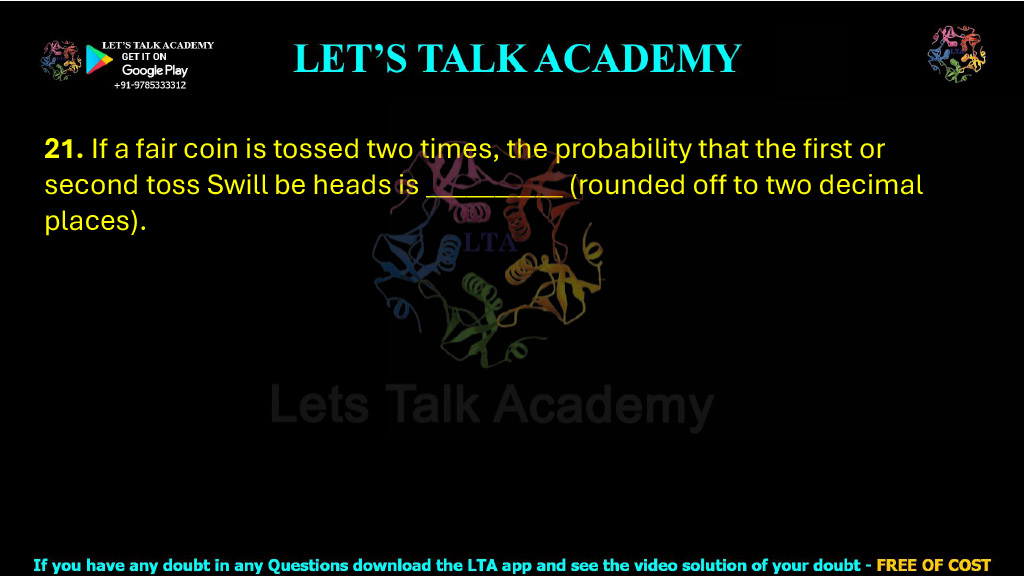
21. If a fair coin is tossed two times, the probability that the first or second toss Swill be heads is __________ (rounded off to two decimal places).
Probability That the First or Second Toss Will Be Heads When a Fair Coin Is Tossed Twice
Understanding the Given Coin Toss Probability Problem
This question asks us to calculate the probability that the first toss or the second toss will be heads when a fair coin is tossed two times. The word “or” is important because the required event includes all outcomes in which the first toss is heads, the second toss is heads, or both tosses are heads.
In other words, we need to find the probability of obtaining at least one head in two tosses of a fair coin.
A fair coin has two equally likely outcomes on every toss:
Head (H) and Tail (T)
Therefore, the probability of obtaining a head on any individual toss is:
P(H) = 1/2
Similarly, the probability of obtaining a tail on any individual toss is:
P(T) = 1/2
Since the coin is tossed twice, we must consider the combined outcomes of both tosses.
Constructing the Sample Space for Two Coin Tosses
When a fair coin is tossed two times, each toss can produce either H or T. Therefore, the complete sample space is:
S = {HH, HT, TH, TT}
Here, the first letter represents the result of the first toss, while the second letter represents the result of the second toss.
The outcomes can be interpreted as follows:
HH = Head on the first toss and Head on the second toss
HT = Head on the first toss and Tail on the second toss
TH = Tail on the first toss and Head on the second toss
TT = Tail on the first toss and Tail on the second toss
Since the coin is fair and the tosses are independent, all four outcomes are equally likely. Therefore, the probability of each outcome is 1/4.
Step-by-Step Solution Using the Sample Space Method
Step 1: Identify the Total Number of Possible Outcomes
The complete sample space contains four outcomes:
{HH, HT, TH, TT}
Therefore:
Total number of possible outcomes = 4
Step 2: Identify the Favorable Outcomes
The required event is that the first toss or the second toss will be heads. Therefore, we include every outcome containing at least one H.
The favorable outcomes are:
HH, HT, and TH
The outcome TT is not favorable because neither the first toss nor the second toss gives a head.
Therefore:
Number of favorable outcomes = 3
Step 3: Apply the Basic Probability Formula
For equally likely outcomes, probability is calculated using the formula:
Probability = Number of favorable outcomes / Total number of possible outcomes
Substituting the values:
P(first or second toss is heads) = 3/4
Converting the fraction into decimal form:
3/4 = 0.75
Therefore:
Probability = 0.75
Step 4: Express the Answer to Two Decimal Places
The question asks for the answer rounded off to two decimal places. The calculated probability is already:
0.75
Therefore, no further rounding is required.
Hence:
Probability = 0.75
Alternative Solution Using the Complement Rule
The same problem can be solved efficiently using the complement rule. The required event is obtaining at least one head in two tosses. The only outcome in which this does not happen is when both tosses are tails.
Therefore:
P(at least one head) = 1 − P(no heads)
Obtaining no heads means obtaining tails on both tosses. Since the two tosses are independent:
P(TT) = P(T) × P(T)
Therefore:
P(TT) = 1/2 × 1/2
Thus:
P(TT) = 1/4
Using the complement rule:
P(at least one head) = 1 − 1/4
Therefore:
P(at least one head) = 3/4
Hence:
P(at least one head) = 0.75
Solution Using the Addition Rule of Probability
The wording “the first or second toss will be heads” can also be analyzed using the addition rule of probability.
Let:
A = Event that the first toss is heads
and:
B = Event that the second toss is heads
We need to calculate:
P(A ∪ B)
The addition rule states:
P(A ∪ B) = P(A) + P(B) − P(A ∩ B)
Since the coin is fair:
P(A) = 1/2
and:
P(B) = 1/2
The probability that both tosses are heads is:
P(A ∩ B) = 1/2 × 1/2 = 1/4
Therefore:
P(A ∪ B) = 1/2 + 1/2 − 1/4
Thus:
P(A ∪ B) = 1 − 1/4
Hence:
P(A ∪ B) = 3/4 = 0.75
Why the Answer Is Not 1
One might initially think that because the probability of a head on the first toss is 1/2 and the probability of a head on the second toss is also 1/2, adding these probabilities gives 1. However, this calculation counts the outcome HH twice.
The outcome HH belongs to both events: the first toss is heads and the second toss is heads. Therefore, when using the addition rule, the probability of HH must be subtracted once to avoid double counting.
Thus:
1/2 + 1/2 − 1/4 = 3/4
This gives the correct probability of 0.75.
Why the Word “Or” Includes the Outcome HH
In probability, the word “or” generally represents an inclusive OR unless the question specifically states “either, but not both.” Therefore, the event “the first or second toss will be heads” includes cases where only the first toss is heads, only the second toss is heads, and both tosses are heads.
The included outcomes are therefore:
HT, TH, and HH
Only TT is excluded. Hence, three of the four equally likely outcomes satisfy the required condition.
Final Answer
The probability that the first or second toss will be heads when a fair coin is tossed two times is 0.75.
Answer: 0.75


