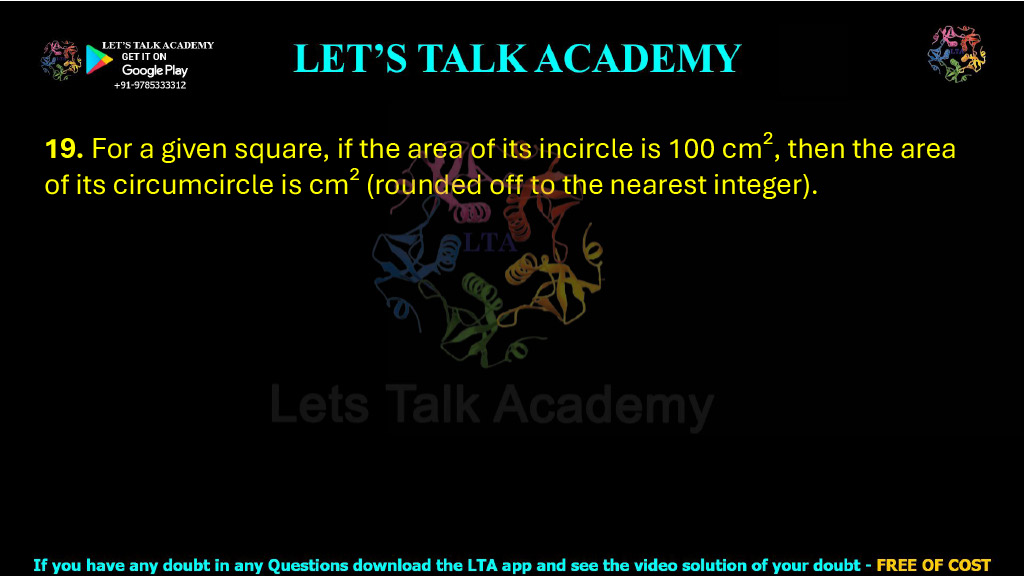
19. For a given square, if the area of its incircle is 100 cm², then the area of its circumcircle is cm² (rounded off to the nearest integer).
Area of the Circumcircle of a Square When Its Incircle Area Is 100 cm²
Understanding the Given Geometry Problem
This question involves two circles associated with the same square: an incircle and a circumcircle. The area of the incircle is given as 100 cm2, and we need to determine the area of the circumcircle.
An incircle of a square is a circle drawn inside the square so that it touches all four sides. A circumcircle is a circle drawn outside the square so that all four vertices of the square lie on the circle.
The important idea is that the radius of the incircle and the radius of the circumcircle are both directly related to the side length of the square. Once this relationship is established, the required area can be calculated easily.
Relationship Between a Square and Its Incircle
Let the side length of the square be a and the radius of the incircle be r.
Since the incircle touches two opposite sides of the square, the diameter of the incircle is exactly equal to the side length of the square.
Therefore:
a = 2r
or:
r = a/2
The area of the incircle is given by:
Area of incircle = πr2
According to the question:
πr2 = 100
Relationship Between a Square and Its Circumcircle
Now let R be the radius of the circumcircle. The diameter of the circumcircle is equal to the diagonal of the square because two opposite vertices of the square lie at the ends of a diameter.
The diagonal of a square with side length a is:
Diagonal = a√2
Since the diagonal is equal to the diameter of the circumcircle:
2R = a√2
Therefore:
R = a√2/2
Since the side of the square is a = 2r, we can substitute this value:
R = (2r × √2)/2
Hence:
R = r√2
This is the key relationship between the inradius and circumradius of a square.
Step-by-Step Solution
Step 1: Use the Given Area of the Incircle
The area of a circle with radius r is:
Area = πr2
The area of the incircle is given as 100 cm2. Therefore:
πr2 = 100
Thus:
r2 = 100/π
We do not actually need to calculate the numerical value of r because the area of the circumcircle can be determined directly from r2.
Step 2: Find the Circumradius in Terms of the Inradius
For a square, we have established that:
R = r√2
Squaring both sides gives:
R2 = (r√2)2
Therefore:
R2 = 2r2
This shows that the square of the circumradius is exactly twice the square of the inradius.
Step 3: Calculate the Area of the Circumcircle
The area of the circumcircle is:
Area of circumcircle = πR2
Since R2 = 2r2:
Area of circumcircle = π(2r2)
Therefore:
Area of circumcircle = 2πr2
From the given information:
πr2 = 100
Substituting this value:
Area of circumcircle = 2 × 100
Hence:
Area of circumcircle = 200 cm2
Step 4: Round the Answer to the Nearest Integer
The calculated area is exactly 200 cm2. Since 200 is already an integer, no further rounding is required.
Therefore:
Area of circumcircle = 200 cm2
Direct Relationship Between the Areas of the Two Circles
The problem can also be solved directly by comparing the areas of the incircle and circumcircle. For a square:
R = √2r
Therefore, the ratio of the areas is:
Area of circumcircle / Area of incircle = πR2 / πr2
Substituting R = √2r:
Area of circumcircle / Area of incircle = π(√2r)2 / πr2
Therefore:
Area of circumcircle / Area of incircle = 2
Thus, for every square:
Area of circumcircle = 2 × Area of incircle
Since the area of the incircle is 100 cm2:
Area of circumcircle = 2 × 100 = 200 cm2
Why the Circumcircle Has Twice the Area of the Incircle
The result follows from the geometry of the square. The radius of the incircle is half the side of the square, whereas the radius of the circumcircle is half the diagonal of the square.
If the inradius is r, the side of the square is 2r. The diagonal is therefore:
2r√2
Half of this diagonal gives the circumradius:
R = r√2
Since the area of a circle depends on the square of its radius, increasing the radius by a factor of √2 increases the area by a factor of:
(√2)2 = 2
Therefore, the circumcircle always has exactly twice the area of the incircle for the same square.
Alternative Solution Using the Side Length of the Square
The answer can also be verified by calculating the side length of the square. Let the inradius be r. From the given incircle area:
πr2 = 100
Therefore:
r = √(100/π)
The side of the square is equal to the diameter of the incircle:
a = 2r
The diagonal of the square is:
d = a√2 = 2r√2
The circumradius is half the diagonal:
R = d/2 = r√2
Therefore, the area of the circumcircle is:
πR2 = π(r√2)2
= 2πr2
= 2 × 100
= 200 cm2
This confirms the result obtained through the direct area relationship.
Final Answer
If the area of the incircle of a square is 100 cm2, then the area of its circumcircle is 200 cm2.
Answer: 200


