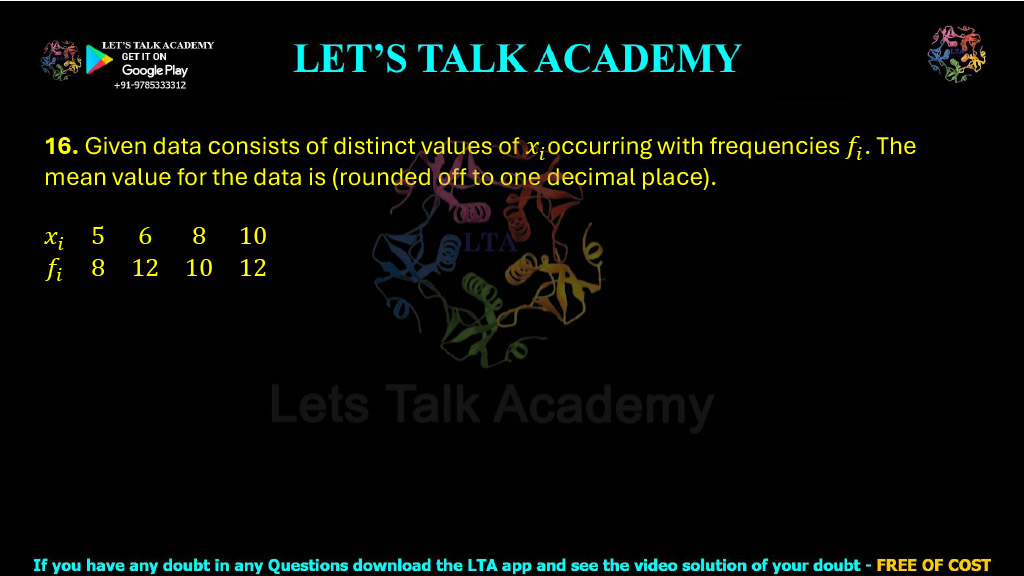
The given data is:
| xi | 5 | 6 | 8 | 10 |
|---|---|---|---|---|
| fi | 8 | 12 | 10 | 12 |
Calculate the Mean of Distinct Values Occurring with Given Frequencies
Understanding the Given Frequency Distribution
This question asks us to calculate the arithmetic mean of data presented in the form of a discrete frequency distribution. Unlike a simple list of observations, each distinct value xi occurs a specified number of times represented by its corresponding frequency fi.
The value 5 occurs 8 times, the value 6 occurs 12 times, the value 8 occurs 10 times, and the value 10 occurs 12 times. Therefore, we cannot calculate the mean by simply adding 5, 6, 8, and 10 and dividing by 4. Each value must contribute to the mean according to the number of times it occurs in the complete dataset.
This is why the mean of a frequency distribution is calculated using a weighted average. The values with higher frequencies contribute more strongly to the final mean than values with lower frequencies.
Formula for the Mean of a Frequency Distribution
For distinct values xi occurring with corresponding frequencies fi, the arithmetic mean is calculated using the formula:
Mean = Σ(fixi) / Σfi
Here, fixi represents the product of each data value and its corresponding frequency. The symbol Σ indicates that all such products are added together. The denominator Σfi represents the sum of all frequencies, which is equal to the total number of observations in the dataset.
Therefore, the calculation requires two main quantities: the total of all frequencies and the sum of all products fixi.
Step-by-Step Solution
Step 1: Calculate the Product fixi for Each Value
We begin by multiplying each distinct value xi by its corresponding frequency fi. This gives the total contribution of that value to the complete dataset.
For xi = 5 and fi = 8:
fixi = 8 × 5 = 40
For xi = 6 and fi = 12:
fixi = 12 × 6 = 72
For xi = 8 and fi = 10:
fixi = 10 × 8 = 80
For xi = 10 and fi = 12:
fixi = 12 × 10 = 120
The complete calculation can be organized as follows:
| xi | fi | fixi |
|---|---|---|
| 5 | 8 | 40 |
| 6 | 12 | 72 |
| 8 | 10 | 80 |
| 10 | 12 | 120 |
Step 2: Calculate the Total Frequency
The total frequency is obtained by adding all the individual frequencies:
Σfi = 8 + 12 + 10 + 12
Therefore:
Σfi = 42
This means that the complete dataset contains 42 observations. In other words, if every repeated value were written individually, there would be a total of 42 numbers.
Step 3: Calculate the Sum of fixi
Now we add all the products calculated earlier:
Σ(fixi) = 40 + 72 + 80 + 120
Adding these values gives:
Σ(fixi) = 312
The value 312 represents the sum of all 42 observations when the repetitions indicated by the frequencies are taken into account.
Step 4: Apply the Mean Formula
Using the formula:
Mean = Σ(fixi) / Σfi
we substitute the calculated values:
Mean = 312 / 42
Dividing 312 by 42 gives:
Mean = 7.428571…
Therefore, before rounding:
Mean ≈ 7.4286
Step 5: Round the Mean to One Decimal Place
The question specifically asks for the answer rounded off to one decimal place. The calculated value is:
7.428571…
To round to one decimal place, we keep the first digit after the decimal point, which is 4, and examine the next digit, which is 2. Since 2 is less than 5, the first decimal digit remains unchanged.
Therefore:
7.428571… ≈ 7.4
Why the Simple Average of 5, 6, 8, and 10 Is Not Correct
If we ignored the frequencies and calculated the simple average of the four distinct values, we would obtain:
(5 + 6 + 8 + 10) / 4 = 29 / 4 = 7.25
However, this would be incorrect because the four values do not occur equally often. The value 5 occurs only 8 times, while the values 6 and 10 each occur 12 times. Therefore, every distinct value cannot be given equal importance in the calculation.
The frequency-weighted mean correctly accounts for the number of times each value occurs. This is why the required calculation is 312/42 rather than 29/4.
Understanding the Mean as a Weighted Average
The mean of a frequency distribution is essentially a weighted average. Each data value is weighted by its frequency. A value with a larger frequency has a greater influence on the final mean because it appears more often in the dataset.
In this problem, the value 10 occurs 12 times and contributes 120 to the total sum, while the value 5 occurs only 8 times and contributes 40. This difference in contribution explains why the mean is calculated using fixi rather than by treating all four distinct values equally.
Verification by Expanding the Dataset
The frequency table can also be interpreted as a complete list in which 5 appears 8 times, 6 appears 12 times, 8 appears 10 times, and 10 appears 12 times. The total number of observations is therefore:
8 + 12 + 10 + 12 = 42
The sum of these observations is:
(5 × 8) + (6 × 12) + (8 × 10) + (10 × 12)
= 40 + 72 + 80 + 120
= 312
Therefore, using the basic definition of arithmetic mean:
Mean = Total sum of observations / Total number of observations
= 312 / 42
= 7.428571…
≈ 7.4
This confirms the result obtained using the standard frequency distribution formula.
Final Answer
The mean value of the given data is 7.4 when rounded off to one decimal place.


