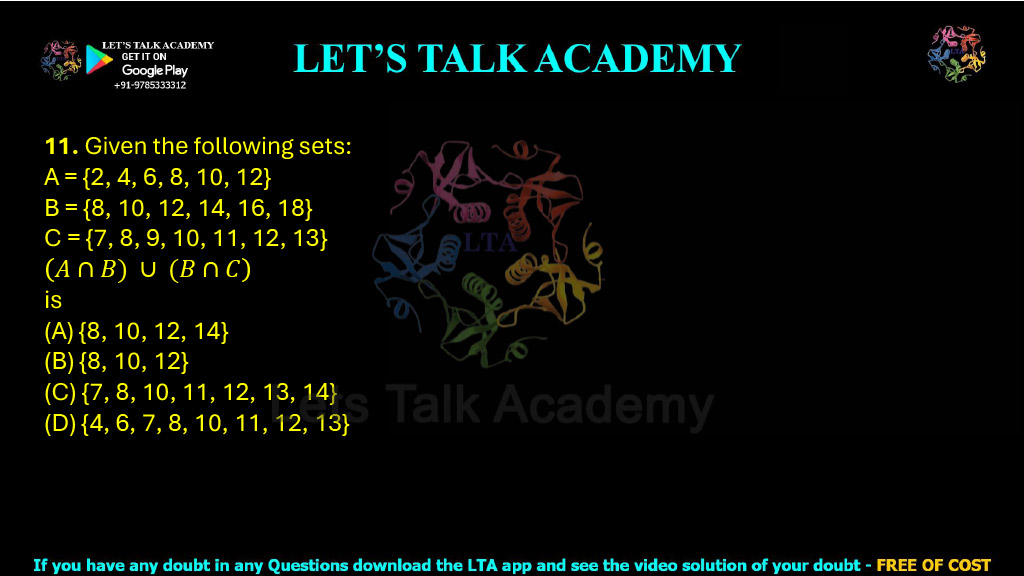
A = {2, 4, 6, 8, 10, 12}
B = {8, 10, 12, 14, 16, 18}
C = {7, 8, 9, 10, 11, 12, 13}
Find:
(A ∩ B) ∪ (B ∩ C)
(A) {8, 10, 12, 14}
(B) {8, 10, 12}
(C) {7, 8, 10, 11, 12, 13, 14}
(D) {4, 6, 7, 8, 10, 11, 12, 13}
Solve (A ∩ B) ∪ (B ∩ C) for the Given Sets
Understanding the Given Set Theory Problem
This question tests two fundamental operations in set theory: intersection and union. The expression contains two separate intersections, A ∩ B and B ∩ C, followed by the union of the resulting sets. Therefore, the correct approach is to evaluate each intersection separately and then combine the results using the union operation.
The complete expression is:
(A ∩ B) ∪ (B ∩ C)
According to the parentheses, we first need to find the elements common to sets A and B. Next, we need to find the elements common to sets B and C. Finally, we take the union of these two resulting sets.
Meaning of Intersection and Union of Sets
What Does the Intersection Symbol ∩ Mean?
The intersection of two sets contains only those elements that are present in both sets. For example, A ∩ B means that we compare sets A and B and select only their common elements.
Mathematically, an element belongs to A ∩ B only when it belongs to both A and B. Therefore, elements appearing in only one of the two sets are excluded from the intersection.
What Does the Union Symbol ∪ Mean?
The union of two sets contains all elements that belong to either set or to both sets. While writing a union, each distinct element is written only once because repetition does not change a set.
Therefore, after calculating A ∩ B and B ∩ C, we combine all distinct elements from these two intersections to obtain the final result.
Step-by-Step Solution
Step 1: Find A ∩ B
The first two sets are:
A = {2, 4, 6, 8, 10, 12}
and
B = {8, 10, 12, 14, 16, 18}
To calculate A ∩ B, we identify the elements that appear in both sets. The numbers 8, 10, and 12 are present in set A as well as set B. The numbers 2, 4, and 6 occur only in A, while 14, 16, and 18 occur only in B.
Therefore:
A ∩ B = {8, 10, 12}
Step 2: Find B ∩ C
Now consider the sets:
B = {8, 10, 12, 14, 16, 18}
and
C = {7, 8, 9, 10, 11, 12, 13}
We again identify only the elements that are common to both sets. The numbers 8, 10, and 12 appear in both B and C. The numbers 14, 16, and 18 are not present in C, while 7, 9, 11, and 13 are not present in B.
Therefore:
B ∩ C = {8, 10, 12}
Step 3: Find the Union of the Two Intersections
We have obtained:
A ∩ B = {8, 10, 12}
and
B ∩ C = {8, 10, 12}
Now substitute these results into the original expression:
(A ∩ B) ∪ (B ∩ C)
= {8, 10, 12} ∪ {8, 10, 12}
Since both sets are identical, their union is the same set:
(A ∩ B) ∪ (B ∩ C) = {8, 10, 12}
Detailed Analysis of Each Option
Option (A): {8, 10, 12, 14}
This option is incorrect because the number 14 does not belong to either of the required intersections. Although 14 is an element of set B, it is not present in set A and is also not present in set C. Therefore, 14 cannot belong to A ∩ B or B ∩ C and must not appear in the final union.
Option (B): {8, 10, 12}
This option is correct. The elements 8, 10, and 12 are common to A and B, so A ∩ B = {8, 10, 12}. The same three elements are also common to B and C, so B ∩ C = {8, 10, 12}. Taking the union of these identical sets gives {8, 10, 12}.
Option (C): {7, 8, 10, 11, 12, 13, 14}
This option is incorrect because it includes several elements that do not satisfy the required intersection conditions. The numbers 7, 11, and 13 belong to C but not to B, while 14 belongs to B but not to A or C. These elements cannot be included in the final result.
Option (D): {4, 6, 7, 8, 10, 11, 12, 13}
This option is also incorrect. The numbers 4 and 6 belong only to A, while 7, 11, and 13 belong to C but not to B. The expression requires common elements obtained through intersections, so elements belonging to only one relevant set cannot be included.
Alternative Solution Using the Distributive Law of Sets
The expression can also be simplified using the distributive law of set operations:
(A ∩ B) ∪ (B ∩ C) = B ∩ (A ∪ C)
First, consider the union A ∪ C. It contains every distinct element appearing in either A or C:
A ∪ C = {2, 4, 6, 7, 8, 9, 10, 11, 12, 13}
Now take the intersection of this set with B:
B ∩ (A ∪ C)
The elements of B that also appear in A ∪ C are 8, 10, and 12. Therefore:
B ∩ (A ∪ C) = {8, 10, 12}
This confirms the result obtained by the direct method.
Final Answer
(A ∩ B) ∪ (B ∩ C) = {8, 10, 12}
Correct Option: (B)


