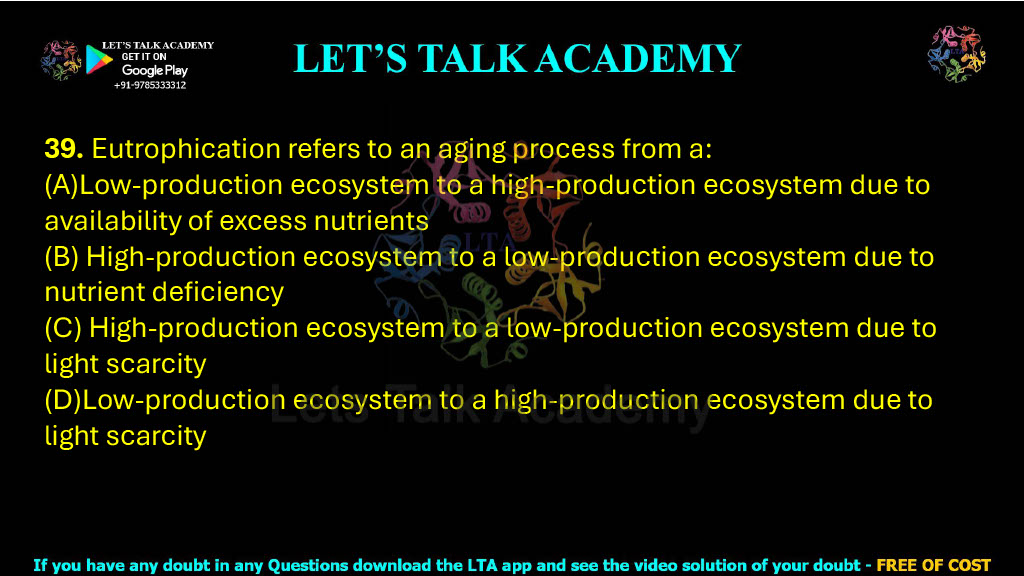
39. Eutrophication refers to an aging process from a:
(A)Low-production ecosystem to a high-production ecosystem due to availability of excess nutrients
(B) High-production ecosystem to a low-production ecosystem due to nutrient deficiency
(C) High-production ecosystem to a low-production ecosystem due to light scarcity
(D)Low-production ecosystem to a high-production ecosystem due to light scarcity
Eutrophication Is the Aging of a Low-Production Ecosystem into a High-Production Ecosystem Due to Excess Nutrients
Detailed Explanation of the Correct Answer
Eutrophication refers to the gradual transformation of a low-production aquatic ecosystem into a high-production ecosystem because of the increased availability of nutrients. Therefore, option (A) is the correct answer.
Eutrophication is a natural aging process commonly associated with lakes and other relatively standing bodies of water. During this process, nutrients gradually accumulate in the aquatic ecosystem. The most important nutrients involved are generally nitrogen and phosphorus, which stimulate the growth of algae, phytoplankton, and aquatic plants.
A young lake may initially contain relatively low concentrations of nutrients and therefore support comparatively low primary productivity. Over time, nutrients enter the water through natural processes such as soil erosion, surface runoff, decomposition of organic matter, and the accumulation of sediments. As nutrient availability increases, biological production also increases.
Thus, the basic direction of eutrophication is:
Low nutrient availability → Low biological production → Nutrient enrichment → Increased primary production → High-production ecosystem
This is exactly the process described in option (A).
Although eutrophication initially increases biological productivity, excessive nutrient enrichment can eventually produce serious ecological problems. Dense algal growth may reduce light penetration, and the decomposition of large amounts of organic matter can consume dissolved oxygen. Therefore, eutrophication can ultimately cause oxygen depletion, deterioration of water quality, and the death of oxygen-dependent aquatic organisms.
What Is Eutrophication?
Eutrophication is the process by which an aquatic ecosystem becomes increasingly enriched with nutrients and consequently experiences increased biological productivity.
The term is commonly applied to lakes, ponds, reservoirs, and other water bodies in which nutrients can accumulate over time. Nitrogen and phosphorus are especially important because they frequently limit primary production in aquatic environments.
When the concentration of limiting nutrients increases, algae and aquatic plants can grow more rapidly. This increased plant and algal production raises the total biological productivity of the ecosystem.
In the context of natural ecosystem development, eutrophication is often described as an aging process of a lake. A relatively nutrient-poor and low-productivity water body gradually becomes more nutrient-rich and biologically productive.
How Does Eutrophication Begin?
Nutrients Enter the Aquatic Ecosystem
The process begins when nutrients enter and accumulate in a water body.
Under natural conditions, nutrients may enter through the weathering of rocks, erosion of soil, decomposition of dead organisms, atmospheric deposition, and runoff from the surrounding land.
Human activities can greatly accelerate nutrient input. Fertilizers from agricultural fields, sewage discharge, animal waste, and nutrient-rich urban runoff can introduce large quantities of nitrogen and phosphorus into aquatic ecosystems.
As nutrient concentrations rise, the biological response of the ecosystem begins to change.
Primary Productivity Increases
Phytoplankton, algae, and aquatic plants require nutrients for growth. When nutrient availability increases, these primary producers can grow more rapidly.
The increased rate of photosynthesis and biomass production causes the aquatic ecosystem to shift from relatively low productivity toward higher productivity.
This increase in biological production is the central reason why eutrophication is described as a transformation from a low-production ecosystem into a high-production ecosystem.
Algal and Plant Biomass Accumulates
As nutrient enrichment continues, algae and aquatic plants may become increasingly abundant.
In strongly enriched water bodies, phytoplankton can multiply rapidly and form dense algal blooms. The water may become green, turbid, or discolored because of the high concentration of photosynthetic organisms.
At this stage, the ecosystem may show very high primary productivity.
However, excessive production also creates a large amount of organic matter that will eventually die and decompose.
Decomposition Increases Oxygen Consumption
When algae and aquatic plants die, bacteria and other decomposers break down the organic material.
Decomposition requires oxygen. Therefore, the breakdown of large quantities of organic matter can consume a substantial amount of dissolved oxygen from the water.
If oxygen consumption becomes greater than oxygen replacement, the water may become hypoxic, meaning it contains very little oxygen, or anoxic, meaning oxygen is nearly or completely absent.
This oxygen depletion can seriously affect fish and other aerobic aquatic organisms.
Why Excess Nutrients Cause High Productivity
Primary producers require several resources for growth, including light, carbon dioxide, water, and mineral nutrients.
In many aquatic ecosystems, the availability of nutrients limits the growth of algae and aquatic plants. When the limiting nutrients become more abundant, primary producers can increase their growth and reproduction.
Phosphorus is often an important limiting nutrient in freshwater ecosystems, while nitrogen can play a major limiting role in many marine environments. However, the exact nutrient limitation varies among ecosystems.
When excessive nutrients enter the water, the normal limitation on plant and algal growth is reduced. As a result, primary productivity rises.
Therefore, eutrophication is fundamentally associated with nutrient enrichment, not with light scarcity.
Natural Eutrophication
Natural eutrophication is a slow process that may occur over a very long period.
A young lake may begin as a relatively deep, nutrient-poor water body with low biological productivity. Over time, sediments, nutrients, and organic matter accumulate.
As the nutrient content increases, aquatic plants and algae become more productive. Dead organisms contribute additional organic matter to the bottom sediments.
Gradually, the lake may become shallower and more biologically productive. Over a sufficiently long period, continued sediment accumulation and ecological succession may transform the aquatic environment into a marsh or other terrestrial ecosystem.
Because this process involves gradual ecological change over time, eutrophication is often described as the natural aging of a lake.
Cultural Eutrophication
Cultural eutrophication is the rapid acceleration of nutrient enrichment caused by human activities.
Agricultural fertilizers are a major source of nitrogen and phosphorus. Rainfall and irrigation can wash these nutrients from fields into nearby rivers, lakes, and reservoirs.
Untreated or poorly treated sewage can also introduce nutrients into aquatic ecosystems. Animal waste, urban runoff, and certain industrial discharges may contribute additional nutrient loads.
Natural eutrophication may take place slowly, whereas cultural eutrophication can cause major ecological changes within a much shorter period.
The result is often excessive algal growth, poor water quality, oxygen depletion, and disruption of aquatic communities.
Option (A): Low-Production Ecosystem to a High-Production Ecosystem Due to Availability of Excess Nutrients
Option (A) is the correct answer.
Eutrophication begins with nutrient enrichment. When nutrients such as nitrogen and phosphorus become increasingly available, algae and aquatic plants can grow more rapidly.
The increase in primary producer biomass raises the overall biological productivity of the ecosystem.
Therefore, the general transition is:
Low-production ecosystem → Nutrient enrichment → Increased primary productivity → High-production ecosystem
This option correctly identifies both the direction of ecological change and its primary cause.
Therefore, option (A) is correct.
Option (B): High-Production Ecosystem to a Low-Production Ecosystem Due to Nutrient Deficiency
Option (B) is incorrect.
Nutrient deficiency can limit biological production, but eutrophication is not a process caused by nutrient deficiency. It occurs because nutrients become increasingly abundant.
The direction given in this option is also opposite to the classical definition of eutrophication. Eutrophication describes increasing nutrient enrichment and productivity, not a transition from high productivity to low productivity.
A nutrient-poor aquatic ecosystem is generally described as oligotrophic, while a nutrient-rich and highly productive water body is described as eutrophic.
Therefore, option (B) is incorrect.
Option (C): High-Production Ecosystem to a Low-Production Ecosystem Due to Light Scarcity
Option (C) is incorrect.
Light availability can influence photosynthesis and aquatic primary productivity, but light scarcity is not the primary cause of eutrophication.
During advanced eutrophication, dense algal blooms may reduce light penetration into deeper water. This can negatively affect submerged aquatic plants. However, this reduction in light is a consequence of excessive biological growth rather than the initiating cause of eutrophication.
The process begins primarily with nutrient enrichment.
Therefore, option (C) is incorrect.
Option (D): Low-Production Ecosystem to a High-Production Ecosystem Due to Light Scarcity
Option (D) is incorrect.
The direction from low production to high production resembles the productivity change associated with eutrophication, but the stated cause is wrong.
Light scarcity does not normally increase primary productivity. Photosynthetic organisms require light to carry out photosynthesis. Reduced light availability generally restricts rather than stimulates photosynthetic production.
The increase in productivity during eutrophication occurs because of increased nutrient availability.
Therefore, option (D) is incorrect.
Oligotrophic and Eutrophic Aquatic Ecosystems
Understanding the difference between oligotrophic and eutrophic conditions helps explain the eutrophication process.
An oligotrophic ecosystem is relatively nutrient-poor and generally has lower primary productivity. The water may be clear because phytoplankton abundance is relatively low. Deep waters may retain substantial oxygen because less organic matter is available for decomposition.
A eutrophic ecosystem is nutrient-rich and generally has higher primary productivity. Algae and aquatic plants may become abundant, and the water may become more turbid.
As organic matter accumulates and decomposes, oxygen levels in deeper water may decline.
Thus, eutrophication can be represented broadly as:
Oligotrophic condition → Increasing nutrients → Increasing productivity → Eutrophic condition
Role of Nitrogen and Phosphorus in Eutrophication
Nitrogen and phosphorus are essential nutrients required for the growth of primary producers.
Phosphorus is frequently associated with eutrophication in freshwater ecosystems because even relatively small increases can stimulate substantial algal growth when phosphorus is the limiting nutrient.
Nitrogen also plays a major role in aquatic productivity and can contribute strongly to nutrient enrichment.
When large quantities of these nutrients enter a water body, they can remove the natural nutrient limitation on algae and aquatic plants.
The result may be rapid biomass production and the formation of algal blooms.
Ecological Consequences of Excessive Eutrophication
Although eutrophication initially increases primary productivity, excessive nutrient enrichment can destabilize aquatic ecosystems.
Dense algal blooms may reduce water transparency and prevent sufficient light from reaching submerged plants. When algae and plants die, microbial decomposition increases.
The increased decomposition consumes dissolved oxygen. Fish and other oxygen-dependent organisms may experience physiological stress or die when oxygen levels become extremely low.
Some algal blooms may also involve species capable of producing harmful toxins. Therefore, excessive eutrophication can affect biodiversity, fisheries, drinking water quality, recreation, and overall ecosystem health.
Why Eutrophication Is Called an Aging Process
A lake naturally changes throughout its ecological history.
A young lake may initially be deep, relatively nutrient-poor, and less biologically productive. Over time, nutrients and sediments enter and accumulate in the water body.
Increased nutrient availability promotes greater biological production. Dead organisms contribute organic matter to bottom sediments, gradually making the lake shallower.
This long-term progression from a relatively nutrient-poor water body toward a more nutrient-rich and productive condition is why eutrophication is described as an aging process.
Final Answer
Eutrophication refers to the transformation of a low-production ecosystem into a high-production ecosystem because of the availability of excess nutrients.
Nutrient enrichment, particularly involving nitrogen and phosphorus, stimulates the growth of algae and aquatic plants and increases primary productivity.
Therefore, the correct answer is:
(A) Low-production ecosystem to a high-production ecosystem due to availability of excess nutrients


