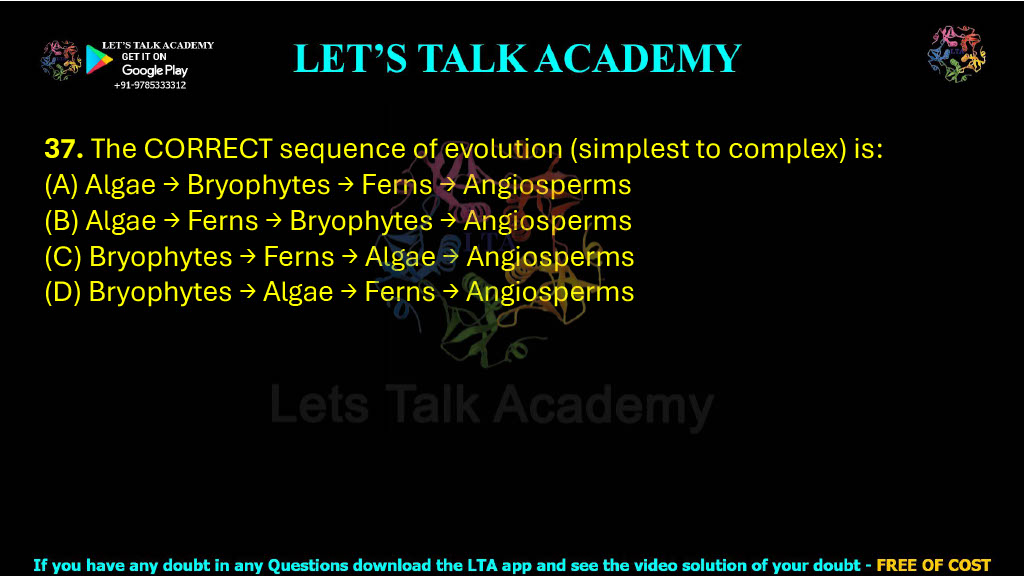
37. The CORRECT sequence of evolution (simplest to complex) is:
(A) Algae → Bryophytes → Ferns → Angiosperms
(B) Algae → Ferns → Bryophytes → Angiosperms
(C) Bryophytes → Ferns → Algae → Angiosperms
(D) Bryophytes → Algae → Ferns → Angiosperms
Correct Sequence of Plant Evolution from Simplest to Most Complex
Understanding the Correct Sequence of Plant Evolution
The correct sequence of plant evolution from simplest to most complex is one of the fundamental concepts in plant biology and evolutionary science. Plants did not appear on Earth in their present complex forms. Instead, plant evolution involved a gradual series of major structural and reproductive innovations that allowed photosynthetic organisms to move from aquatic environments to terrestrial habitats and eventually develop highly specialized vascular tissues, seeds, flowers, and fruits.
Among the groups listed in the question, the evolutionary sequence is:
Algae → Bryophytes → Ferns → Angiosperms
Therefore, Option (A) is the correct answer.
This sequence represents a broad increase in structural and reproductive complexity. Algae are predominantly simple aquatic photosynthetic organisms. Bryophytes represent early non-vascular land plants. Ferns are vascular plants with true roots, stems, and leaves. Angiosperms represent the most complex and highly diversified group in this sequence because they possess flowers, seeds enclosed within fruits, and highly specialized vascular and reproductive systems.
Why Option (A) Is Correct
Algae → Bryophytes → Ferns → Angiosperms
Option (A) Algae → Bryophytes → Ferns → Angiosperms gives the correct sequence from simpler to more complex forms.
The evolutionary history represented by this sequence shows a progressive acquisition of adaptations for terrestrial life. The earliest plant-like ancestors were aquatic photosynthetic organisms related to green algae. During the transition to land, early plants evolved mechanisms to reduce water loss, protect reproductive cells, and retain developing embryos. These early terrestrial adaptations are represented by bryophytes.
Later, vascular tissues evolved, allowing plants to transport water and nutrients more efficiently and grow larger. Ferns represent this important stage of vascular plant evolution. Finally, the evolution of seeds, flowers, fruits, highly efficient vascular tissues, and specialized reproductive structures reached its greatest complexity in angiosperms.
Thus, the sequence correctly reflects the broad evolutionary transition from relatively simple aquatic forms to highly specialized flowering plants.
Hence, Option (A) is correct.
Algae: The Simplest Group in the Given Sequence
Aquatic Photosynthetic Ancestors of Land Plants
Algae represent the simplest organisms among the groups listed in the question. Most algae live in aquatic or moist environments and possess relatively simple body organization.
The body of an alga is generally called a thallus because it is not differentiated into true roots, stems, and leaves. Many algae also lack the complex vascular tissues found in advanced land plants.
From an evolutionary perspective, green algae are especially important because land plants are understood to have evolved from green algal ancestors. In particular, charophyte green algae share several important characteristics with land plants.
The transition from an aquatic algal ancestor to terrestrial plants was one of the most significant events in the history of life. On land, plants faced major challenges such as water loss, gravitational stress, exposure to ultraviolet radiation, and the need to reproduce without being completely surrounded by water.
These challenges created strong selective pressures for new adaptations.
Bryophytes: Early Non-Vascular Land Plants
The First Major Stage of Terrestrial Plant Adaptation
Bryophytes represent a more complex stage than algae because they possess several important adaptations for life on land.
This group includes mosses, liverworts, and hornworts. Bryophytes possess a multicellular embryo that remains protected within the tissues of the parent plant. This is a major evolutionary innovation associated with land plants.
However, bryophytes do not possess well-developed vascular tissues such as true xylem and phloem. As a result, their ability to transport water over long distances is limited, and most bryophytes remain relatively small.
Bryophytes also depend strongly on water for sexual reproduction. Their male gametes are flagellated and must swim through a film of water to reach the egg.
Therefore, bryophytes represent an intermediate evolutionary stage between predominantly aquatic algae and more advanced vascular land plants.
Ferns: The Evolution of Vascular Tissues
Development of True Roots, Stems, and Leaves
Ferns represent a major evolutionary advancement over bryophytes because they possess well-developed vascular tissues.
The evolution of xylem and phloem transformed the history of terrestrial plants. Xylem allowed efficient transport of water and minerals from the roots to aerial parts of the plant, while phloem allowed the transport of sugars and other organic substances.
Because of this vascular system, ferns can grow larger than most bryophytes and possess true roots, stems, and leaves.
Ferns also show a dominant and independent sporophyte generation. This represents an important change from bryophytes, in which the gametophyte is the dominant stage of the life cycle.
However, ferns still reproduce through spores rather than seeds. Their sperm generally require water to reach the egg during fertilization. Therefore, although ferns are more advanced than bryophytes, their reproduction remains partly dependent on moist environmental conditions.
The evolutionary position of ferns can therefore be understood as a stage in which plants achieved efficient internal transport and greater structural complexity but had not yet evolved seeds or flowers.
Angiosperms: The Most Complex Group in the Sequence
Evolution of Flowers, Fruits, and Enclosed Seeds
Angiosperms, commonly known as flowering plants, represent the most complex and evolutionarily specialized group among the options given.
The defining characteristic of angiosperms is the production of flowers. Flowers are highly specialized reproductive structures that improve the efficiency of pollination and fertilization.
Angiosperms also produce seeds enclosed within an ovary. After fertilization, the ovary generally develops into a fruit. The fruit protects the seeds and often assists in seed dispersal.
Another important feature of angiosperms is double fertilization. One male gamete fuses with the egg to form the zygote, while another male gamete participates in the formation of endosperm, which provides nourishment to the developing embryo.
Angiosperms also possess highly efficient vascular tissues. Their xylem commonly contains vessel elements, while their phloem contains sieve tube elements associated with companion cells.
These reproductive and structural innovations contributed to the enormous ecological success and diversity of flowering plants.
Major Evolutionary Innovations in the Sequence
The sequence Algae → Bryophytes → Ferns → Angiosperms can be understood through the gradual appearance of important evolutionary innovations.
The transition from algae to bryophytes involved adaptation to terrestrial life, protection of reproductive structures, and retention of the developing embryo.
The transition from bryophytes to ferns involved the evolution of vascular tissues, true roots, stems, and leaves, and a dominant sporophyte generation.
The later evolution of advanced seed plants ultimately led to angiosperms, which possess flowers, fruits, enclosed seeds, double fertilization, and highly specialized vascular tissues.
Thus, each successive group in the sequence shows greater independence from water, increased structural complexity, and improved reproductive efficiency.
Why Option (B) Is Incorrect
Algae → Ferns → Bryophytes → Angiosperms
Option (B) Algae → Ferns → Bryophytes → Angiosperms is incorrect because it places ferns before bryophytes.
Bryophytes represent a more primitive stage of land plant organization than ferns. They lack true vascular tissues and remain strongly dependent on water for reproduction.
Ferns possess vascular tissues, true roots, stems, and leaves. These features evolved after the appearance of early non-vascular land plants.
Therefore, the evolutionary sequence cannot move from algae directly to ferns and then return to the simpler bryophyte level of organization.
The correct order places bryophytes before ferns.
Hence, Option (B) is incorrect.
Why Option (C) Is Incorrect
Bryophytes → Ferns → Algae → Angiosperms
Option (C) Bryophytes → Ferns → Algae → Angiosperms is incorrect because it places algae after bryophytes and ferns.
Algae represent the earliest and simplest group among the organisms listed in the question. Land plants evolved from green algal ancestors, not the reverse.
Placing algae after vascular plants would contradict the broad evolutionary progression from simple aquatic photosynthetic organisms to increasingly complex terrestrial plants.
The correct sequence must begin with algae.
Hence, Option (C) is incorrect.
Why Option (D) Is Incorrect
Bryophytes → Algae → Ferns → Angiosperms
Option (D) Bryophytes → Algae → Ferns → Angiosperms is also incorrect because it places bryophytes before algae.
Bryophytes are terrestrial embryophytes and possess adaptations that evolved during the transition from aquatic ancestors to land environments. Algae represent the simpler ancestral condition in the sequence provided.
Therefore, algae must occur before bryophytes in the evolutionary progression.
Although the later part of the sequence, Ferns → Angiosperms, follows the correct direction of increasing complexity, the beginning of the sequence is reversed.
Hence, Option (D) is incorrect.
Increasing Complexity During Plant Evolution
The broad pattern of plant evolution shows increasing complexity in several important biological characteristics.
The plant body became progressively more differentiated. Simple thalloid forms were followed by plants with increasingly specialized organs such as roots, stems, and leaves.
Internal transport also became more efficient. Early non-vascular plants were followed by vascular plants possessing xylem and phloem.
Reproduction became progressively less dependent on external water. Bryophytes and ferns require water for the movement of flagellated sperm, whereas advanced seed plants use pollen for the transfer of male gametes.
Protection of the developing embryo and reproductive structures also increased. The evolution of seeds provided protection and nourishment to embryos, while flowers and fruits further improved reproduction and dispersal in angiosperms.
These innovations explain why the sequence from algae to angiosperms represents a general transition from simpler to more complex plant organization.
Important Scientific Note About the Evolutionary Sequence
The sequence in this question is a simplified educational representation of major stages in plant evolution.
Modern evolutionary biology does not describe evolution as a straight ladder in which one living group directly transforms into another living group. Present-day algae, bryophytes, ferns, and angiosperms are all surviving lineages with their own evolutionary histories.
More precisely, land plants evolved from green algal ancestors, early land plant lineages preceded vascular plants, and seed plants later evolved within vascular plant evolution. Angiosperms subsequently became the most diverse group of living plants.
Therefore, for the purpose of this question and the progression from simpler to more complex organization, the expected sequence is:
Algae → Bryophytes → Ferns → Angiosperms
Final Answer
Correct Option: (A) Algae → Bryophytes → Ferns → Angiosperms
Among the groups given, algae represent the simplest photosynthetic organization. Bryophytes represent early non-vascular land plants, ferns represent vascular spore-producing plants, and angiosperms represent highly specialized flowering plants with enclosed seeds and fruits. Therefore, the correct sequence from simpler to more complex forms is Algae → Bryophytes → Ferns → Angiosperms.


